

AI summary
An inside look at marketing teams that achieve success with AI. See how mindsets, governance, and experimentation influence adoption.
You could invest in the best AI marketing tool for your team, but it’s how they work with it that decides success. The teams that get the most from AI — what we’re calling high-performing AI marketing teams — do so by changing their approach to work.
In this post, we’ll look at the specific traits that separate teams thriving with AI from those still struggling. You'll learn how to bridge the gap between having AI and actually seeing results.
Why marketing teams struggle with AI
A marketing team might learn that their company is adopting an AI tool for email and ad campaigns. They'll get a walkthrough, some time to experiment, and a request for feedback. Then, they’re left to figure out the rest on their own.
This is when the problem starts.
Without clear guidance on the best practices of integrating AI into daily workflows, teams won’t see results. Without the right perspective on how AI will change the way they work, they won’t embrace the tool. Eventually, the tool will sit unused.
High-performing AI marketing teams adopt AI with a clear vision. They grow the use of their AI platforms through experimentation, sharing best practices, and strong governance. They ensure it adds value to users while protecting brand integrity. When it's time to scale, AI has already become a strategic asset.
7 traits of high-performing AI marketing teams
An inside look into the functioning of successful AI marketing teams reveals a set of shared traits:
1. They involve internal AI power users early on
Most marketing teams are already using AI. They will have at least a few highly proficient AI users that can share their workflows and become springboards for developing best practices. The broader team trusts them because they know exactly how to use AI to create great content.
And so, your AI power users can be the first to receive hands-on training in the tool. They can bring a real campaign or deliverable and learn first-hand how the AI platform solves bottlenecks, like personalizing an email campaign across personas or cutting cross-platform ad resizing time in half.
Their hands-on experience becomes invaluable as they know how to craft prompts that deliver results, when to avoid AI altogether, and how to build repeatable workflows that solve pain points and set their colleagues up for success.
2. They create space for experimentation
Even savvy AI power users cannot become pro users of a new AI platform within a day or even weeks. High-performing AI marketing teams get this and create space for experimenting and sharing learnings. They run small tests, see what works, and then share those wins across teams and agency partners that will use the tool.
This could mean sandboxes to explore freely, a central "prompt library", and a shared Slack channel to document discoveries. If someone finds the best way to generate five distinct and highly engaging email versions in minutes — work that previously took hours of copywriting time — the whole team knows about it within the week. Testing and sharing knowledge are the fastest ways to increase your team's collective AI IQ and build their change muscle.
3. They don’t hesitate to redesign workflows where AI adds the most value
In enterprises, workflows are sacred. But one of AI's greatest values is automating repetitive, time-consuming tasks. High-performing AI marketing teams aren't so rigid about their workflows that they refuse to change them. In fact, according to Typeface Founding GTM Lead, Elah Horwitz, they're willing to rethink everything, even legal review processes.
Horwitz recommends openness to change as a prerequisite for AI implementation. Since workflows will inevitably shift, she advises mapping them first: document how long each step takes, where bottlenecks occur, who reviews what, and which processes repeat. These metrics help quantify and strengthen the ROI narrative once AI enters the picture.
Also, as content workflows touch multiple departments — creators, legal, IT, and ops — each group helps define the new workflow. IT ensures smooth integrations, creators decide which tasks AI handles, and legal understands that faster reviews mean more content flowing through the pipeline.
4. They build AI governance from day one
You can't scale AI content if you're worried about brand safety or legal risks. Successful teams build guardrails early so they can move fast without breaking things. It’s why governance is often called the “scaffolding” on which AI is scaled safely and responsibly.
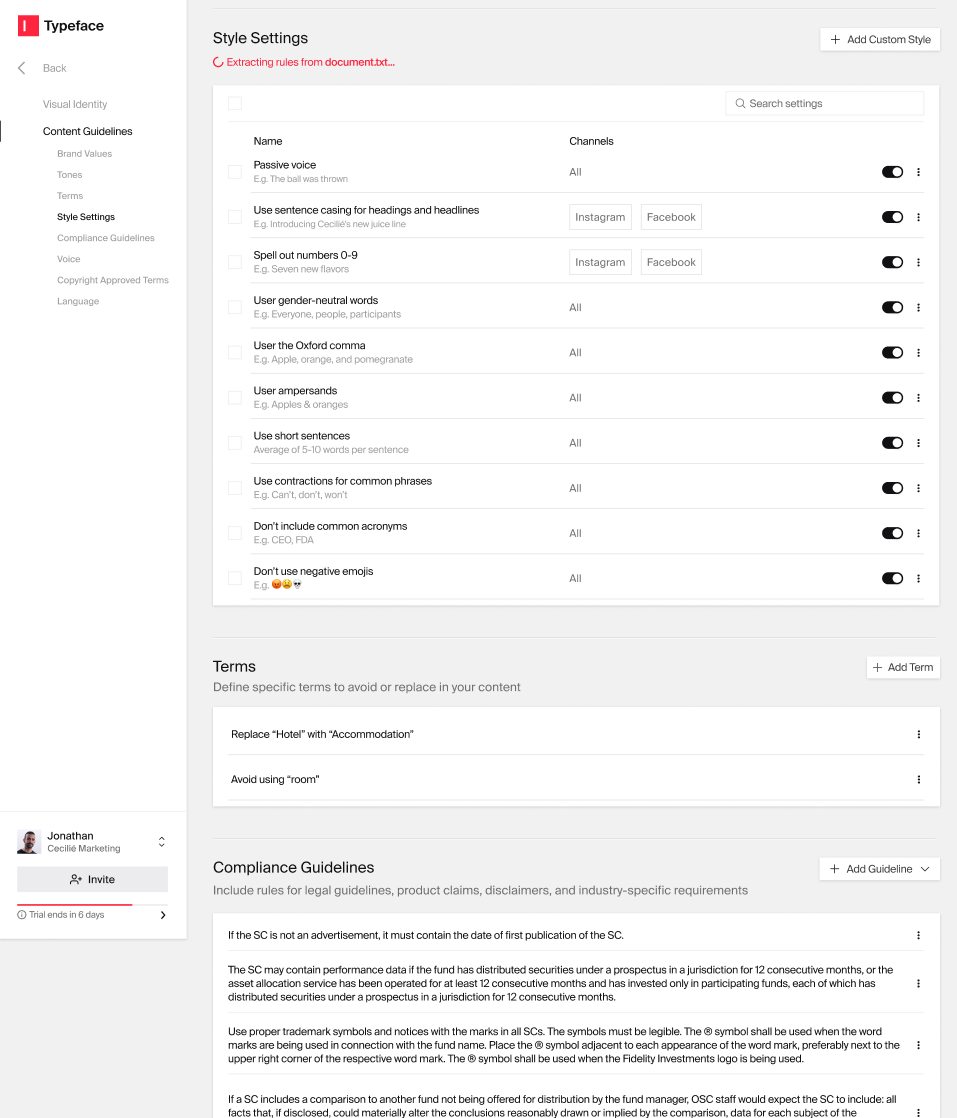
A solid AI governance framework defines who approves AI-generated content and how brand standards are enforced. It embeds feedback loops to ensure the AI gets better over time and maintains audit trails for transparency and accountability. Typeface turns these governance requirements into controls you can configure and control:
Custom usage policies: Define exactly how AI should be used by specifying approved use cases, prohibiting certain content types, and setting strict quality standards for all generated content.
Multi-stage human review: Establish clear sign-off points before any content goes live. Typeface supports a structured review process that ensures relevant stakeholders, from legal to creative, provide the final green light.
Transparent audit trails: Maintain detailed records of how content is created and approved. Audit trails ensure compliance and allow you to trace any issues back to the source for quick correction.
Role-based access control: Maintain full control over your creative environment by assigning specific permissions. Decide exactly who in your organization can create, review, modify, or publish content.
5. They view AI as something that enhances their work rather than replace them
Employees get anxious about AI being used in the workplace. They fear it will shrink their role or eliminate it entirely. They worry AI will set the performance bar impossibly high and devalue the skills, talent, and experience they've built over years.
These concerns can be misguided but without the right perspective on AI’s value — straight from leadership — teams will continue to see it as a threat.
High-performing AI marketing teams don't fear AI because they're clear what it's for. Their leaders don't view AI as a means to reduce headcount, but rather as a way to multiply creative capacity, test more ideas, and reinvest time into traditional PR and in-person events.
When teams see AI as something that enhances their work and drives results for their organization, engagement improves and fuels performance.
6. They never sacrifice brand
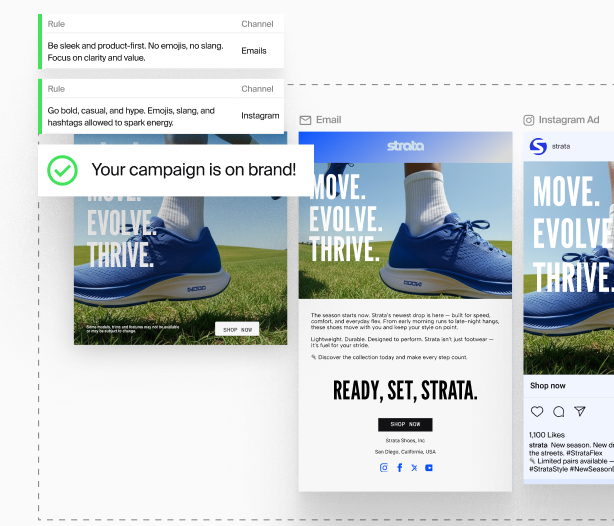
One of the biggest fears about AI in marketing is that everything will start to sound generic. High-performing teams keep this concern out by investing time upfront to train AI in their brand voice and visual style.
They use tools that let them embed their unique brand identity into the AI by feeding it style guides, past successful campaigns, and approved messaging. This allows them to produce content at scale that still feels distinctly theirs while maintaining brand consistency across every piece.
Enterprise marketing teams using Typeface achieve both speed and brand consistency. Moving past the old habit of manually checking every piece of content, they use trained AI to create on-brand materials and flag inconsistencies automatically. And so, they not only save time but also handle higher content volumes without sacrificing brand integrity. Far from threatening their brand identity, AI strengthens it.
7. They measure AI ROI
AI can solve real marketing problems. Informed marketing leaders know what they want to get out of AI and define outcomes before investing.
For example, Company Z wants AI to do the tedious task of adapting the same content across channels and summarizing long interview transcripts. AI will also be used to generate early concept mockups before the designer steps. The belief is that these use cases will free up time for higher-impact work teams understand and are aligned around.
Implementation is the second lens for measuring AI ROI, covering complexity, cost, and regulatory or infrastructure challenges.
The third lens is user satisfaction. Are teams happy with the tool? Is it improving workflows and allowing them to offload cumbersome tasks so they can focus on more important work? Managers should regularly monitor sentiment to catch issues early and escalate what they can’t resolve.
Build your high-performing AI marketing team
AI team traits are nurtured by aware and supportive leadership. A smart implementation strategy combined with an AI culture that addresses real human concerns builds high-performing teams.
Of course, the right AI marketing platform makes a significant difference! AI marketing platforms like Typeface support high-performing teams by handling both the repetitive and the creative work. AI agents automate time-consuming tasks like adapting social media posts across platforms and creating detailed blog briefs. They also assist with creative work like generating personalized variations of emails and banner ads in minutes.
Typeface's simple interface, straightforward AI training, and no-code custom agents help teams adopt AI without the typical friction. Learn more by taking a product tour today, or getting in touch with our sales team.
FAQs
Q: How do you build an AI culture in a marketing team that's resistant to change?
Start by showing, not telling. Highlight a few "quick wins" where AI saved a team member hours of tedious work. When people see that AI is a tool to help them — not replace them — resistance usually turns into curiosity.
Q: What's the difference between AI-ready teams and teams just using AI tools?
An AI-ready team has the mindset, workflows, and governance to get the most from AI. They use AI regularly and strategically, supported by clear processes that allow them to scale confidently and adopt new use cases as needs evolve.
Teams that use AI tools without this foundation might see some benefits, but they hit walls quickly. Without governance, they take on unnecessary risks. Without updated workflows, they create bottlenecks. Without the right mindset, adoption stalls. They fall short of what they could achieve and struggle to scale or adapt when requirements change.
Q: How long does it take to transform a traditional marketing team into a high-performing AI team?
There’s no fixed timeline for becoming a top-performing AI marketing team. Progress is better measured by impact than by time — and the data bears this out. AI high performers are far more likely to use AI across marketing and sales activities. In fact, the majority of marketers say AI is helping them tackle one of marketing’s biggest challenges: improving customer experience, with the strongest impact seen in targeted advertising.
Q: Do high-performing AI marketing teams still need content strategists and writers?
Yes, more than ever. While AI is great for quick research, outlines, and improvements, only your team can provide the strategy and contextual judgment that makes the content fit for its audience.
Related articles

July 9, 2025
Creating profitable retail campaigns has always been hard. Now, with rising tariffs and supply chain pressures, marketing teams face tougher decisions about where to invest their limited resources. E

April 21, 2026
More than 50% of marketers use AI to create images. But most are stuck in endless trial-and-error cycles, tweaking prompts and hoping for something usable. Sound familiar? More often than not, the pro

June 27, 2025
The pressure to deliver personalized, on-brand campaigns at scale has never been greater, but manual processes and fragmented tools often slow down even the most experienced marketing teams. In our d