January 20, 2026
Typeface on Typeface: How We 4x'd Email Conversion with Personalized Campaigns

Joanna Huang
Product Marketing Manager
AI summary
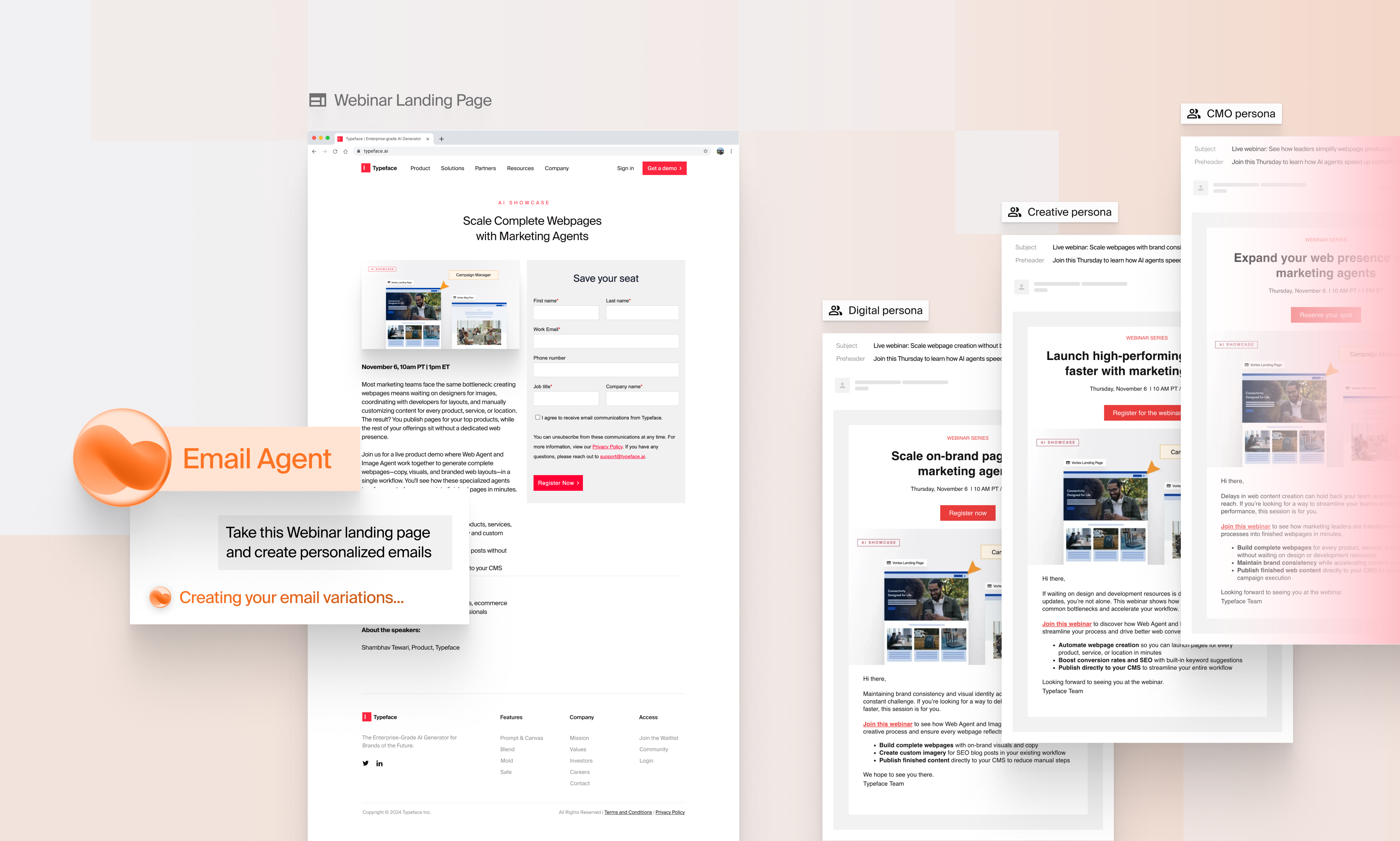
We're diving into how we used Email Agent to create personalized campaigns for our webinars — resulting in 4x higher email-to-registration conversion.
Welcome back to Typeface on Typeface, where our team shares how we use AI agents to modernize our marketing workflows. Today, we're diving into how we used Email Agent to create personalized campaigns for our webinars — resulting in 4x higher email-to-registration conversion.
For our webinar promotion, we had a large marketing database with completely different personas — CMOs focused on business outcomes, creative directors who maintain brand consistency, and marketing ops teams dealing with technical workflows.
We ran into the same challenge many marketing teams face: send a generic email blast to our database, or manually spend hours personalizing emails for different audiences.
We decided to test whether Email Agent could help us break that trade-off.
Testing Email Agent: A Three-Wave Approach
To promote our upcoming webinars, we structured our email campaign as a learning experiment across three waves.
Wave 1: Use a generic blast as a control group. We sent a single generic email to our entire database to establish a baseline. The results were what you'd expect from a database blast. Open and click through rates had standard performance.
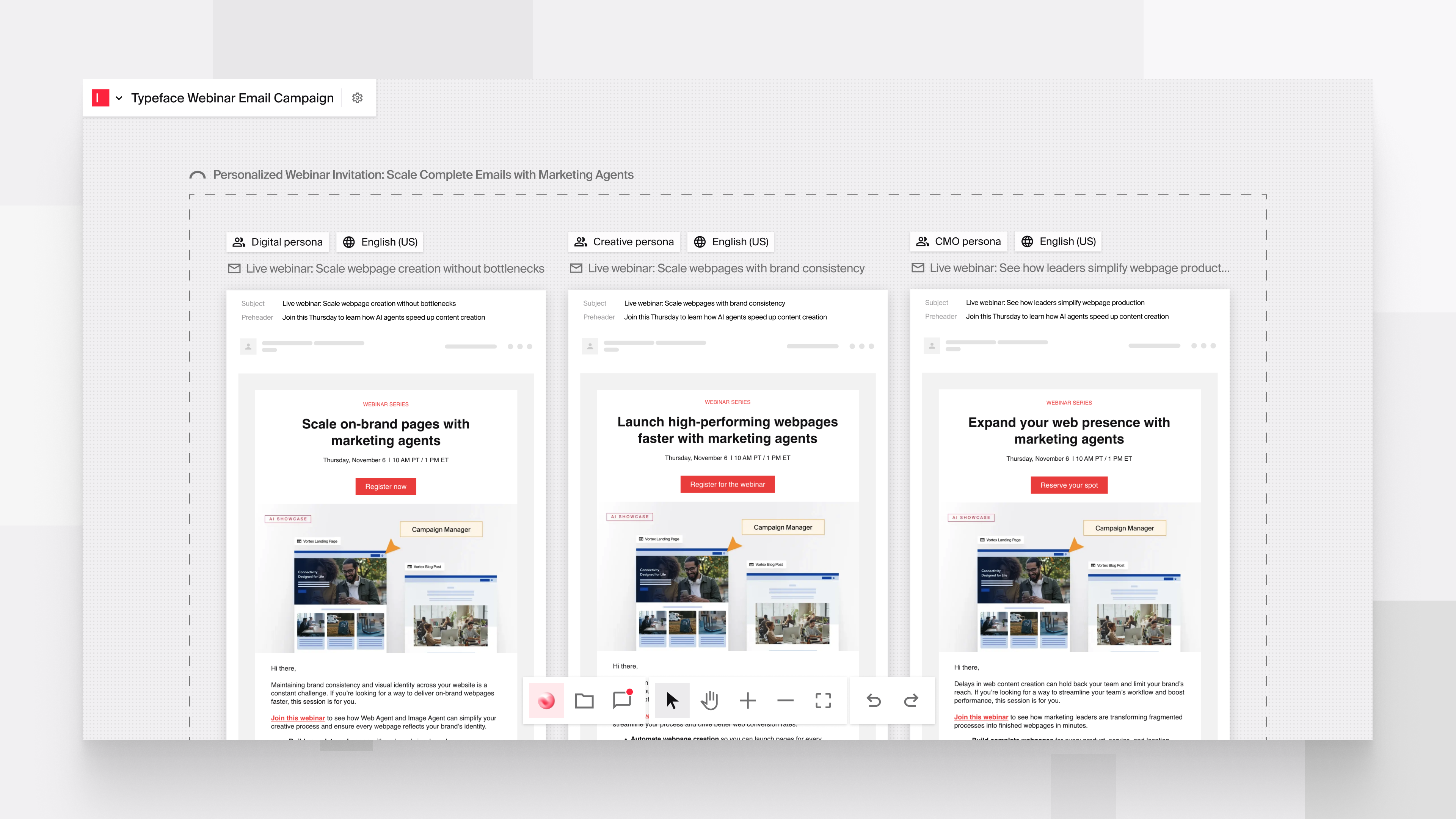
Wave 2: Run a test with 5 personas. Using Email Agent, we created five distinct email variants for the same webinar, each tailored to a different persona. Each variant positioned the content around what that specific audience cares about most. The variants included messaging for CMOs and leaders, brand and creative teams, and marketing operations. Even with a small test segment, we saw higher engagement which validated the approach.
Wave 3: Scale the best variant to a targeted segment. We took the top-performing variant — the CMO and leaders messaging — and sent it to a larger targeted segment. In the end, we emailed roughly one-sixth of the original blast audience and still drove a similar number of registrations.
Email Agent helped us resonate with our audience. We provided basic persona characteristics, and the agent generated content that adapted the value proposition for each role. CMOs saw messaging about business outcomes, creatives saw messaging about brand control, and ops teams saw messaging about workflow efficiency.
The Results
In our final wave 3 experiment, we sent fewer emails to a smaller audience — and still met our registration goals. The click-through rate was 2x our typical performance. We had 4x higher email-to-registration conversion than generic email blasts.
Before this experiment, creating five distinct email versions from scratch would typically consume hours of copywriting time. Email Agent compressed that into minutes, letting us quickly produce multiple on-brand variants.
What's Next
If you're considering using AI agents for your email marketing, here's our advice: start with a small test to validate the approach with real performance data, then scale to targeted segments.
As for us, we're running another Email Agent campaign for our next webinar to continue to refine this approach. Want to try Email Agent yourself? Start here.
Related articles

October 10, 2026
When sales cycles span months or even years, email marketing can help keep the relationship going between major touchpoints. It gives you a way to stay connected with prospects throughout their journe

August 28, 2025
Gartner predicts that by 2025, 30% of outgoing marketing messages from organizations will be generated by AI. But the real game-changer isn't AI writing your emails. It's agentic AI that can make deci
April 30, 2025
Marketers have never known more about their customers, yet putting that insight into action remains frustratingly complex. We recently sat down with the marketing director of a major grocery retailer