

AI summary
With the right context, AI can personalize many elements of your emails. Learn what effective AI email personalization requires. See where it can break down, and how leading teams scale campaigns while keeping brand consistency and accuracy.
You already know AI creates personalized emails. What you may not be entirely clear about is how AI gets email personalization right, and where it can go wrong. We explain what goes into effective AI email personalization.
Why use AI for email personalization?
AI can handle the repetitive work of creating email variations for dynamic personalization. Enterprise marketing teams can scale personalized communications across buyer personas and business lines without adding manual effort.
What can AI personalize in an email?
AI can adapt different parts of an email based on what matters to each audience.
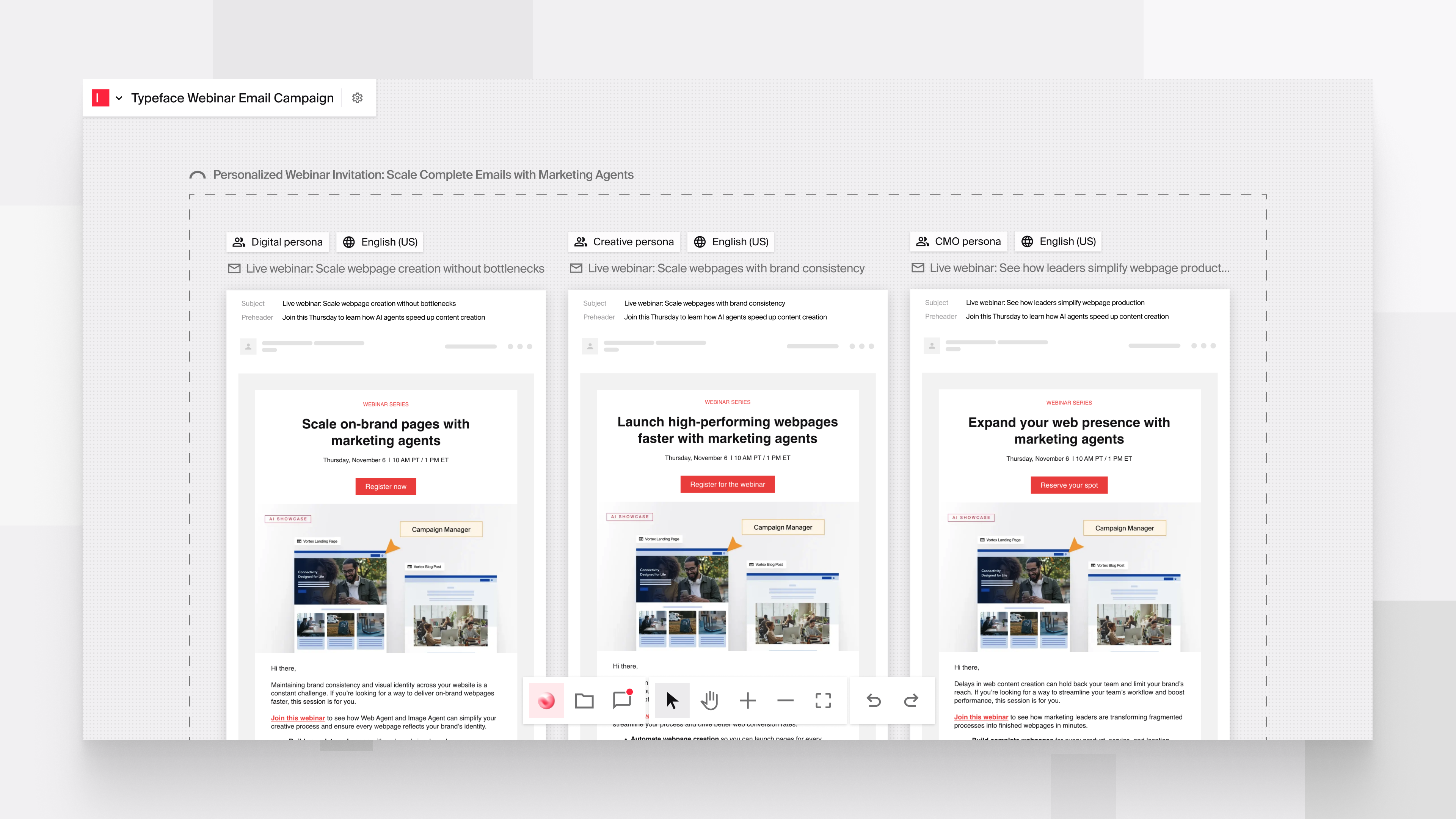
Subject lines and preheaders can focus on the reason an audience is most likely to open the email.
Value propositions can highlight different product benefits based on what matters to the audience.
Body copy can use different supporting points (like case studies) or levels of detail (like a list of takeaways).
CTAs can frame the next step based on the campaign goal.
Images and video blocks can show different creative depending on what’s most relevant to each audience.
Here's what that looks like in practice, using Typeface as the example.
What does AI need to create personalized email campaigns?
AI needs enough audience and product context to connect the needs and challenges of each segment with the right product capabilities and value propositions. It also needs detailed product and company information to keep content accurate and avoid making up information when it lacks the necessary context.
There’s also the brand aspect. To make sure every email sounds and looks like your brand, AI needs access to your copy and visual guidelines so it can apply them to everything it generates. This apart, give AI your existing email layouts and image assets to ensure visual consistency across personalized variations.
Here’s what you’d give AI to create on-brand personalized emails:
Audience segments: Demographics, job roles, interests, needs, pain points, priorities, and other audience characteristics that help AI understand what matters to each segment.
Product and company knowledge: Your product capabilities, benefits, differentiators, use cases, key messaging, blogs, and other knowledge documents that AI can draw from to create accurate content.
Brand standards for content: Your email tone of voice, headline and punctuation rules, formatting requirements, product naming conventions, terms or claims to avoid, etc.
Approved images and layouts: Your existing email layouts and approved image assets give AI the visual context to create personalized messages that fit your existing email design.
Campaign brief: The purpose of the email, target audience, offer or message, and desired recipient action help AI choose the right framing and CTA.
How does email personalization work? The process explained.
AI email generation has evolved beyond using one tool for subject lines and body copy and another for image generation. Now, teams use multimodal AI, which works across text, images, video, and audio inputs to create email campaigns in the same platform.
In Typeface, Arc Graph centralizes your brand and audience context, image assets, approved email layouts, strategy briefs, and product documents together so AI and your team can access and reuse them during email generation. Here’s how it works:
Connect your marketing stack: Use connectors to bring relevant brand, audience, product, and campaign context from your existing systems into Typeface. Also use our ESP (Salesforce Marketing Cloud, Braze, Klaviyo) connectors for direct publishing.
Mark dynamic elements: Identify the sections of your email that should change. AI generates personalized copy or visuals in these dynamic sections while the rest of the email retains its existing content.
Provide the right inputs: Select the audience segment, campaign brief, email or brand voice, layouts, and supporting product documents as inputs for generation.
Generate personalized emails: Email Agent works with other specialized agents to generate personalized email variations based on your inputs. It can create multiple personalized emails as well as multistep email journeys that include push notifications.
Review and refine: Arc Graph helps ensure generated email copy, visuals, and modules align with your brand standards. You make further edits:
Tweak copy or use the inline AI editor
Replace images as needed with approved assets you've saved or prompt AI to generate new ones
One of our AI features creates email modules — hero sections, CTAs, product highlights, and footers — that you can use to create distinctive layouts.
Publish to your email platform: Send your finished emails directly to your connected ESP, or export them as PNG, Excel, HTML, or PDF files for sharing outside of Typeface.
When does AI email personalization go wrong?
The hallmarks of weak email personalization are messaging that misses what the audience cares about, and off-brand copy or visuals. This is the result of not giving AI enough context about your brand, audience, and products. Common culprits include:
Generic personalization Swapping in a name, company, or job title isn't personalization if the message underneath stays the same for everyone. The email should speak to what that segment actually cares about, not just look tailored on the surface.
Off-brand drift When brand and voice guidelines aren't built into the system, AI fills the gaps with its own defaults. The copy might read fine on its own, but it won't sound like you, and small inconsistencies add up across a campaign.
Inaccurate claims Without solid product and company context, AI can generate benefits or details that sound plausible but aren't true. This is especially risky in email, where inaccurate claims reach customers directly.
Intrusive messaging Highly specific data points can make personalization feel unsettling, whether or not AI is involved. Give AI the audience information it needs without sharing personal details, and have your team review every AI-generated email before it goes out. If your industry relies on one-to-one communication, continue being transparent about how you use customer data and seek explicit consent when appropriate as you adopt AI.
Give AI and your team the audience, product, and brand inputs to work with, and personalization stays brand-safe at scale.
Create personalized email campaigns
Effective personalization starts with a clear understanding of the audience and the reason the message should change.
AI can help marketing teams bring that understanding into content creation to create meaningful variations, reducing the manual work of testing them. With the right product and brand context, your email variations can stay accurate and recognizable while giving each audience a more relevant reason to engage.
See how Typeface Email Agent can help you create personalized email campaigns. Get a demo or discuss your requirements with our sales team.
FAQs
Q. Does AI personalization mean creating a different email for every audience?
No. Effective personalization keeps the core campaign idea, product truth, and brand consistent while adapting the message to what matters to a particular audience.
Q. What context does AI need to personalize email content?
AI needs four types of context: audience information to understand what matters to a segment, accurate product and company information to keep claims grounded, brand guidance to maintain consistency in voice and presentation, and campaign context to understand the email’s purpose and desired action.
Q. How do you keep AI-personalized emails on-brand?
Use AI that applies your brand voice, messaging, visual guidelines, approved assets, and email structures to every email generation. Let your teams do a final pass and improve how AI creates by editing existing inputs.
Q. Can you A/B test personalized email variations?
Yes. AI can quickly generate variations of subject lines, value propositions, CTAs, body copy, and creative treatments for different audiences. Testing email variations can show whether a particular personalization approach improves engagement or conversion. Typeface’s marketing team used this approach to boost click-through rates by 2x and email-to-registration conversion by 4x.
Q. Why use AI for email personalization?
AI helps you expand personalized outreach without proportionately increasing your workload. It allows you to test different approaches and learn which messages resonate with particular audiences. Feeding those insights back into how AI creates personalized emails helps you continuously improve campaign performance.
Related articles

August 28, 2025
Gartner predicts that by 2025, 30% of outgoing marketing messages from organizations will be generated by AI. But the real game-changer isn't AI writing your emails. It's agentic AI that can make deci
March 25, 2026
Welcome back to Feature Focus. This month marks Typeface’s biggest evolution yet: we’ve crossed a new frontier as a Marketing Orchestration Engine, bringing Marketing, IT, and Creative teams together

September 28, 2026
When AI tools are introduced in an organization, the ripple effects extend far beyond simple workflow adjustments. The best way to address emotional resistance to AI is by treating it as a human respo