February 10, 2026
AI Personalization in Marketing: Creating Tailored Content for Diverse Audiences

Neelam Goswami
Senior Content Marketing Associate

AI summary
Personalization at scale is now possible with AI, which allows marketing teams to quickly create tailored content across email, ads, blogs, and landing pages without sacrificing brand consistency. By combining customer data with brand guidelines, enteprise AI marketing platform Typeface generates variations across cohorts to boost testing, engagement, and conversions.
Most brands have the customer data to create personalized content. The problem is, they lack the connected workflows that turn information into relevant experiences.
AI can be the connective layer that consolidates customer and brand insights into personalized email, ad, social, and web experiences.
In this article, we’ll go over how AI personalization works and how it helps enterprise brands (like you) win today’s consumers.
What is AI personalization in marketing?
AI personalization adapts a core message into dozens of versions targeted at different audience segments and markets.
If you’re promoting your latest line of walking shoes, AI can create ads targeting genders, ages, and locations based on your audience data, campaign brief, and prompts.
If you’re sending emails to clients in seven different industries, you can tailor each email with a case study from their industry showing how you've already solved the exact problem they're facing.
How do you get started with AI personalization in marketing?
The first step is to connect your CDP customer data and brand assets to your AI marketing platform, typically through API integrations. This transforms siloed data into actionable information the AI can use when generating content.
With this context in place, you can begin with key use cases, like generating variations of emails, ads, web pages, and visuals tailored to specific segments. This gives AI the context it needs to keep every piece of content accurate and on brand.
Next, we’ll take a step-by-step look at how to use AI to generate relevant, personalized content at enterprise scale.
Create key audience segments
Effective personalization starts with clearly defined audience segments. Build detailed profiles based on key characteristics like age, gender, interests, and spending patterns. (You may already have rich data like this in your customer data platform, or CDP.)
For example, young professionals in their early 20s may be price-sensitive and career-focused, while established professionals in their 40s might prioritize premium experiences and convenience.
These audience profiles directly shape your content. If you're targeting tech-savvy millennials, your messaging might emphasize innovative features and digital integration. For health and wellness enthusiasts, focus would be on benefits and lifestyle alignment.
Typeface makes this (and more granular) personalization practical. Save your audience profiles with detailed demographic and behavioral data, then apply them to any content you generate. The platform automatically adjusts messaging and visuals to match each segment's preferences and priorities. You can also import existing segments from your CDPs, so that your AI-generated content leverages your existing customer intelligence for more precise targeting.
Integrations with leading data platforms like Salesforce Data Cloud, ActionIQ, Google Cloud BigQuery, GrowthLoop, and more let you access high-quality customer and brand intelligence, and create more customized content in a fraction of the time compared to manual processes.
Power personalization with relevant insights
AI combines audience intelligence with brand insights to tell resonant stories. This makes personalization meaningful — rather than simply inserting a name or a job title, you’re sharing industry-specific insights that actually require effort and expertise, and reflect the interests of the recipient.
Typeface’s Arc Agents help you deliver the right message to the right audience faster than manual personalization. For this, they need proof points like case studies, statistics, testimonials, solution whitepapers, research reports, and persona battlecards. Bring your brand knowledge to Typeface by connecting your digital asset management platform (DAM), add via a series of URLs, or upload documents when you’re ready to generate content, and they’ll remain there for future reference.
Maintain brand consistency across scale
Your writers are experts at expressing your brand values across social media, email, website, and other channels. But maintaining brand identity at scale can bog them down. With assistance from AI trained in your brand voice and visuals, they can make each of the hundreds of unique ad variations sound like they came from your brand.
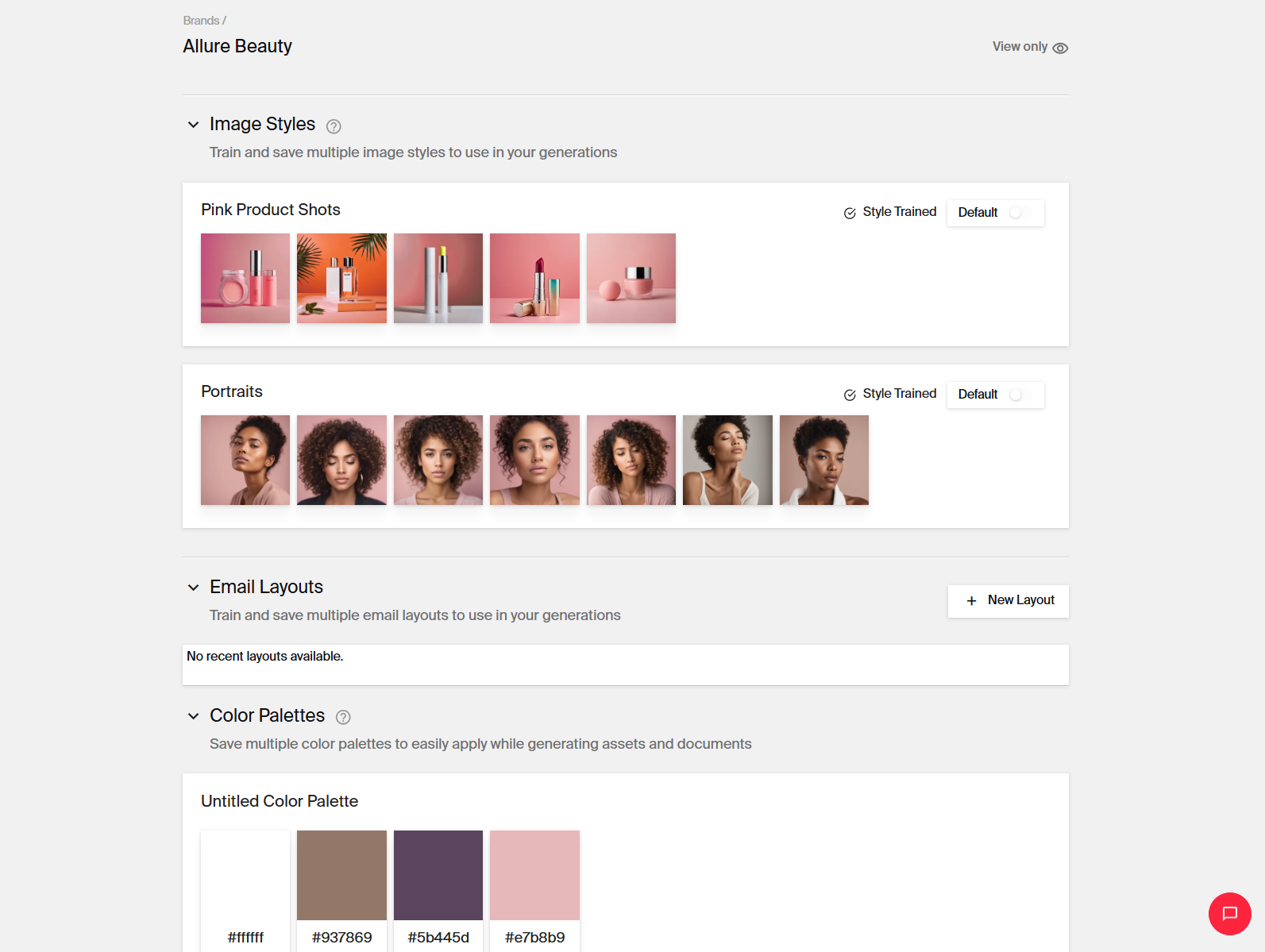
In Typeface, Arc Graph, is a living brand system for your brand voice, language, values, and assets (documents, images, video, audio), making the relevant context available across content creation tasks rather than requiring teams to provide it from scratch each time.
Beyond this, Brand Agent actively checks content and flags deviations from your messaging guidelines, saving hours in editorial checks while maintaining brand consistency at scale.
Related reading:
Examples of AI content personalization across marketing channels
Now let’s make the abstract more concrete. Generative AI has made personalization in content marketing possible across various marketing channels and content types.
Here we’ll go over how you can achieve AI powered personalization at scale in various areas of your content marketing strategy.
1. Personalize email campaigns with AI
You know personalized emails perform better — but creating unique versions for every segment feels impossible when you're already stretched thin. Here's how AI changes that equation.
Email offers your most direct connection with customers, which is why personalization matters most here. When you land in a prospect's inbox, it’s your chance to win their trust and attention by delivering content that looks custom-made for them. In fact, nearly two-thirds of marketers believe personalized emails have the most impact of any other types of content — and they're increasingly turning to AI to create them at scale.
How email personalization works with Typeface
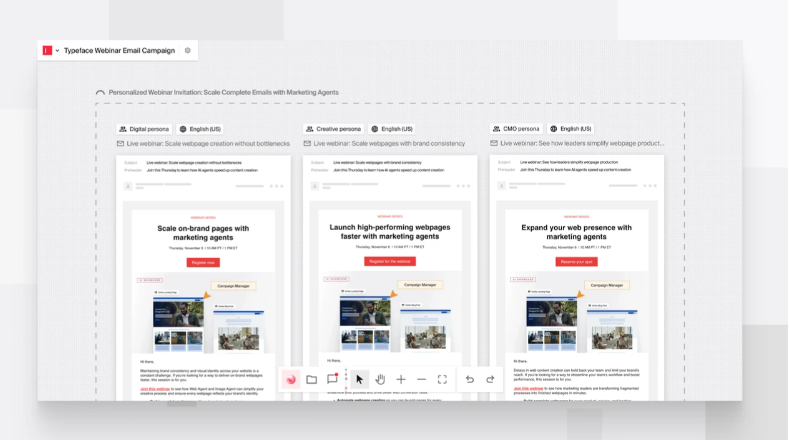
Email Agent generates audience-specific email variations with tailored offers for different segments and regions, adapting tone and language automatically.
Step 1: Prompt Email Agent. For example, “Create a renewal reminder sequence for annual customers” or “Create a product announcement email for our new feature launch.”
Attach a detailed campaign brief, reference email copy, product information, and images and media (provide as much context as you can for more relevance). Select pre-loaded email template, audience segment, and Brand Kit. Generate the email.
Step 2: Generate audience-specific variations of the email, selecting every audience you’re sending out to.
Personalization can extend beyond the body of the email. Subject lines, CTAs, banners, pre-headers, and inline imagery can all be adapted to the audience or journey stage. For multi-step campaigns, map variations to moments such as welcome, consideration, renewal, cart abandonment, or loyalty rather than treating every email as a standalone interaction.
Step 3: Review and edit the emails using the in-line editor.
Edit the subject lines, headlines, body copy, CTAs, by clicking on each element.
Change an email image by selecting an alternative from your uploaded image assets, or use Image Agent to generate a relevant image.
Crop, resize, and add click-through links and alt text.
Step 4: Post-review, export the email campaign directly to your Email Service Provider (ESP) such as Salesforce Marketing Cloud, Braze, or Klaviyo.
Related reading:
Typeface on Typeface: How We 4x'd Email Conversion with Personalized Campaigns
Scale Personalized Email Variations with Email Agent – Step By Step Guide
2. Create personalized ads for different audiences
Here’s what you’re up against: 81% of consumers tune out of generic ads, and 45% of shoppers don't mind sponsored ads if they are relevant.
AI can rapidly generate ads across multiple ideal customer profiles (ICPs). If time and capacity constraints have so far limited the volume of highly targeted campaigns you can produce, AI is exactly what you need.
How ad personalization works with Typeface
Typeface’s Ad Agent generates social ads (Meta, LinkedIn, Instagram, etc.), and banner campaigns across audiences, channels, and markets. It creates audience-specific ad variaions and adapst ads for different platforms.
Step 1: Prompt Ad Agent. For example, “Create Google Display Ads for our spring sale.” Attach your ad layouts, campaign brief, pre-approved images, and copy. Generate your ads.
Step 2: Select audience segments to create targeted ad variations.
Step 3: Make in-line copy edits. Select a different image or generate it.
Step 4: Use the resize button to automatically resize ads to platform-specific requirements
Step 4: Post-review, publish directly to Campaign Manager 360, Google Ads, and Meta Ads.

Related reading:
3. Scale creative personalization
Nearly 75% of marketers report using AI for ad creation, including video and images, making it one of the top five use cases for AI.
AI art and photography tools are transforming how teams personalize and adapt creative assets across channels. Need studio shots? Location-specific imagery? Lifestyle imagery tailored to different audiences? AI can generate them with just a few simple inputs. And those platform-specific adaptations that add up to creatives’ busywork? AI can automate such repetitive creative work, driving creative personalization at scale.
How creative personalization works with Typeface
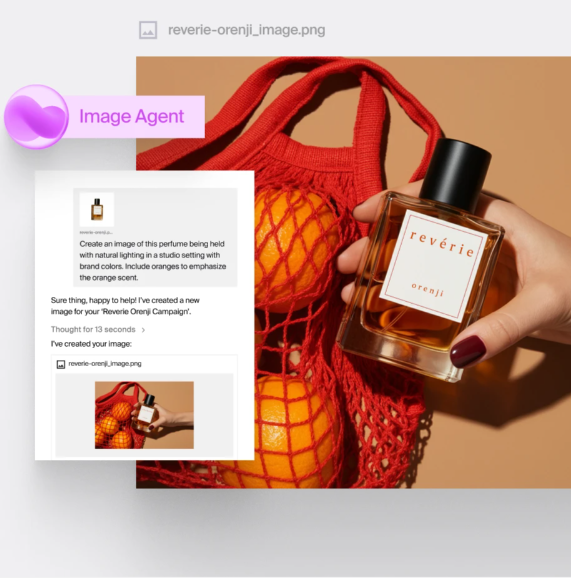
Image Agent generates images in three ways:
Text to image: Use an image prompt describing the scene (e.g., Executive passengers working comfortably in business class, soft cabin lighting”).
Image to image: Upload a reference image to guide AI to keep the original's strucrure and style while applying the new creative elements you describe in your prompt.
Product shot customization: Upload a product shot and describe a scene to transform the background (e.g., “Create an image of this bottled water in an outdoor hiking setting”).
More uses:
Resize and reformat into banner, landscape, sqqure, and widescreen variations.
Give agent an inspiration image and it will create a mood board matching the input image’s aesthetic
Related reading:
4. Create localized and personalized landing pages and blogs
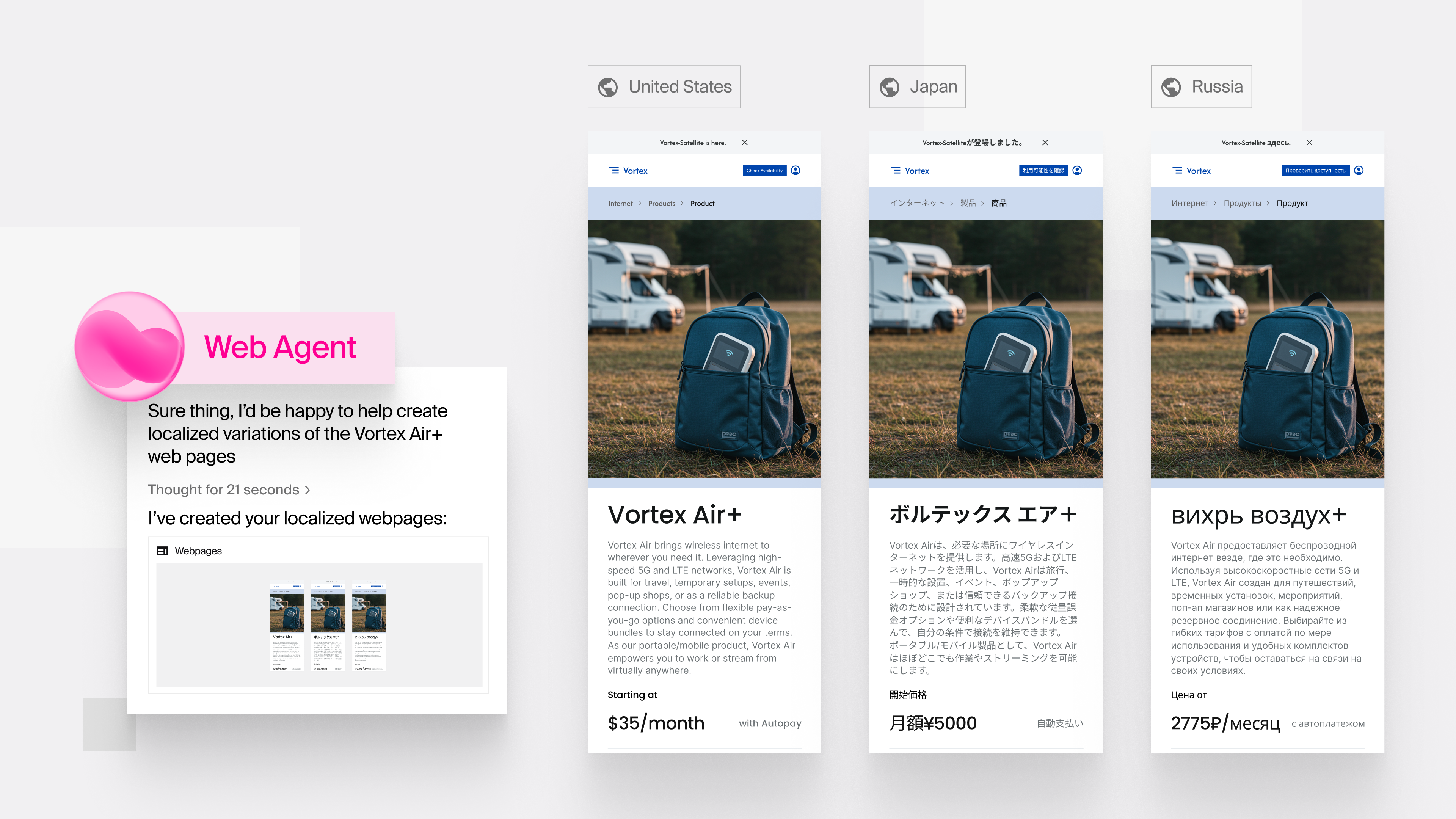
AI adds localized context to your core service details to generate local and industry-specific web pages at scale. It also repurposes customer stories, behind-the-scenes insights, and leadership opinions into blogs targeting personas and industries.
How web localization and blog personalization works with Typeface
Typeface brings content ideation, drafting, design, SEO optimization, and publishing into a single platform. It creates copy, images, and SEO tags in a single flow, streamlines review, and pushes content straight to Contentful, WordPress, AEM, and more. Here’s how to create localized web pages using Web Agent:
Step 1: Define your task. Prompt Web Agent with “Build location pages for our NYC, London, and Mumbai consultancies.”
Step 2: Upload layouts from your brand kit, solution sheets, and audience segments.
Step 3: Review the web page. Make inline edits or regenerate visuals with Image Agent.
Step 4: Use “Create Variations” to generate variations for different geographic regions, customer segments, or languages. Review and refine.
Step 5: Send directly to your CMS or download as HTML, PDF, PNG, JSON, or Excel.
Related reading:
Does AI personalization actually improve results?
Yes, because AI personalization lets you scale relevant experiences while maintaining a recognizable voice across channels, building customer trust. In contrast, manually tailoring ads, social posts, emails, and web pages across multiple audience segments quickly becomes unsustainable and often leads to generic messaging that fails to resonate and drive action.
Expanded reach
Marketing teams can now significantly expand their content reach by creating multiple variations optimized for different channels and segments. Instead of using one generic message, AI helps create tailored versions of emails, social posts, ads, and landing pages— each adapted for specific audience needs while maintaining brand consistency.
Deeper engagement
When content speaks directly to each audience segment's needs, engagement naturally follows. Teams using AI personalization see higher email open rates, increased ad click-throughs, and stronger content performance because their messaging resonates with each specific audience.
Higher conversions
By showing customers content and offers that align with their preferences and spending behavior, AI-driven personalization can significantly increase conversion rates for your business. Relevance drives action, making it more likely for customers to complete purchases or engage with your services.
Real scalability
Most importantly, AI makes this level of personalization scalable by creating segment-specific variations in minutes. Teams can test more ideas and move quickly, adapting campaigns for different markets and geographies within days rather than weeks or months.
Brand consistency
AI ensures brand integrity across all personalized content. By applying consistent brand guidelines, tone of voice, and messaging principles automatically, teams can personalize at scale without risking brand dilution. Every piece of content — whether it's an email, social post, or landing page — maintains core brand standards while adapting to specific audience needs.
FAQs
Q. How do I personalize content at scale without burning out my team?
The short answer: AI handles the variations while you focus on strategy. Once you've defined your audience segments and brand guidelines, platforms like Typeface generate tailored versions automatically. Your team creates one piece of content, and AI adapts it for different segments.
Q. Is AI-generated personalization truly authentic?
Not if you're feeding it the right inputs. When you pair audience intelligence from your CDP with specific brand voice guidelines, the AI generates content that speaks directly to each segment's needs. The key is setting up detailed audience profiles and brand kits upfront — the more context you provide, the more authentic the output.
Q. How do I maintain brand consistency across all these personalized variations?
This is actually where AI shines. Unlike human teams that might drift from guidelines under deadline pressure, AI applies your brand rules consistently every time. With Typeface, you save your brand kit and voice guidelines once, and they're automatically applied to every piece of content you generate.
Q. How can you continuously improve AI personalization?
Effective AI personalization gets better with each campaign. If audience and brand context shape the content, campaign performance provides insights that can inform what you create next.
With Typeface's Arc Loop, campaign performance and engagement signals can feed back into Arc Graph, enriching the knowledge available for future content creation. This creates a continuous cycle where audience and brand context inform content creation, campaign results provide new learnings, and those learnings make subsequent content more relevant and effective.
Q: What challenges might arise when using AI for content personalization?
Poor data quality is a significant obstacle. Without enough audience context or specific brand knowledge documents, personalization may fall short of expectations, and require intensive edits. Another potential challenge is over-personalization or surface-level personalization, two opposing, unwanted outcomes that result from a lack of strict human oversight over AI-generated content.
Making AI personalization in marketing work for your brand
AI breaks the traditional trade-off between scale and relevance, letting marketing teams create tailored content that reaches more people while staying true to brand standards. Rather than choosing between quality and quantity, teams can now deliver both.
To create those relevant moments, bring your audience data and brand guidelines into Typeface. With a clear understanding of your brand, AI agents can more accurately personalize emails, ads, social posts, blogs, and web pages.
For more information, talk to sales. To see AI personalization in action, get a demo.
Related articles

April 2, 2026
Most enterprise marketing teams are already using some form of generative AI. The real question isn't whether to use it — it's which workflows are actually worth your attention, and which ones will cr
![50+ Content Marketing Statistics to Watch [2026]](https://images.ctfassets.net/x690ow8339ug/5YJN3lwHNYQXknMt4gscBs/e4be19b297f1148a627bfcdd5b67f385/img-blog-cover-Content_Marketing_Statistics_to_Watch-2026-3840â__2160.png)
February 6, 2026
Content marketing delivers lasting value. The time and effort teams invest in producing and distributing content create growth over time, even if the path isn’t always predictable. Disruptive trends a

July 26, 2023
As content creators, marketers, and creative professionals, we know the power of captivating visuals and compelling copy to connect with our audience. But, adapting content for different platforms or