
AI summary
Typeface’s March update marks a major shift to a Marketing Orchestration Engine, unifying Marketing, IT, and Creative teams on a single platform to manage the full content lifecycle.
Key improvements include:
- •Video and creative workflows: Faster production of campaign-ready videos with transcript-based editing, reusable scene variations, automatic branding, audio control, and easy resizing for different platforms.
- •Stronger brand governance: Arc Graph now offers more flexible, channel-specific controls, automated brand rule extraction, and expanded support for visual guidelines.
- •Scalable workflows with Agent Studio: Teams can build reusable AI agents and workflow automations to scale content production across campaigns, regions, and formats.
Welcome back to Feature Focus.
This month marks Typeface’s biggest evolution yet: we’ve crossed a new frontier as a Marketing Orchestration Engine, bringing Marketing, IT, and Creative teams together to operationalize AI across the entire marketing lifecycle.
We didn't stop there. We also made major upgrades across the platform — including video, email, and image agents, stronger brand governance, smarter workflow orchestration, and powerful new integrations.
Powering the full content lifecycle with the Marketing Orchestration Engine
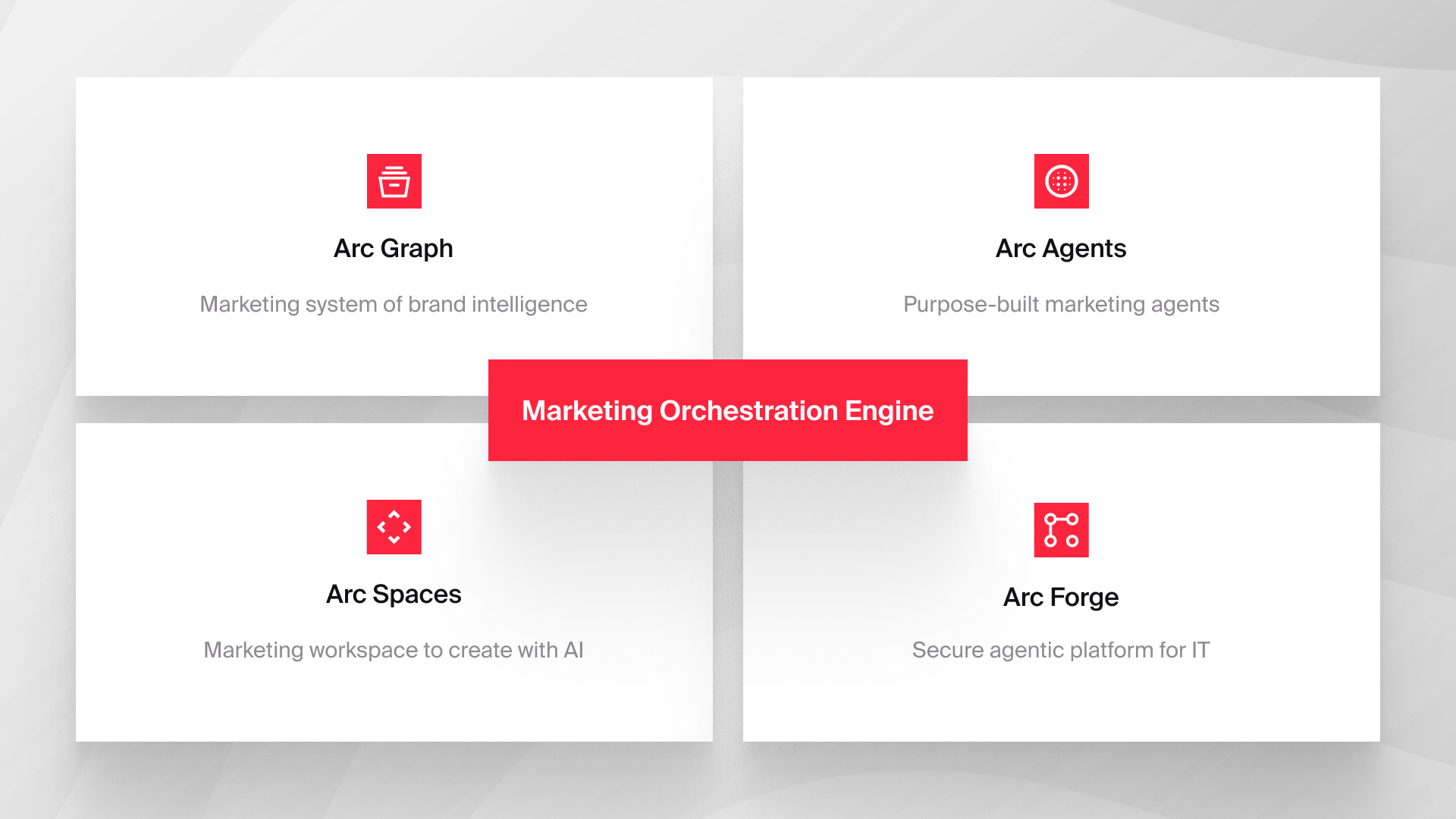
Marketing execution is cross-functional by nature. Typeface's Marketing Orchestration Engine unites workflows of different teams on a single platform — powering the full content lifecycle from strategy and creation to activation.
The result is a shared operating layer where Marketing, IT, and Creative teams work from the same brand intelligence, turn expert processes into repeatable systems, and execute across channels with greater speed and control.
What powers this operating layer:
Arc Graph: Living brand intelligence grounded in your standards and assets
Arc Agents: Marketing agents for email, social, paid, web, video, and more
Arc Spaces: A unified workspace to create, collaborate, and publish
Arc Fabric: IT infrastructure that turns expert workflows into reusable agents
Read the full announcement: Typeface Marketing Orchestration Engine
Produce campaign-ready video faster, without manual edits
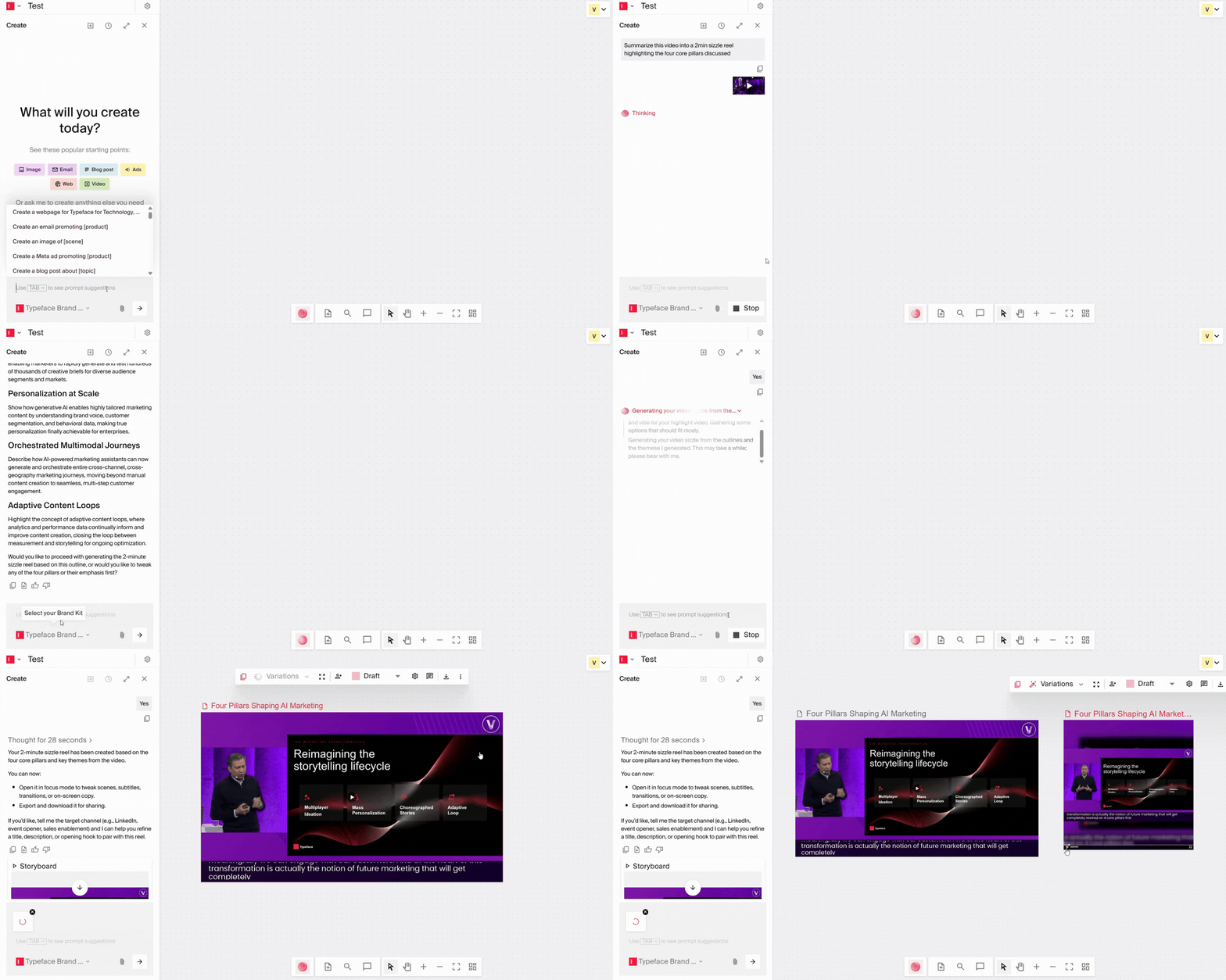
We’ve made major upgrades to video and animation workflows so teams can move from raw footage or static layouts to campaign-ready creative faster.
Turn transcript-based videos into social-ready sizzle reels faster: Teams can now turn transcript-driven videos into polished highlight reels more efficiently, helping repurpose source content into social-ready assets.
Test more creative directions without starting over: Create multiple sizzle scene options from the same transcript structure, making it easy to explore different narratives, pacing, and clip selection without rebuilding from scratch.
Keep every reel on-brand automatically: Generate animated title cards using layouts from your brand kit, making it easier to introduce sections with branded visual consistency.
Get cleaner audio and more editing control: Users can now separate speech from background music directly in the editor. Speech isolation gives editors cleaner voice tracks and better audio control within the timeline.
Adapt videos for every social channel with less rework: Resize videos to multiple output formats for channels like Instagram and YouTube without rebuilding edits manually.
Turn static layouts into motion ads with a simple prompt: Attach a layout and prompt Typeface to animate it—for example, keeping the image static while swiping a header across the frame—so teams can turn banner creative into lightweight motion ads faster.
Strengthen brand governance with the evolved Arc Graph
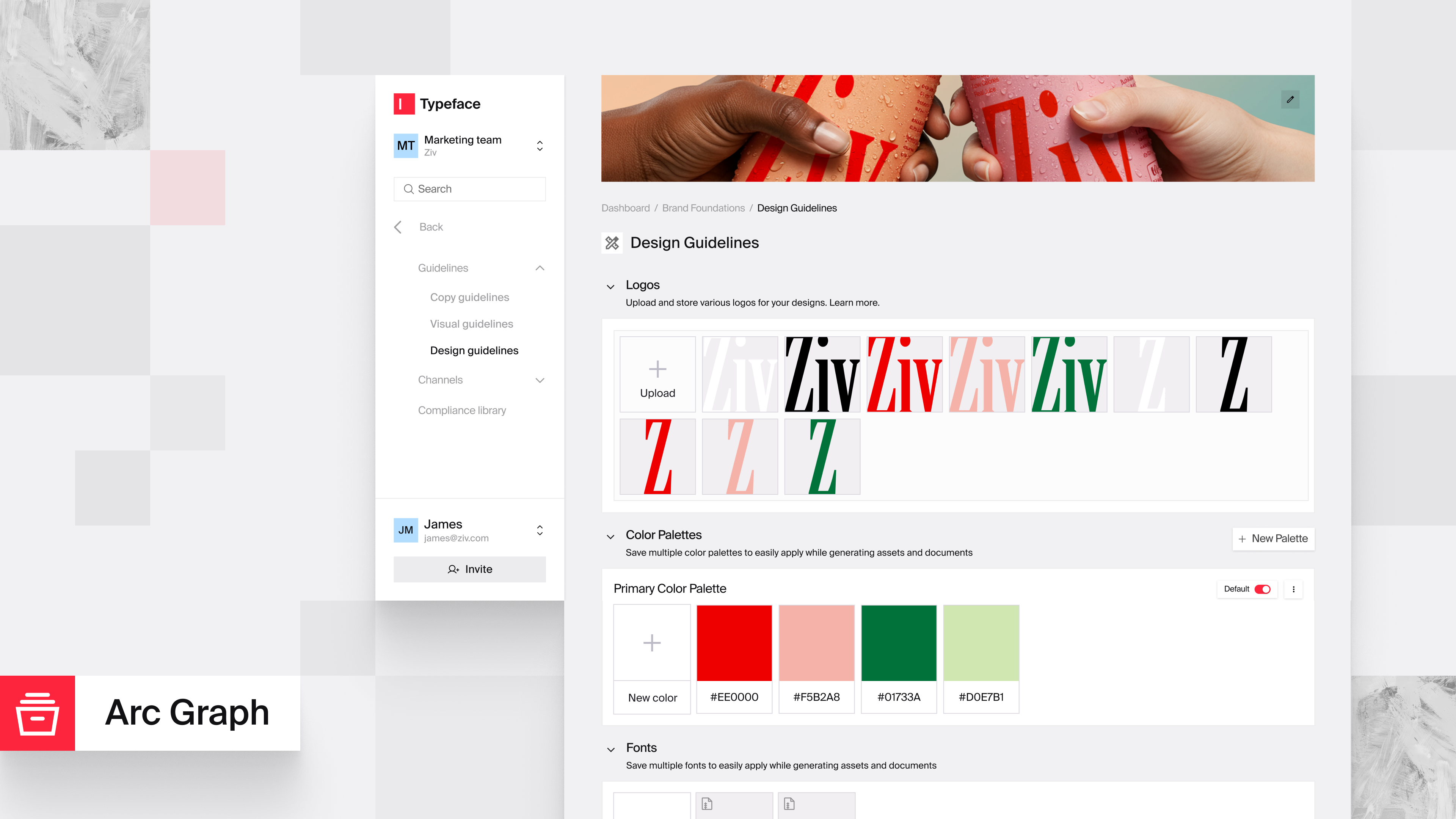
Arc Graph is Typeface’s intelligence layer, connecting your brand standards, approved assets, audience insights, and performance signals into a unified context graph that informs every piece of content your team creates. With a stronger evaluation suite across language and visuals, Arc Graph helps teams enforce brand alignment more systematically and catch issues earlier in the workflow.
Now, Arc Graph is becoming more intelligent, flexible, and comprehensive. Here’s how:
Apply brand governance more flexibly across channels: The redesigned Brand Kit makes it easier to configure how brand rules should work in different contexts.
Tailor brand controls to every marketing surface: Teams can now create channel-specific configurations instead of relying on a single universal setup.
Reduce manual setup with smarter brand extraction: Typeface can pull structured company information from URLs and extract rules like “words to avoid” from PDFs, making brand intelligence faster to operationalize.
Extend brand governance beyond text into visuals: Teams can upload visual brand books, define image and design rules, and evaluate creative in chat against those standards.
Learn more about Arc Graph.
Scale repeatable marketing work with Agent Studio
This month, Agent Studio takes a major step forward in helping teams not just operationalize content creation faster, but build systems that make campaign execution repeatable.
With Agent Studio, teams can codify how work gets done into structured, customizable agents, making quality repeatable and execution scalable across teams and regions. Our new Workflow Agents also support broader AI adoption by helping teams turn repeatable marketing operations into systems that scale across channels, products, and audiences.
Builders can assemble steps into a single orchestrated workflow and publish it as an agent for the rest of the organization to use. Each step can include its own instructions, logic, and integrations. With built-in governance, IT teams can safely manage and integrate agents, while marketing teams can use and refine them.
Workflow Agents power scale by running repeatable tasks across structured inputs such as CSVs, collections, and bulk records. This makes it possible to generate hundreds of assets in a single workflow—from product descriptions to campaign variants—without rebuilding the same process each time.
Bonus enhancements
Faster design-to-production handoff with Figma imports: Teams can now bring email, web, and ad layouts from Figma into Typeface one at a time, making it easier to turn approved designs into ready-to-use starting points for execution.
Adapt image creative faster while preserving design intent: Image updates now support resizing with negative space instructions and one-click background removal, helping teams make precise edits with better composition control.
Move from approved email layout to review-ready asset faster: With new connectors for Marketing Cloud Next and Adobe Campaign, along with direct HTML editing, flexible module updates, and editable Word exports, teams can more easily adapt, finalize, and share email assets, speeding up production and review across stakeholders.
Your content now sounds more like you, and less like a bot: We’ve rebuilt our content generation pipeline to separate creative writing from brand rule enforcement, so content flows more naturally while staying on-brand. That means faster turnaround across email, web pages, SMS, press releases, and more—and content that no longer needs three rounds of editing to sound like you.
Together, these updates move Typeface closer to a more orchestrated future for marketing, where brand intelligence, creative production, and campaign execution operate as a unified system.
That’s a wrap for March.
Related articles
January 28, 2026
Welcome back to Feature Focus! We've added generative sizzle video creation, team collaboration features, and saved webpage modules to help you scale content production faster. Let’s dive in → Creat
December 15, 2025
Welcome back to Feature Focus! As we wrap up the year, we’re introducing more flexibility and scale across our platform. This includes all-new Adaptive Templates, key enhancements to Agent Studio and
November 5, 2025
Connect Typeface to your daily tools, automate campaigns in Salesforce, and publish complete webpages in minutes. Welcome back to Feature Focus! Last month, we expanded how and where you can access T