

AI summary
AI can tailor social media posts to each audience and platform, changing not just what a post says but how it looks. See how audience, product, brand, and channel context keeps every post on-brand, and how performance signals feed back into future campaigns to make each new round more effective.
AI makes it easier to tailor social media content to different audiences and platforms. It can create audience-specific messages and images, adapt tone for different platforms, and resize posts for cross-posting. It can also create multiple highlight videos from a long video, and combine clips from different videos into a sizzle reel.
Your team focuses on what each audience should see and hear, while AI handles the work of producing and adapting those versions. You review the AI-personalized posts and feed insights back into future campaigns, helping AI create more effective content with each iteration.
From creating everything yourself to engineering AI to build campaigns — here’s how it all comes together.
What can AI personalize in a social post?
Social media personalization can change both what a post says and what it looks like. AI can adapt each variation to what’s most relevant to the audience.
Messages and value propositions
This is a classic case where AI creates a campaign message around different audience priorities. The product truth stays consistent while specific reasons are highlighted based on the audience. These include the pain points, use cases, or customer stories that support the main message.
Images and creative concepts
Image personalization is a growing AI use case. From expressive graphics to atmospheric settings, AI can align visuals to campaign briefs and audience segments, creating different scenes, compositions, or creative concepts.
Platform-specific variations
AI instantly resizes images and videos for every social platform. Export multiple sizes for your key platforms within minutes.
Language and regional aspects
A global campaign may need different copy and creative treatments across markets. AI can localize content by language, region, and audience, adapting as much or as little as you want.
Video variations
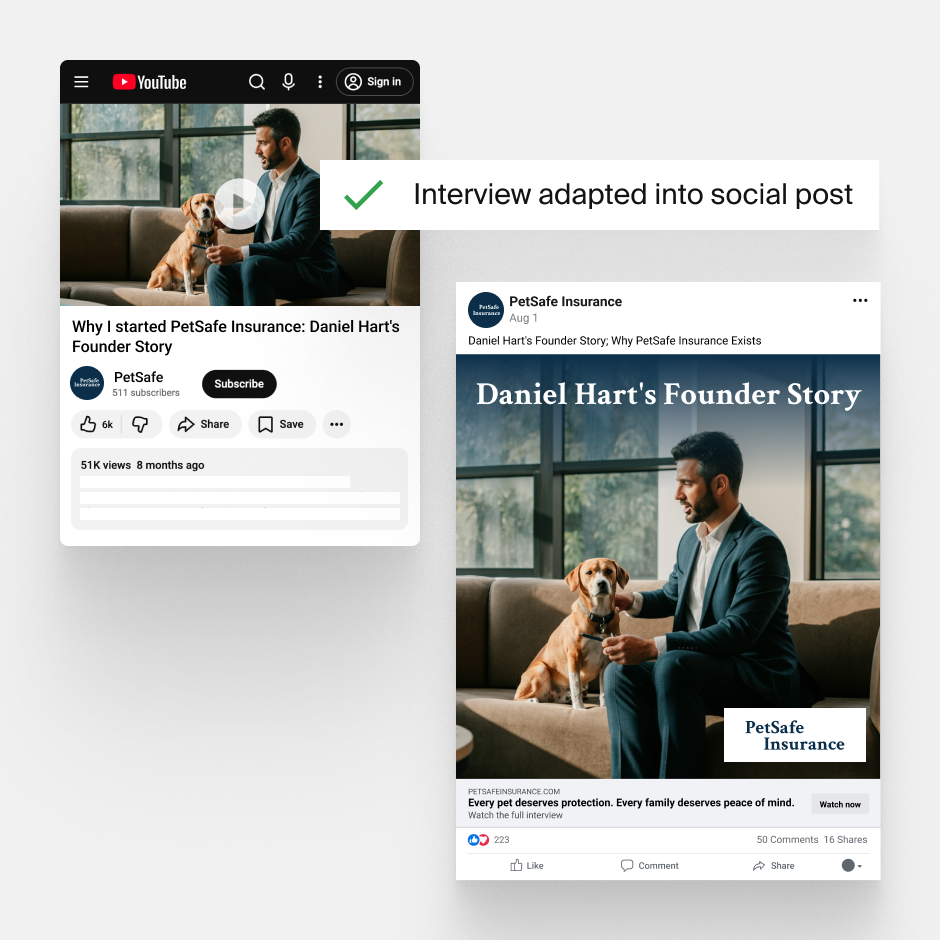
AI simplifies personalizing creative using existing video footage. You can create highlight reels from your CEO’s keynote or stitch moments from different videos into a sizzle reel for a specific audience. AI handles the technical work, letting you explore new ways to repurpose the videos you’ve spent hours producing.
How does AI personalize social media content?
AI personalization starts with context:
Audience context like needs, interests, behaviors, pain-points, priorities, and other details helps AI understand who the content is for and what matters most to them.
Product context spans the products you’re creating social posts around. Capabilities, benefits, and persona-specific details help keep personalization grounded in product truth.
Brand context gives AI the voice, visual guidelines, approved assets, messaging, and other rules it needs to create recognizable brand content.
Channel context helps AI adapt content to the requirements and conventions of each platform.
AI personalization works at scale when context is reusable:
AI needs persistent access to the context that makes content relevant and on-brand. In Typeface, Arc Graph brings together brand standards, approved assets, audience insights, and other marketing knowledge, giving AI a shared source of brand and business context to draw from whenever it creates social posts.
Multimodality expands what AI can personalize:
Copy, visuals, and tone are common personalization elements in social media posts. AI can tailor these to audiences and platforms in the same workflow.
Typeface is multimodal, accepting images, documents, videos, and audio files to create personalized social posts. Purpose-built agents handle different parts of the workflow:
Image Agent creates and adapts campaign visuals for different audiences, markets, and channels, while Video Agent turns existing footage into social snippets and sizzle reels. Each agent works from your brief to create variations and make edits based on simple prompts.
AI personalization gets smarter with performance signals:
One of the biggest tasks AI can take off your plate is A/B testing copy, images, and formats for evidence about which creative approaches are worth repeating. Just as importantly, AI can use audience and campaign signals to improve campaign performance.
In Typeface, Arc Loop is a closed-loop system in which performance and engagement signals feed back into Arc Graph and inform future content creation. Create content for an audience, enrich Arc Graph with campaign insights, and make the next iterations more relevant to your audience and effective for your campaign.
Personalization category | Reference materials |
Messages & value propositions | Audience segments, product information, campaign briefs |
Images & creative concepts | Brand guidelines, approved assets, audience insights |
Platform-specific variations | Platform requirements, ad layouts, existing creative |
Language & regional variations | Regional guidelines, localized messaging |
Video variations | Existing video footage, campaign briefs (plus prompts for generation and conversational editing) |
Personalize social content with less effort
Create personalized social posts for different audiences and platforms without adding time or overhead. AI follows your brand rules for content creation and learns from campaign performance to create with a better audience understanding.
In Typeface, brand governance is built in to keep every social post true to your identity. Once you set up your brand rules in the platform, you can direct agents to generate personalized posts and get campaigns ready faster. Beyond creating personalized versions, agents can format posts, adapt language, and localize images for different regions and seasons.
Get started with enterprise social media personalization. Book a demo or talk to sales today.
FAQs
Q. How does AI know what content to create for different audiences?
AI doesn't have knowledge about your audience or product. You'll need to provide this context, not in every prompt, but to a knowledge graph AI can draw from when it generates social posts. Typeface's Arc Graph is an example of a knowledge graph that informs every content generation, updates with your brand, and learns from performance insights.
Q. Can AI personalize social media images and videos?
Yes. AI can create and adapt images for different audiences and markets. It can also work with existing video footage to create short videos and combine moments from different videos into new creative like sizzle reels and social media ads.
Q. How do you use AI for social media content?
You can use AI to create text, image, and video posts. Repurpose existing content faster. Create audience-personalized variations of posts and also let AI resize posts across platforms. Bottom line: You can direct AI to create social media campaigns.
Related articles

April 2, 2026
Most enterprise marketing teams are already using some form of generative AI. The real question isn't whether to use it — it's which workflows are actually worth your attention, and which ones will cr

August 11, 2026
Your demand gen team just wrapped a 90-minute webinar. You’ve uploaded the recording and posted the slides, but that’s it. No follow-up social posts, no email recap, no blog pulling out the best momen
July 8, 2026
Welcome back to Feature Focus! June brings major upgrades to Ad and Video Agents. Your creative team can produce more ads and videos, on-brand and sized for every channel, while performance marketers