August 11, 2026
Content Repurposing with AI: 5 Ways to Repurpose Your Content for Maximum Impact

Neelam Goswami
Senior Content Marketing Associate

AI summary
Content repurposing increases the reach and lifespan of your existing content. Using AI for content repurposing can help you turn any piece of content into a new format in minutes. Here are 5 ways to repurpose content effectively.
Your demand gen team just wrapped a 90-minute webinar. You’ve uploaded the recording and posted the slides, but that’s it. No follow-up social posts, no email recap, no blog pulling out the best moments. This is a great opportunity to boost brand visibility that gets lost, because nobody had the time to create more content.
That's the gap AI content repurposing closes. AI agents can take that one webinar and turn it into a LinkedIn carousel, three email snippets, a blog post, and a week of social content — all checked against your brand guidelines — in a fraction of the time it would take a writer to do it manually.
You’ve already done the research and analysis. The bottleneck is always adaptation.
Most enterprise teams are sitting on months of high-value content that's not being used to its full potential. This post shows you five practical ways to change that and what the workflow looks like when AI handles the heavy lifting.
TL;DR — Key takeaways
AI content repurposing converts one approved asset into multiple channel-specific formats automatically.
Enterprise teams may see a 3–5x increase in content output per person per quarter.
Brand consistency is enforced by a brand model or AI agent, so quality doesn't slip at volume.
Start with your top-performing evergreen content, map it to one underserved channel, and run a two-week pilot.
What is AI content repurposing?
AI content repurposing uses machine learning to identify the core ideas in an existing asset and generate new, channel-specific versions, each adapted for the desired format, length, and audience.
Rather than truncating or reformatting, a good AI agent understands what the content means and rewrites it to fit into the new context.
Why repurpose content?
Reason 1: Increases content discoverability
When you repurpose a blog into social posts and link back, you're creating additional touchpoints with your audience. This can lead to more shares and engagement, and potentially earn backlinks from those who discover your content.
Reason 2: Meets audiences where they already are
Not everyone reads blogs. Some prefer video, others like quick social posts, and many want email summaries where they can dive into the full content if it piques their interest. Repurposing ensures your message reaches people in their preferred format and platform.
Reason 3: Reduces content creation costs
Creating net-new content requires significant investment in research, writing, design, and review. Repurposing multiplies the value of the work you've already done — one comprehensive piece can be transformed into multiple formats without starting from scratch each time.
Additional benefits:
Reinforces key messages through repetition on different customer touchpoints
Strengthens brand recognition
Provides a testing ground for messaging across channels
Why do enterprise teams struggle to repurpose content manually?
The volume problem is real. The average enterprise content team manages, say, 200+ assets per quarter across six or more channels. Manually reformatting a single whitepaper into social, email, and sales variants can take two to three days of writer and designer time. Multiply that across a full quarter, and most of it doesn't get done.
Beyond time, there's the consistency problem. When different team members adapt the same source material, brand voice drifts. A LinkedIn post written by one person and an email snippet written by another can feel like they're from different brands.
How is AI repurposing different from just reformatting content manually?
Manual reformatting is structural: e.g., you shorten a paragraph, change a headline, adjust the layout, etc.
AI repurposing is semantic: the agent understands the core argument, identifies the most relevant points for the target audience, then rewrites the content to fit the format natively.
A LinkedIn post based on a blog, for example, is a distinct piece of writing that follows LinkedIn's conventions as well as your brand’s persona on the channel.
Agentic AI takes this further. Rather than waiting for a human to prompt each conversion, the AI agent can run the full workflow — ingest, adapt, brand-check, output — autonomously. Your team reviews and approves; the agent does the formatting work.
5 ways to repurpose content with AI — and what good output looks like
These five content types give the highest return on AI repurposing effort. Each one has a clear input and output, along with some realistic examples of what the workflow looks like in practice.
1. Blog posts into social media content
Social platforms move fast, but the ideas in a blog post don't expire the week you publish it. A post from last quarter can still resurface as a LinkedIn update, an X thread, or an Instagram caption — AI agents handle the channel-native reformatting so that value doesn't just sit unused after the first week.
For the full step-by-step workflow — what to gather beforehand, and what good output looks like by channel — see How to Repurpose Blog Posts with AI: A Step-by-Step Workflow.
2. Whitepapers and e-books into blog post series
A whitepaper or e-book usually contains stronger thinking than the audience it reaches — most stay closed behind a form, invisible to search, read only by whoever filled it out. AI agents can break the report into a handful of posts, each built around one theme, so the ideas inside it show up in search without giving away the full asset.
For the full step-by-step workflow — how to pick themes instead of chapters, and what good output looks like by post type — see How to Repurpose Whitepapers and E-books into Blog Post Series?
3. YouTube videos and webinars into written content
Long-form video and webinar content are expensive to produce and often underused after the event. A 60-minute webinar contains enough substance for five blog posts, a dozen social posts, plus a two-part email series. But extracting that value manually means someone has to watch the whole thing and write it all up.
AI agents can work from a transcript or direct video input, identify the most insight-dense moments, and generate written variants for each channel. So, your webinar investment keeps generating content for months.
Typeface’s multimodal content generation agents can convert any type of content into any format, including videos, images and transcripts. Check out this blog to find out how.

4. Podcasts into newsletters and social posts
Podcasts only reach people who choose to press play, which leaves out everyone who'd rather scroll a feed or skim a newsletter. AI agents can process the audio directly — no transcript needed — and turn the strongest exchanges into LinkedIn posts, newsletter sections, or quote graphics, extending an episode's reach past your subscriber list.
For the complete workflow — including guest-approval considerations and what good output looks like by format — see How to Repurpose Podcasts with AI: A Step-by-Step Workflow.
5. Long-form content into summaries and briefs
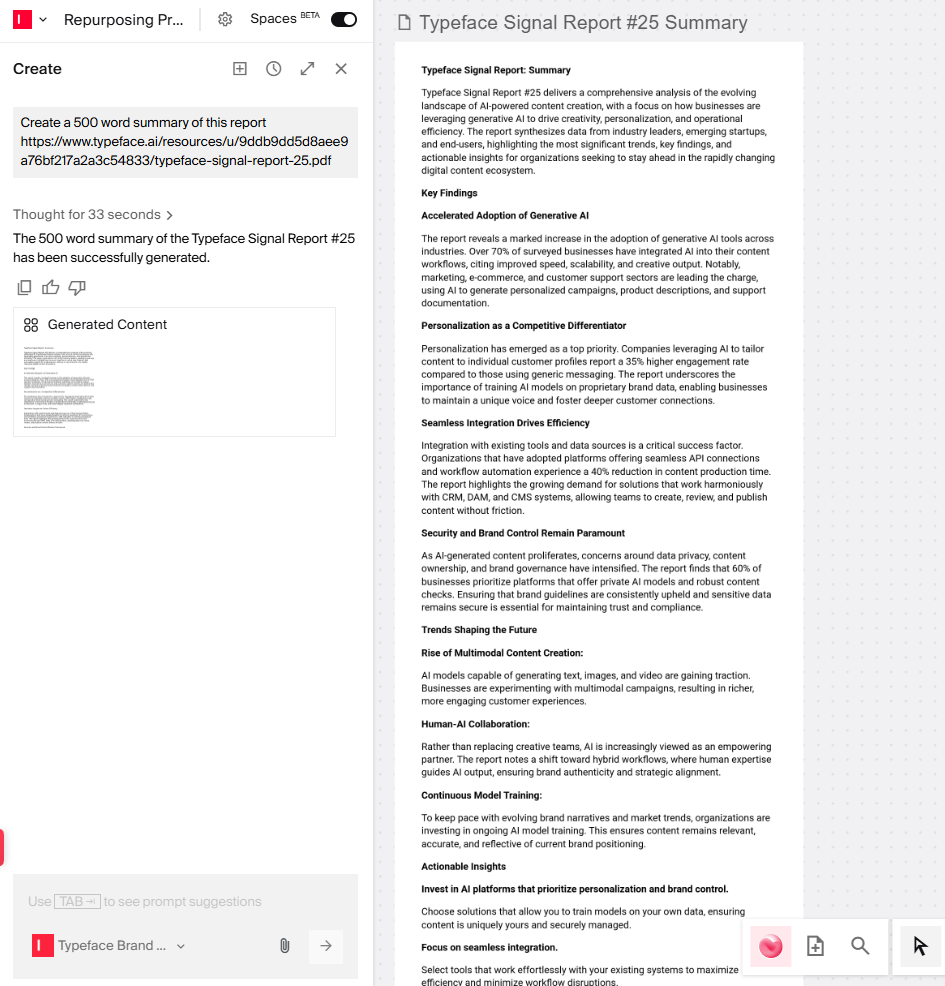
This one is often overlooked because it doesn't feel like 'content production,' but it's one of the highest-impact repurposing use cases for enterprise teams. When your team needs to synthesize a 50-page research report or a lengthy analyst brief into something actionable, AI agents can generate a structured summary in minutes.
Agents can also structure the summaries for specific use cases.
A sales brief gets different emphasis than an exec summary or a social-ready stat sheet. AI agents can generate all three from the same source document, each tuned for its audience.
How does Typeface handle AI content repurposing?
Typeface is an enterprise agentic AI marketing platform that enables teams to orchestrate multichannel campaigns. It’s AI agents connect to your asset library, understand your brand rules, and run the full repurposing workflow without requiring human intervention at each step.
What does the end-to-end workflow look like?
Here's how it works in practice:
Connect your content library. Link your DAM, CMS, or Google Drive to Typeface. Arc Graph, Typeface's knowledge layer, ingests your existing assets and makes them available to the AI agent.
Set up your Brand Kit. Upload your brand voice guidelines, visual style rules, and any channel-specific tone adjustments. This becomes the brand model that every AI output is checked against before delivery.
Run a repurposing workflow in Arc Spaces. Give the agent a source asset and a target output. For example, 'turn this whitepaper into three LinkedIn posts and an email teaser.' The agent generates the variants with your brand rules applied, and surfaces them for your review.
Review and publish. Your team reviews the outputs, makes any judgment calls, and approves. The AI handles the volume work; your team handles the editorial decisions.
How does Typeface keep repurposed content on-brand?
Arc Graph is the single source of truth for your brand identity inside Typeface. It stores your voice guidelines, terminology lists, visual style rules, and channel-specific tone adjustments. Every output Arc Agents generate is evaluated against your brand model before it reaches your review queue.
This is what makes enterprise-grade repurposing different from using a generic AI writing tool. With generic tools, brand-checking is a manual step your team has to do — which means it often doesn't happen at scale. With Typeface, it's built into the workflow.
What content should you repurpose first?
Not all content is worth repurposing. Prioritize assets where the underlying thinking is strong and the topic stays relevant, then work outward from there.
Priority | What belongs here |
Priority 1 — Start here | Top 20% by engagement. Evergreen topics. Content your sales team uses to close deals. |
Priority 2 — Do next | New content on trending topics. Seasonal content approaching its peak window. Channels where you're clearly underserved. |
Priority 3 — Do later or skip | Low-performing content that needs a full rethink. Highly time-sensitive content that's already outdated. |
How do I identify my Priority 1 content?
Pull your analytics and look at three signals:
Organic traffic (which posts drive consistent search visits?)
Engagement rate (which posts earn shares, comments, or saves beyond the first week?)
Sales utility (which content does your sales team actively send to prospects?)
Content that scores on all three is your best starting point.
How do you get started with AI content repurposing?
Start narrow. Pick one high-value asset, one target channel, and one measurable output. Run the pilot, measure time savings and output quality, then expand to the next asset type or channel. Teams that try to automate everything at once almost always stall; teams that start focused ship faster and see results sooner.
What's a realistic first pilot?
Take your three best-performing blog posts from the past six months. Use Typeface to generate LinkedIn and email variants from each.
Track: How long did it take vs. your manual baseline? How did the outputs perform vs. your typical posts? Two weeks of data is enough to know whether the approach works for your team and where to expand next.
What does your team need to have in place first?
Three things:
Your brand guidelines (so you can build your Arc Graph)
A content library you can connect to Typeface
A light editorial review process so your team knows who approves AI outputs before they go live.
None of these requires a major operational overhaul. Most enterprise teams have these already.
Ready to put AI content repurposing into practice?
See how Typeface's AI agents turn your existing content library into a multi-channel content machine without adding headcount or starting from scratch.
Get a demo or connect with our sales team right away.
Content repurposing FAQs
How often should you repurpose content?
A quarterly review cadence works well for most enterprise teams. With the rise of AI search, content freshness matters more than ever before. AI answer engines evidently favor high quality content with more recent information.
Every three months, pull your analytics, identify your top performers by engagement and sales utility, and run them through your repurposing workflow for the channels you're underserving. High-performing evergreen content can be repurposed multiple times across platforms and updated annually. For trending topics, repurpose while the window is open — don't wait for a quarterly cycle.
Which content types work best for repurposing?
Long-form assets give you the most to work with: whitepapers, webinar recordings, research reports, comprehensive guides, and case studies all contain enough substance to generate multiple derivative pieces. Blog posts work well as sources for social and email variants. Podcast episodes are an underused source for written content. The common denominator: assets where the underlying thinking is strong and the topic stays relevant beyond the publish date.
Will AI content repurposing replace my content team?
No. The teams seeing the best results aren't replacing people — they're giving each writer and strategist more capacity. AI handles volume, formatting, and channel adaptation. Your team handles editorial judgment, original insight, strategic decisions about what to create, and the human perspective that makes content worth reading. The division is clear: the agent does the repetitive work; your team does the work that requires thinking.
How do you avoid duplicate content issues with repurposed content?
Repurposing doesn't create duplicate content because you're adapting for a new format, audience, and platform; versus copying text verbatim. A LinkedIn post generated from a blog post is structurally and contextually different from the original. That said, follow these practices: link social posts back to your canonical blog URL rather than republishing paragraphs verbatim; always adapt for the platform and audience; and if publishing similar content across multiple external sites, use canonical tags to indicate the original.
Bottom line: Platform-native adaptation — not just shortening or truncating — is what keeps repurposed content from creating SEO risk.
How do you track the ROI of repurposed content?
Measure four things:
Time saved per asset type (your manual baseline vs. AI-assisted production time)
Output volume per quarter (how many more pieces per person?)
Channel coverage (are you now reaching channels you were skipping?)
Downstream performance metrics for the repurposed content itself — engagement rate, email open rate, pipeline sourced
The clearest ROI signal is often content that previously wasn't getting made because the team didn't have capacity.
Do I need to disclose that content is AI-repurposed?
No. Repurposing means adapting and transforming content strategically. The AI is doing formatting and adaptation work, not inventing facts or fabricating sources. The underlying ideas, data, and voice are yours. That said, always verify that repurposed content is still accurate, that statistics haven't become outdated, and that any claims in the source material still hold.
Bottom line: Repurposed content is your content in a new format. Accuracy review is still your team's job.
Does repurposed AI content perform as well as original content?
For awareness and nurture channels — social, email, retargeting — repurposed content typically performs comparably to original content.
For SEO, original thought leadership and first-party research still outperform derivative assets.
The right model: use AI repurposing to maximize distribution of your best ideas; use original content investment to build search authority and earn the source material worth repurposing.
Related articles

June 17, 2025
Creating video content (whether it’s a customer interview, a product demo, a webinar, or a training session) takes a lot of time, energy, and budget. But once the video is live, turning it into writte

May 21, 2025
Despite investing heavily in content creation, your materials reach only a fraction of potential customers worldwide. Why? It’s probably because of an outdated content localization approach that trap

June 23, 2025
Creating quality content for all your marketing channels is tough. Really tough. Most marketing teams hit the same wall: they need content for social media, email campaigns, videos, and other marketi