August 24, 2026
How to Optimize Content for AI Answer Engines: Tactics That Work

Ashwini Pai
Senior Copywriter

AI summary
AI answer engines extract passages that answer specific questions with precision and clarity. Here's what we know about the AEO style of writing.
AI answer engines like ChatGPT, Perplexity, and Google AI Overviews pull passages that answer a question clearly and synthesize them into a response, with citations and additional discovery links. Writing for extraction isn't a traditional SEO fundamental, though the clear, structured writing it emphasizes has its merits beyond AEO. Here are key tactics for doing it well.
(If you're familiar with these but need clarity on how AI models trust a source enough to cite it, go to the post How to Get Cited by AI Search Engines.)
1. Structure sections as a Q&A
Write each major section as a direct answer your reader is asking, followed by a direct answer. Treat the piece as a conversation rather than an essay building toward a point.
Why: AI models often break down a single question into smaller sub-queries before retrieving an answer, in a process called query fan-out. A section structured as a Q&A pair gives the model a self-contained target to retrieve for a specific sub-question.
What you'd do in SEO: You'd still use answer-based headers to target Featured Snippets and People Also Ask. But SEO gives you more room to use headers as signposts within a larger discussion rather than a standalone answer. The header doesn't need to be answered in the next sentence.
Example: In Typeface's What is AI Campaign Orchestration? Why It Matters for Modern Marketing Teams, the header "Why you need AI campaign orchestration," poses the section as a series of quoted questions a reader might ask out loud: "Why does our AI-generated content keep missing the mark?", "How do we maintain quality when volume goes up 5x?", "Why does it still take weeks to get a campaign out the door?"
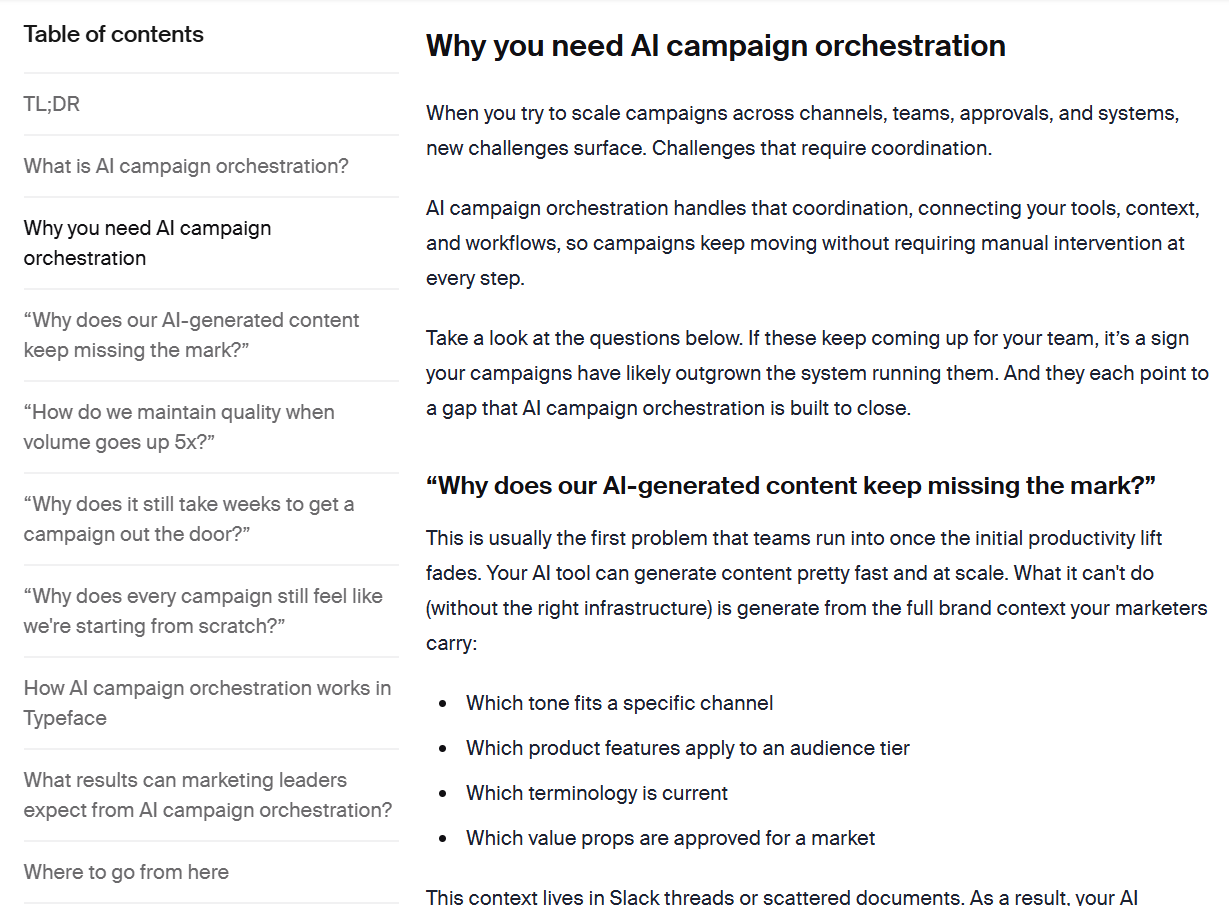
Each one becomes its own subheading, answered directly underneath. This tactic of anticipating the reader's conversational phrasing makes the section a high-match target for voice and semantic search.
The SEO Way: Header reads: ""Producing More AI Content Without Losing Quality"
The AEO Way: Header reads: "How do we maintain quality when volume goes up 5x?"
2. Lead with a complete answer before you elaborate
Put the direct, standalone answer in the first sentence or two, kept to roughly 3-4 lines. Save the context, caveats, and detail for after.
Why: An AI answer is a summary of relevant passages (across various sources) that make sense on their own. So, try to answer the question within the first 3-4 lines. Longer paras risk blending the answer with a connected idea or two, or an unnecessary elaboration, making it harder to extract cleanly.
The answer needn't be a paragraph. A comparison table, a bulleted list, or a short definition sitting right under the heading can work just as well.
What you'd do in SEO: The inverted pyramid has long been good SEO practice too, helping bots understand the page's overall topic and helping readers get the facts upfront. But it's a preference. A slower build can hold attention and boost dwell time, while a deep, well-researched middle of a piece can earn backlinks from other sites citing your research. A page can still rank well with these elements, so long as the full page collectively satisfies intent.
Example: The section below on how AEO differs from classic SEO tactics opens with one sentence stating that AEO builds on SEO fundamentals, then moves straight into a comparison table breaking down various aspects side by side. There's no paragraph of setup between the header and the table. The table itself is the answer, structured for easy retrieval.
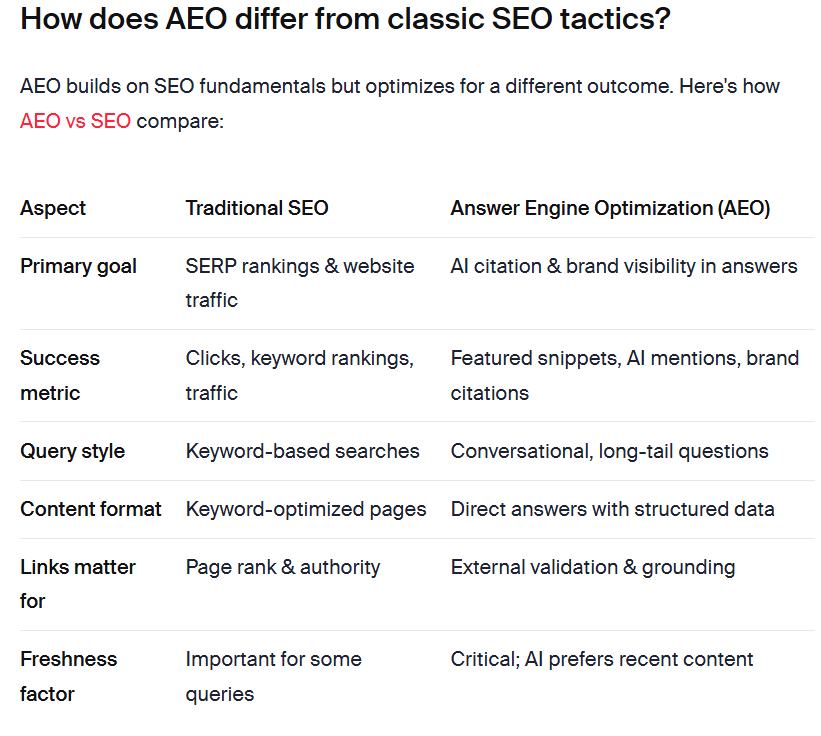
One exception worth knowing on the AEO side: The answer-first rule isn't absolute. AI answer engines can pull from deep in a page when the content is a table, a comparison chart, a bulleted data set, an original quote, statistic, or case study result, or a step-by-step guide cited as sequential steps.
Conversational content on forums and Q&A sites gets cited for the same reason, even though it isn't structured like an answer at all. The bottom line: you can use an answer-first structure to your advantage without letting it come in the way of writing clear, uncluttered passages.
3. Name your entities precisely, every time
Use specific, consistent names for the concepts, products, and mechanisms you're describing. For example, our blogs and pages describe Typeface as a "marketing orchestration engine" built on "multimodal agents" and "brand governance" through "Arc Graph" and "Brand Agent".
Why: Algorithms called embedding models convert text, images, video, and audio into vectors and capture their semantic meaning by placing them on a map near similar concepts.
When a user asks a question, the question also becomes a vector. The AI finds the closest matching content on that map, identifies the source documents, extracts the relevant text chunks, and feeds them to a language model (like Gemini) to generate a single summary.
In our own writing, using "marketing orchestration" consistently means that when someone searches for it, our content has a shot at citation, other factors considered.
What you'd do in SEO: Keyword consistency has always mattered for SEO. However, search engine crawlers can infer meaning from synonyms, variations, and links on a page. As AI models retrieve self-contained text chunks, sentence-level precision becomes important and naming entities ensures the required specificity.
Example: Typeface is an orchestration engine. Using this term consistently helps AI tie it to related entities like "brand governance" and "Arc Loop". Using "orchestration engine" in one blog, and "workflow automation" in another can confuse the AI's entity map.
4. Answer the sub-questions explicitly, don't rely on inference
If a topic has several distinct facets, address each one directly, even if the connection between them feels obvious to you.
Why: Query fan-out surfaces the sub-questions a model thinks a reader might be asking. If your content only implies an answer to one of those angles, it may get skipped for that specific sub-query, even while it ranks well for the topic overall.
Covering more sub-questions makes the article comprehensive but not necessarily longer if you keep explanations tight. If there are many connected or relevant ideas to discuss, you can consider splitting them across a few shorter, focused pages as you might for SEO.
What you'd do in SEO: The instinct is the same, with comprehensive coverage helping, whether it's all on the same page or spread across a cluster. Only, in AEO, sub-questions answered on a neighboring page will fail to count towards the page you're creating.
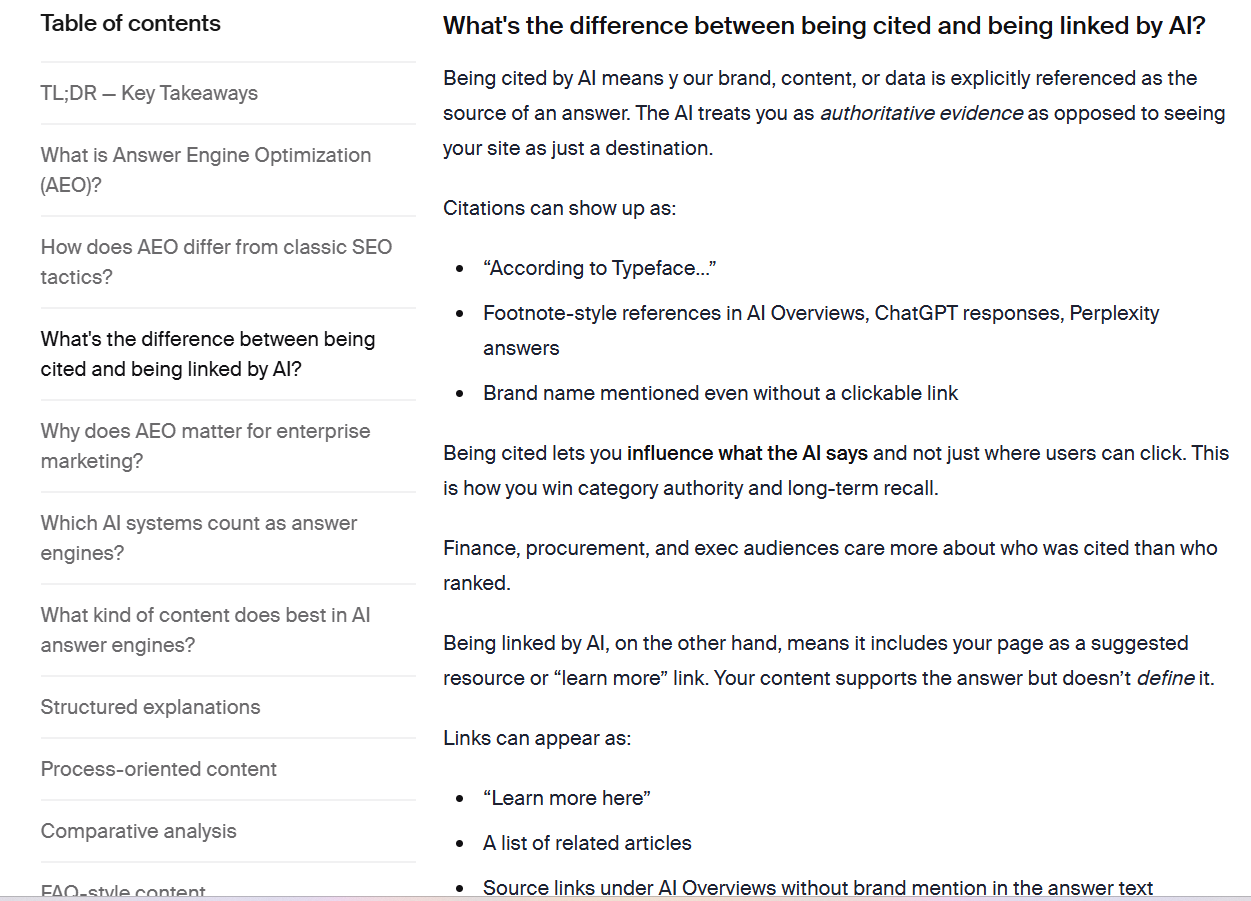
Example: Typeface's AEO guide treats "What is AEO" as several distinct questions, from what counts as being cited versus being linked, to why AEO matters for enterprise marketing, and which AI systems count as answer engines. Each is a facet a reader might ask about separately and gets addressed to satisfy many of the related questions they may have about the topic.
5. State claims directly, with a number where you have one
Write your strongest claims as flat statements, backed by a specific figure or result where possible. Make them stand out with a callout box, bold text, or a pull-quote. Some ideas:
Why: A distinct, direct claim is easier for a model to extract as fact than one buried in narrative or qualified gradually.
What you'd do in SEO: Supporting evidence is valuable in both SEO and AEO writing. The distinction is in how you package it: tightly in AEO, with the subject, action, and finding in one self-contained line or short paragraph (minus the fluff), or loosely in SEO, with more room to weave it into narrative and storytelling.
6. Build authority signals into the page
This one carries from SEO. If you've built topical authority, with comprehensive content, semantic relationships, and specific answers to user intent, you're at an advantage. Along with this ongoing effort, you can use these quick tactics to improve content credibility:
Add an author bio with credentials or direct experience
Cite to primary sources, not other blog posts
Include expert points of view based on knowledge and experience
Create posts around or strengthen claims with original data or research you conducted yourself
Why: Like how search engines prioritize websites that demonstrate deep authority in their niche, AI systems look for trust signals when deciding what to site.
7. Clean up punctuation for machine parsing
Avoid decorative punctuation like ellipses, arrows, asteriks, and emojis. Prefer clean, crisp lines that aid understanding and readability.
Why: Decorative punctuation like ellipses, arrows, asterisks, emojis, and excessive em dashes breaks text flow and can confuse AI systems the same way it confuses human readers. Overloaded sentences can blur meaning, leading to context drift or plain confusion.
What you'd do in SEO: Punctuations don't hurt your SEO rankings but they can come across as spammy or unprofessional when used in excess.
8. Add schema markup for the content types you publish
This is also an SEO recommendation. Schema tells AI systems what a piece of content is, correctly distinguishing between FAQs, how-tos, and product pages. Use FAQPage schema for your FAQ section, Article schema for blog posts, and HowTo schema for step-based content.
Writing for AEO with an AI marketing platform
With AI marketing platforms increasingly used for enterprise web page and blog writing, teams are getting clearer on how AI fits into the process. For AEO blogs in particular, AI can help refine structure, condense text, or generate well-structured answer blocks, even entire articles. Add features that evaluate blogs for AEO fit, and you're saving time while keeping pace with an AEO content strategy that doesn't drag on.
Take Typeface's Web Agent. It generates copy, blogs, press releases, and long-form content in your brand voice, or a specific author's voice (such as your CEO's), checked against your brand guidelines for grammar, language, compliant terms, and more.
Give Web Agent a topic and basic details — a blog topic, audience, word count, reference documents and/or URLs — and it will build a structure, suggest keywords, and surface competitor outlines along with People Also Ask questions for the topic. You can override the structure and framing as needed by editing the document before generating the piece.
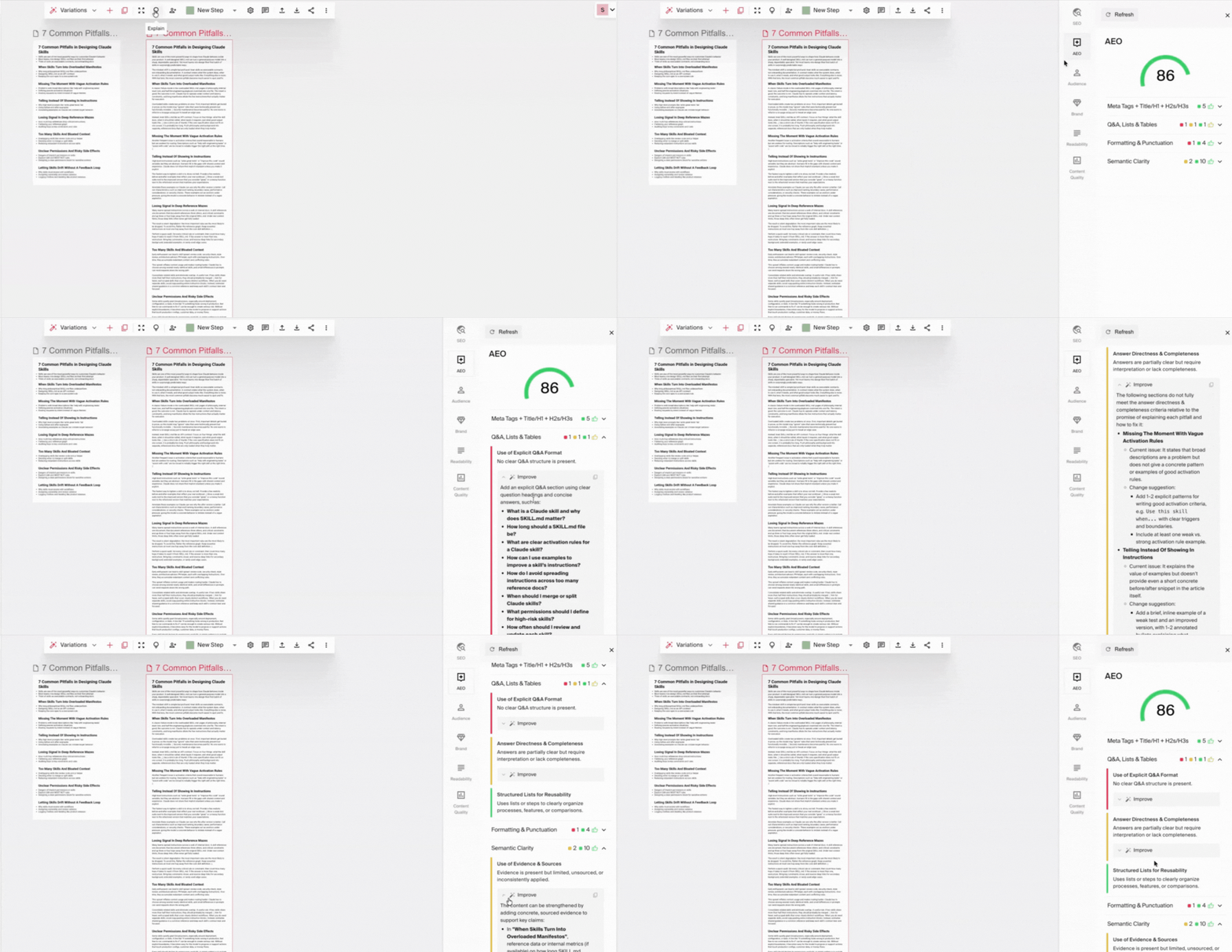
After completing a blog, ask AEO Analyzer to score the page on AEO factors like formatting, headings, semantic clarity, and punctuation. Each score comes with suggestions you can incorporate, tweak, or ignore, then re-check. With automated analysis, you can chase down every AEO-improving detail or make as many quick improvements as time allows.
Understand how Web Agent and other channel-specific AI agents can work for your enterprise content creation goals. Get a demo or talk to sales today.
FAQs
Q. Does word count affect AEO?
Word count has no effect on AEO. Self-contained passages and answer-first design matter more. Keep narrative build-up only when necessary and write in 40-60 word blocks that are self-contained enough to be extracted and used as answers without needing additional context.
Q. Does writing for AEO mean writing more robotically?
The mechanics of AEO writing can feel a bit stifling at first, but they ultimately reward clarity and precision. You can use a simple and structured writing style while adding color and nuance where it's needed, satisfying both people and AI models.
Q. Why does third-party validation matter, and how do you get it?
To avoid returning inaccurate answers, AI models weigh whether your claims align with what other trusted sources say. Existing PR and SEO tactics all help, including earning mentions (linked or not) in industry publications, contributing expert commentary others cite, and publishing original data that other sites reference back to.
Q. How do you measure the impact of AEO?
Traditional rank tracking doesn't capture results from AEO. Track citation frequency in AI Overviews and chat platforms, monitor branded search lift after AI mentions (a sign someone saw you in an answer and searched your name directly), and watch for referral traffic from AI platforms in your analytics, even though it's currently a small, imprecise signal.
Related articles

December 21, 2025
Although LLM searches are taking a minimal chunk out of organic SEO traffic, AI Overviews have changed how people search and competition among AI search tools has intensified. Far from being dead, org

August 24, 2026
Traditional search returns a ranked list of links for people to explore. AI answer engines generate a direct response and cite a handful of sources. Searchers get their answers without visiting a webs
September 29, 2025
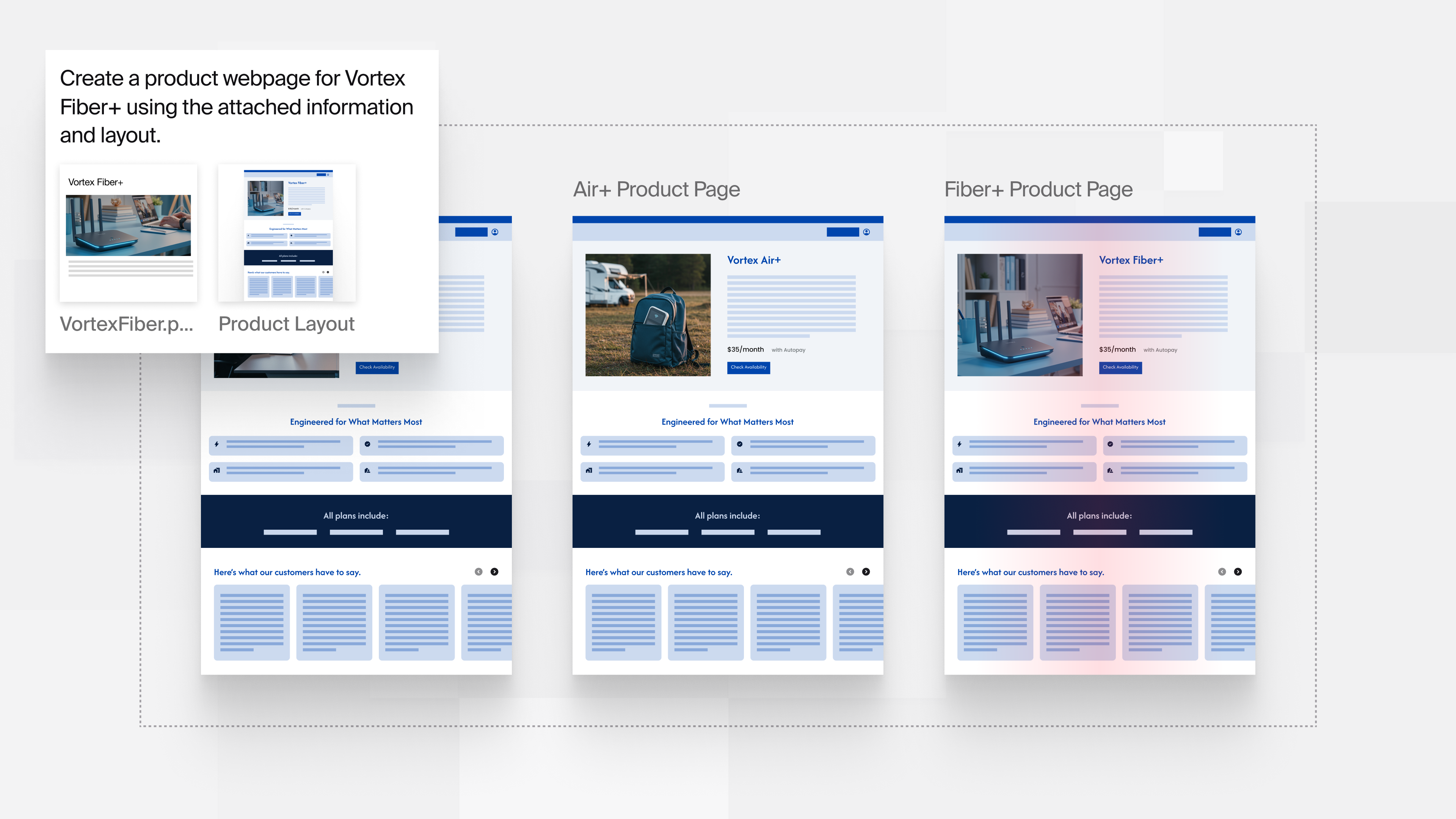
Marketing teams face an impossible choice. Create webpages for every product, service, and location—or scale back to just a few because your team is stretched thin. A financial services company told u