

AI summary
AI is changing what it means to be visible online. This definitional post covers the key concepts behind answer engine optimization (AEO).
Answer engine optimization (AEO) is the practice of creating content to increase its chances of being included in AI-generated answers and citations across answer engines like ChatGPT, Claude, Google AI Overviews, Gemini, and Perplexity.
The five AEO objectives:
Be a credited source within AI-generated answers in Google AI Overviews, ChatGPT, Gemini, Claude, and similar platforms.
Earn a linked or unlinked brand mention in AI-generated responses.
Secure citations in the references or discovery links shown under AI answers.
Be the answer users get for relevant voice search queries.
Capture the Featured Snippet when Google serves one instead of an AI Overview for a query.
Why is AEO important?
Today, AI does the searching for you and gives you a relevant response with source citations for further exploration. The same AI-assisted discovery is now common across Perplexity, Claude, and ChatGPT. Direct answers are great for your audience but reduce clicks and traffic, which means you need both AEO and SEO.
A quick history: The term "answer engine optimization" was originally associated with voice search. It first appeared around 2018, when the rise of voice assistants led some SEO practitioners to predict that brands would increasingly compete to become the single trusted answer to user queries. As AI search has evolved, AEO has expanded beyond voice search and today primarily refers to optimizing content for AI-generated answers and citations.
How to do AEO
AEO is about giving the best and clearest possible answer to a query, from a source AI search platforms consider trustworthy. Clear answers and authority work together. One helps the model understand your content; the other gives it confidence to cite it. Beyond the answer itself, think about the questions that naturally follow.
Covering those related angles has always been good SEO, and it's just as important for AEO. That gives you three levers:
Writing mechanics — Structure content so a direct answer sits immediately below the question, phrase H2/H3 headings as questions, add pull quotes highlighting key insights, and focus on simple, clear writing.
Entity trust — Build off-site authority that tells engines your brand is a recognized source in your niche. Consistent naming, schema markup, third-party citations, PR, and thought leadership reinforce brand authority over time.
Content architecture — Match content depth to intent, but not every article should try to cover everything and not every sub-topic needs its own article. Where a sub-query fully answers a query without more room, make it a tight 300-400 word chunk. Where a sub-topic is useful on its own or demands specificity, like comparisons or data points, split the hub.
Recency is another aspect. AI systems evaluate what changed on a page and favor meaningful updates whether that's the latest statistics, comparisons, or product features. If regular content refreshes are part of your content strategy, you're already doing one of the most important things for AEO.
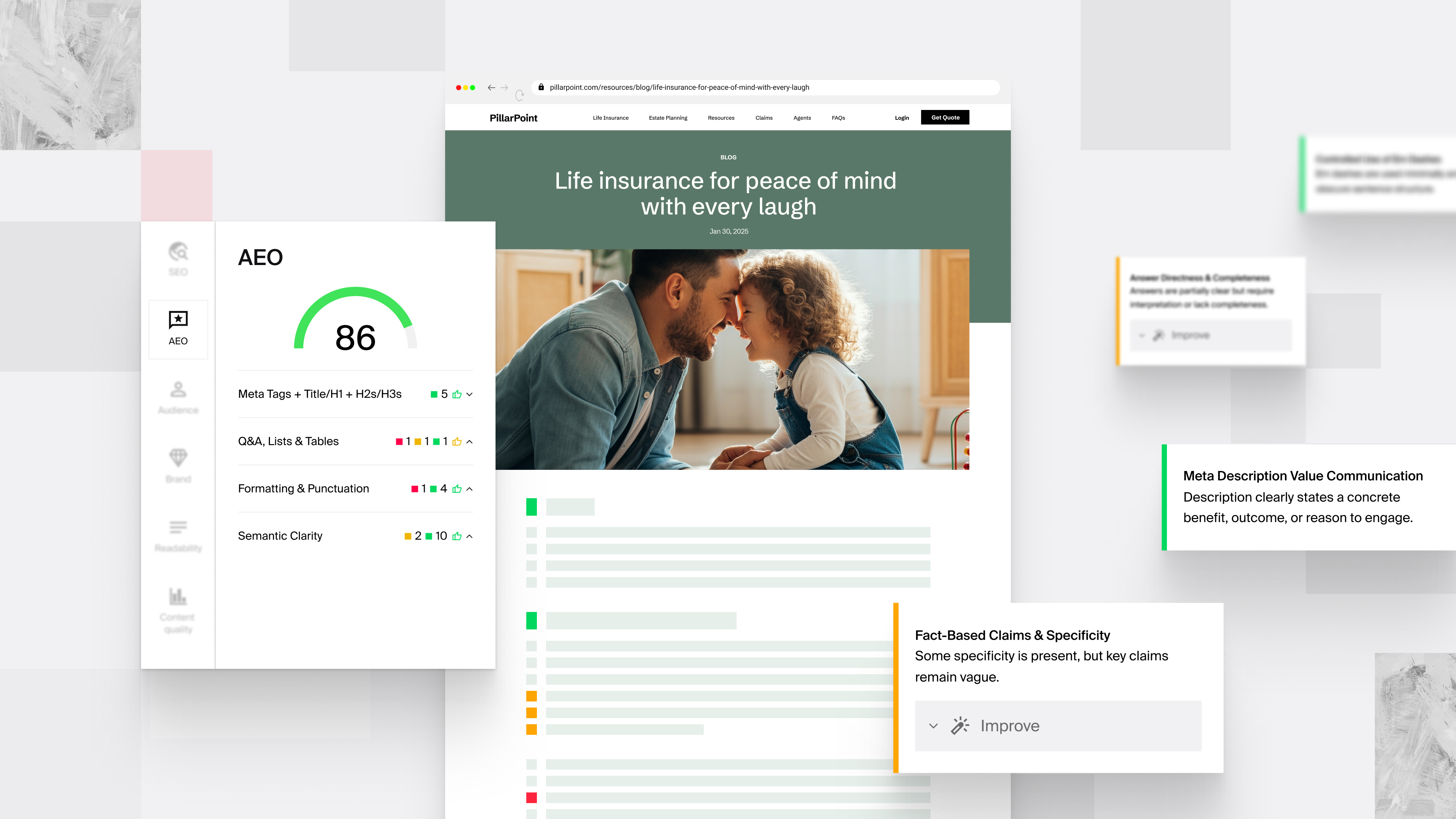
AEO Analyzer can audit your blogs for AEO: Typeface's AEO Analyzer scores each page across dimensions like heading structure, Q&A formatting, and semantic clarity, then surfaces prioritized recommendations. Run it on a single post right after you write it, or across hundreds at once for per-page suggestions.
Is AEO the same as GEO?
The two terms are often used interchangeably. When practitioners do distinguish them, AEO tends to signal a focus on the answer itself: the Featured Snippet or the voice search response, with some including the AI Overview citation and some not.
Generative engine optimization (GEO) tends to focus on generative, conversational engines specifically, like ChatGPT or Perplexity. Usage varies enough, so use whichever term feels right for your context.
Typeface can support your AEO and SEO strategy across your product and sub-brand content. Get a demo or contact sales.
Related articles

August 12, 2026
AI has quietly powered search for years, but the launch of numerous AI answer engines and Google's AI Overviews changed how people find answers for good. Search has expanded into "AI SEO," where brand
April 30, 2026
A content marketing manager at a CPG brand recently told us she had spent months creating blog posts and product pages. The rankings were solid. Traffic was consistent. Then she started noticing somet

July 15, 2026
For AI search, you need an evolved version of your SEO strategy that accounts for how answer engines retrieve and cite information differently than traditional search. Some SEOs argue that AI discover