

AI summary
Being retrievable by AI is about writing mechanics. Being selected requires trust. Discover what it takes to build the authority and third-party validation that gets your brand cited by AI search engines.
Being retrievable by AI engines is about writing mechanics. Getting selected in the first place means what you claim to be matches how other sources describe you, and that trust-building takes effort on multiple fronts. See what this aspect of answer engine optimization entails. (For the on-page half of AEO, see How to Optimize Content for AI Answer Engines: Tactics that Work)
How is being retrievable different from being trusted?
When AI models extract passages for a response, they're evaluating relevance and structure. Citing you from that pool of retrievable pages is a separate decision built on trust. On-page signals like author bios, primary-source citations, and social proof help, but trust also has to live off the page, in how consistently your brand shows up across the web, whether other sources back your claims, and whether the model already associates your name with the topic.
What builds the trust that gets you cited by AI search engines?
As AI engines rely largely on Google or Bing search indexes to surface information, strong search rankings help your visibility and give you an advantage in AI search. Top rankings are, after all, proof that your content holds up and your site is technically sound. AI engines also weigh trustworthiness from other angles, and those are what your AEO playbook needs to cover.
1. Ensure a consistent entity presence across the web
Leave no doubt about what your company is and what your products do. Keep facts, positioning, and claims consistent everywhere your brand appears, so your site says what your press coverage and third-party listing describe. If your Wikidata entry clashes with your homepage copy, resolve the doubt it can create. Practically, this means auditing your business profiles regularly, checking whether names, descriptions, and key facts match across the web.
2. Earn mentions from sources the model already trusts
Like how backlink build link equity for SEO, mentions in publications or resources AI models deem authoritative help back your claims. Here's what you can do:
Contribute expert commentary to publications in your space
Pursue interviews and guest contributions on established sites
Get included in "best of" roundups and comparison content other people write
3. Publish original data other sites cite back to you
Another site referencing your statistic or finding is third-party validation of your content's accuracy. An original benchmark study or survey works as a linkable source other sites can cite to back up their own authority (while also differentiating your own blogs and pages). The same piece of research can reinforce your authority on the topic across every site that references it.
Tip: Use Typeface to repurpose your research reports into blogs, social posts, and emails. Typeface is a multimodal platform that generates content across formats from a single brief, with a living brand system that keeps your entity mentions consistent across everything you publish.
4. Build topical authority before the query happens
AI models draw on two kinds of knowledge: what they retrieve live at query time, and what they already learned during training, sometimes called parametric memory. Publishing consistently on a topic over time increases the odds a model already associates your brand with that subject before it runs a single retrieval step. If you haven't already, start now.
5. Let others validate your claims instead of just stating them
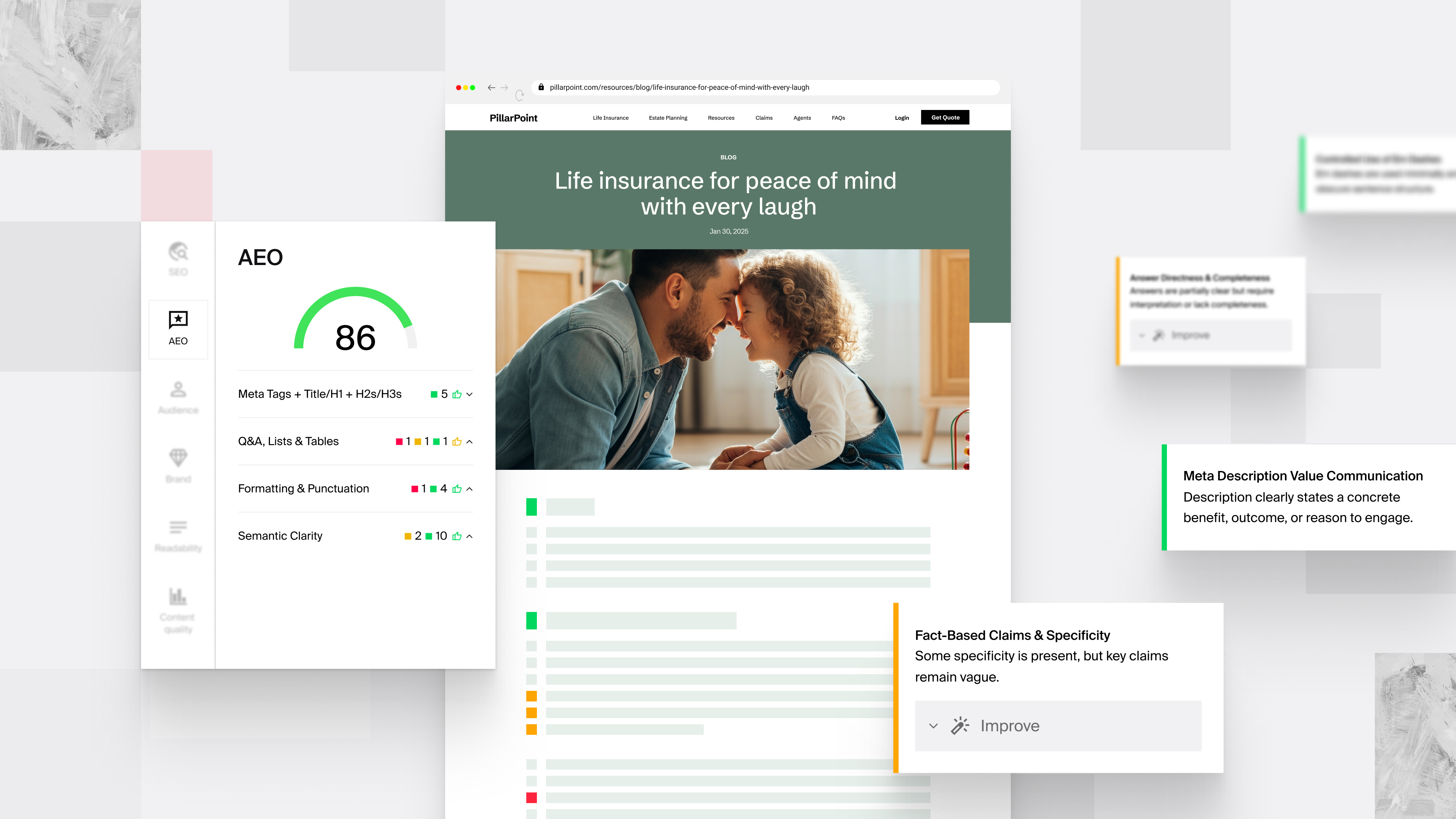
Self-published superlatives like "industry-leading" or "best-in-class" only carry weight when they align with what trusted sources say about you. The same claim reads as objective fact in an independent review or case study, and as promotional filler in your own product copy. Typeface's Web Agent creates SEO and AEO blogs grounded in your brand knowledge and guidelines. It suggests SEO keywords and scores your content on AEO parameters. See how with a demo or discuss your content requirements with our sales team.
FAQs
Q. Why does third-party validation matter, and how do you get it?
Models try to avoid returning inaccurate answers by weighing whether a claim reflects what other trusted sources say. You earn it through digital PR: mentions in industry publications, expert commentary other people cite, and original data other sites reference back to you.
Q. Does traditional link building still matter for AEO?
Link building is an SEO tactic, passing ranking authority between pages. AEO relies on "mention building", working towards consistent brand narratives and third-party validation to increase trust.
Related articles

August 12, 2026
AI automates the research-heavy groundwork behind every content brief, and a two-hour task becomes a two-minute one. All that without surrendering the strategic judgment that makes content rank, such

February 4, 2026
Answer Engine Optimization (AEO) is the practice of structuring content so AI systems like ChatGPT, Perplexity, Gemini and Google's AI Overviews can easily extract and cite your information as direct
April 30, 2026
A content marketing manager at a CPG brand recently told us she had spent months creating blog posts and product pages. The rankings were solid. Traffic was consistent. Then she started noticing somet