July 30, 2026
How CMOs Build the Business Case for AI Transformation — A Practical Guide

Ashwini Pai
Senior Copywriter

AI summary
AI transformation requires both the right platform and the right operating model.
- •Build the business case around measurable business value.
- •Use a platform that embeds governance and workflow orchestration.
- •Roll out AI through executive sponsorship, phased implementation, and measurable outcomes.
AI is changing marketing economics, and the numbers back it up. The 4th edition of the Typeface Signal Report, surveying 200+ marketing leaders at VP level and above, found that 61% had captured ROI from AI investments, and another 32% expected it within six months. Suffice to say, for CMOs building next year's plan, AI is already a line item. For those where it isn’t, a business case is becoming harder to ignore. If that’s you, this guide will help you build a compelling case for AI transformation.
TL;DR
AI earns approval when it solves business problems.
Cost consolidation, personalization, and better use of team capacity make the strongest business case.
Leadership, people, and workflows determine whether AI delivers lasting value.
Governance belongs inside the workflow.
A clear budget, timeline, ownership, and measurable return make the decision easier.
How do CMOs build the business case for AI transformation?
The best way to build a business case is by showing how AI creates measurable value. The strongest AI transformation business case ties AI to outcomes an executive sponsor can evaluate. In marketing, those outcomes typically come from three levers:
Cost consolidation: Identify where AI can lower production costs without sacrificing quality by validating which work can move in-house.
Personalization and market impact: Prove that AI makes scalable personalization economically viable, increasing engagement and conversions.
Capacity creation: Explain how the time AI creates will be reinvested into growth, efficiency, or quality improvements, rather than simply producing more content.
1. How does cost consolidation improve the ROI of AI transformation in marketing?
AI lowers the cost of certain content production activities, which makes collapsing agency spend into internal teams look attractive on paper. But be cautious about what you take back in-house. AI is no silver bullet, and genuine expertise is hard to replace. If you get it wrong, the cost of rebuilding that expertise later can exceed what you saved.
Given the institutional experience and specialized creative talent agencies bring, build in a validation phase before you make a sourcing decision. Bring a subset of previously outsourced work in-house and compare quality and performance against the agency benchmark. It's the only reliable way to know where AI-enabled internal teams hold up, and where agencies still add differentiated value. As a general starting point, these are the content types worth testing first:
Generally lower-risk to bring in-house first: High-volume, repeatable production, where AI delivers speed and consistency. Think localized ads, social copy, personalized emails, and A/B landing pages. Still worth validating against your own quality bar before broad adoption.
Where agencies are strong: Brand campaign concepting, category-defining creative, and work that requires recognizing what’s working across the industry. Exactly the kind of judgment and outside perspective that make agencies valuable, and that AI-assisted internal teams haven't yet had the reps to build. Reassess as your internal team's track record grows.
Worth testing before deciding either way: Stakeholder-facing strategic content that your most talented agency partners have consistently delivered on. Where feasible, bring a subset in-house, compare quality and performance against the agency benchmark, and only expand scope once that comparison holds up repeatedly.
Bottom line: The business case is cheaper production without sacrificing quality. Until you can demonstrate equivalent quality, any savings from bringing work in-house are hypothetical.
2. How does personalization increase marketing AI transformation ROI?
AI is huge for personalization. A hundred localized landing pages, ten ad variants per audience segment, individualized ABM campaigns — these build the personalization muscle that boosts connection and engagement. Human teams can't produce at that volume. If better-targeted content has always been the thing you couldn't scale, now AI makes it possible, and that deserves a mention in your AI transformation case.
When you include it, paint a picture of the impact you've already seen, to show what volume does. For example, "Localized landing pages double conversions in our mid-market segment. AI lets us create them for every key product and solution.”
Bottom line: Personalization is one of the strongest capabilities AI puts on the table. Link it to a response metric to strengthen your AI transformation business case.
3. How do you measure the ROI of AI transformation beyond productivity gains?
AI creates capacity. The opportunity (and value) lies in redirecting it to higher-value work. There are four realistic possibilities:
1. Growth: Your team creates more personalized campaigns and enters new markets faster. Measure impact through conversion lift from personalized campaigns, new market entries enabled by AI, and revenue from AI-driven campaigns compared with non-AI campaigns.
2. Efficiency: You maintain output with fewer resources. Measurable through cost per asset before and after AI adoption, headcount or hours reallocated (not just freed), and agency spend reduction tied to a specific insourced scope.
3. Quality: Your team can afford to spend more time refining assets, increasing overall quality. Measurable through brand compliance or QA pass rates, revision cycles per asset, and performance lift (engagement, conversion) on refined assets versus prior baseline. The strongest version of this case connects the lift directly to time reinvested in refinement.
4. No strategic change: More content produced without a corresponding shift in the above three metrics. This is the default outcome without a deliberate plan, which is why your business case needs projected benefits and clear success metrics.
Bottom line: Hours saved aren't the AI marketing ROI. Name the outcome they produce: growth, efficiency, quality.
What does it take to be ready for AI marketing transformation?
Organizational, people, and workflow readiness. When all three are in place, you're ready to move AI from pilot to production. Right now, most brands aren’t there. Only 16% are fully prepared to operate at AI speed, while 67% have the tools but not the people or processes.
1. Organizational readiness
Organizational readiness means an executive sponsor backs the initiative and uses that influence to pull in cross-functional stakeholders, turning it into a well-supported enterprise effort.
You know that executive sponsorship is the starting point for any tech adoption. Without active backing from a senior executive, you may still get your AI pilot off the ground, but it may be limited in what it can achieve. So, ground the initiative in three to five objectives that tie to business strategy, and get C-suite commitment behind them.
The same executive backing also proves crucial in running AI as an enterprise-wide project. Since an AI initiative cuts across marketing, tech, and legal, involve copy, creative, legal, and IT teams from the start. Shared ownership ensures the initiative benefits from the collaborative lens of every function it touches and gets the support it needs to scale.
2. People readiness
People readiness means the team has both the capacity and the pathway to move into higher-value work once AI takes on routine production. There are two aspects to this: making sure people are equipped to use AI effectively, and trained to move into higher-value work as routine tasks get automated.
Create a plan for freed-up hours. Is the expectation that the copywriter shifts into strategy, quality review, or performance analysis? If so, are they suited to that shift? Does enough higher-value work exist? And if the answer to both is yes, what support do they need to get there?
Budget for training and give teams protected time to practice new skills beyond tool onboarding. Then track whether the time AI frees up is being reinvested in higher-value work. If not, revisit your change management plan.
3. Workflow readiness
Workflow readiness means AI is connected to the systems and processes a campaign already runs on. Your teams aren't forced into new workflows. Instead, they move from inefficient routes to a faster production highway.
In practice, though, most organizations aren't there yet.
Our research found that 92% of marketing leaders need 10 or more stakeholders to execute, with over two in five requiring 20 or more. AI has made content creation faster, but it hasn't made campaigns faster because the coordination required to deliver them hasn't become any simpler. The bottleneck has shifted from technology to the organization.
Fortunately, AI marketing platforms are designed with the realities of modern marketing in mind. They connect to your existing tools to move data seamlessly, embed brand guidelines into content generation, and preserve existing workflows while making content creation and approvals faster.
Bottom line: If technology gets AI started, then organizational, people, and workflow readiness determine whether it sticks and creates business value.
What does responsible AI look like in day-to-day marketing operations?
Responsible AI in day-to-day marketing operations means governance is built into the way work gets done. AI follows your brand rules for content, uses your existing campaign templates, and includes review checkpoints that give your team the final say before anything goes live. It takes a workflow and brand system, and teams that understand their role within it. Get that right, and your executive sponsor will have the confidence to keep backing the initiative.
When can you say AI is being used responsibly?
Governance is embedded in the workflow. Brand standards, compliance guardrails, and quality checks sit inside the workflow. AI generates content with brand rules already applied, so every asset starts from an approved foundation.
How it works in Typeface: Arc Graph, Typeface's brand governance layer, pulls from your DAM, CRM, and existing knowledge bases to build a live, centralized source of brand truth. Those rules are organized as Brand Kits at the org and sub-brand level, with each team working from guidelines scoped to them. That knowledge feeds directly into generation, so every text and visual output meets brand standards automatically rather than needing a separate compliance pass.
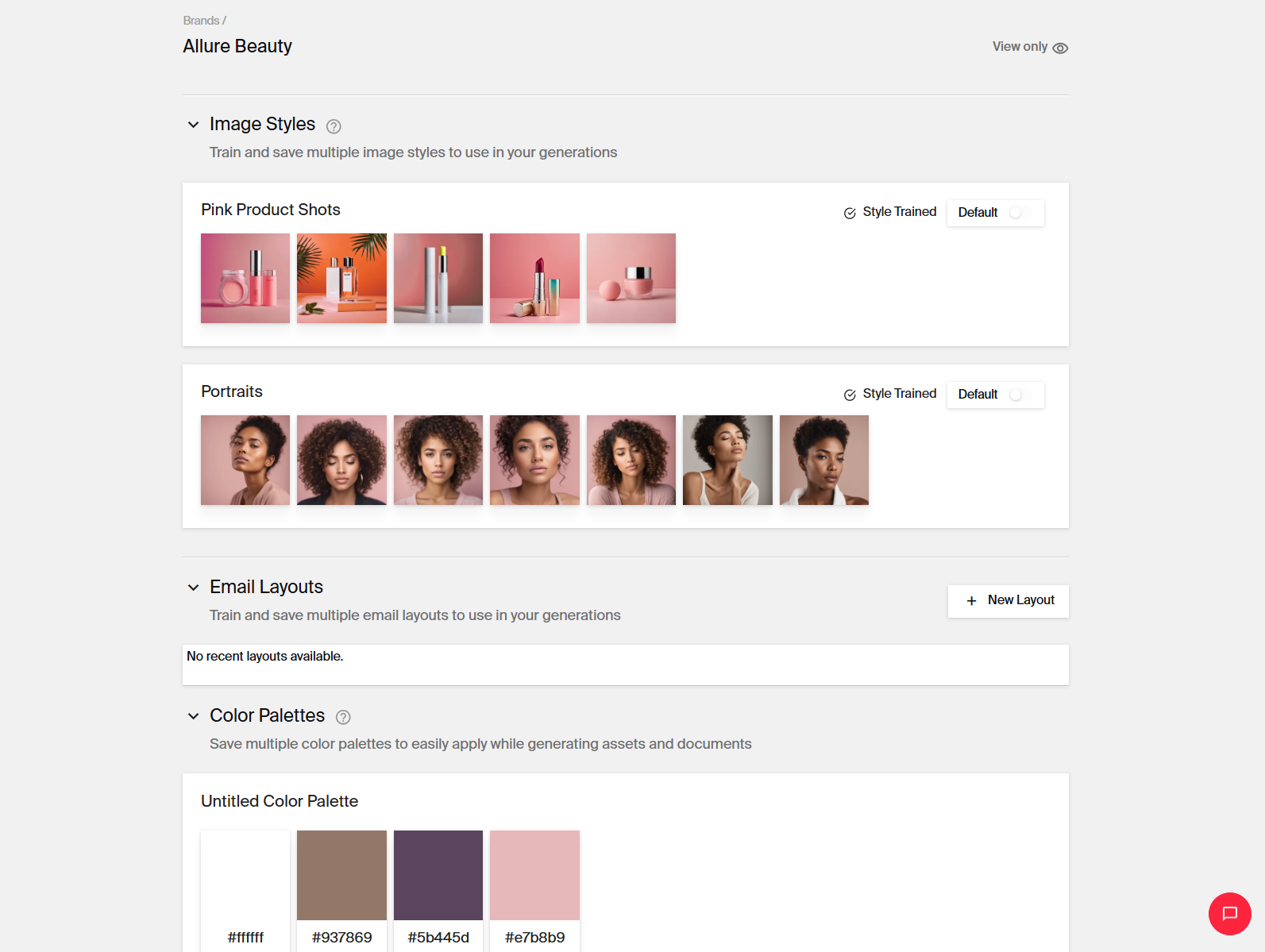
Approvals flow without bottlenecks. Speed and ease of execution come down to how a campaign moves from creation to sign-off. Map the full path from brief to launch, build approval flows across cross-functional teams, and fix the handoffs where campaigns stall.
How it works in Typeface: Typeface MCP lets teams work in Claude Desktop, VS Code, and ChatGPT with approved assets, audience segments, and campaign history available where they work.
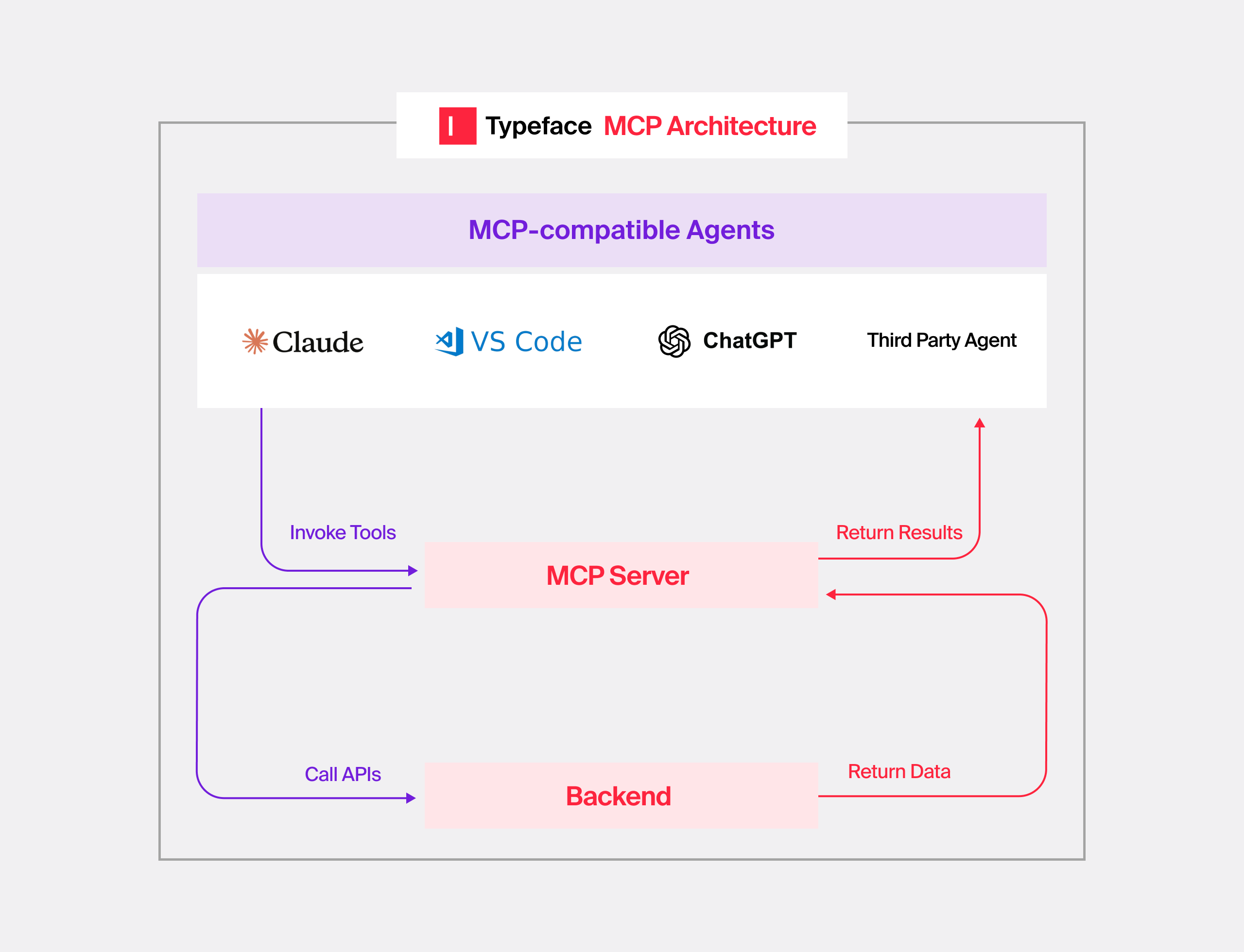
Standards are consistent across every team. Establish workflows and ownership to run campaigns safely. Codify templates, document brand guidelines, and define approval workflows. Any permitted team or channel should be able to pick up the same standard and replicate it consistently, at the same quality.
How it works in Typeface: Templates come annotated, documenting the structure and intent behind each content block. Brand guidelines for voice, tone, and visual style live in Brand Kits, which teams can edit, update, or extend. Role-based permissions and audit trails keep approval and compliance built in. And because standards are tied to roles, a new team member starts with the right workflows from day one.
Bottom line: Responsible AI is built into the work. Brand standards are applied automatically, leaving teams to focus on judgment and quality.
What should an AI transformation business case include?
To go from pilot to full scale, an AI transformation business case needs four things: resourcing, a timeline, a budget, and an expected return. Executive sponsors expect to be asked for all four directly.
Resourcing
A program owner who manages the vendor relationship and reports progress to leadership.
A cross-functional team, pulled from legal, IT, and creative, that assesses, plans, and stays engaged through implementation.
Timeline
For example, in a 90-day rollout:
Days 1–30: Discovery and brand training. Exit criteria: documented workflows, baseline metrics captured, first use case scoped.
Days 31–60: Controlled implementation with a small team (5–10 people) on 1–2 use cases. Exit criteria: use case hits its defined metric consistently.
Days 61–90: First expansion wave. Exit criteria: repeatable workflow, training materials that work without live support, a clear go/no-go decision to widen access.
Reassess formally every 6 months after that
Budget
Account for the cost of the AI marketing platform and the training involved. Tie the investment to measurable business outcomes to give the CFO clear success criteria. For example:
Launch 15 localized landing pages for [segment/market] that weren't previously feasible, tracked against the existing baseline.
Reduce production time per asset by 30%, with freed hours reallocated to strategy or personalization work.
Hit 85% brand-voice consistency, measured monthly.
Expected return
Match the return to outcomes:
Growth: Campaigns or markets entered, plus revenue growth in those campaigns compared against non-AI campaigns, reported at the 90-day and 6-month marks.
Efficiency: Cost per asset before and after, and hours reallocated to higher-value work.
Quality: QA pass rates and revision cycles per asset, against the pre-AI baseline.
No strategic change: This scenario arises when none of the above numbers move but output volume rises. If that happens, treat it as a signal to revisit the plan.
Ready to start?
Multiple tools and scattered data create AI chaos. Typeface provides the governance and operational foundation to standardize how AI is used across your organization, making it easier adopt and manage.
See how that works with a demo. We're also happy to help you build your AI transformation business case — contact sales today.
FAQs
1. What is AI transformation in marketing?
AI transformation in marketing is the organization-wide adoption of AI to redesign how marketing work gets done. It begins when AI becomes part of governed, human-in-the-loop workflows that enforce brand and compliance standards across teams. Over time, insights from campaign monitoring and performance feed back into planning and execution, enabling each campaign to become more effective than the last.
2. What makes a strong AI transformation business case?
An effective AI transformation proposal answers the five questions every executive team will ask before approving an investment: What business problem are we solving? How much value will AI create? What will it cost? What are the risks, and how will we manage them? And how will we measure success? When your proposal addresses these questions with clear, evidence-based answers, it shifts the conversation from AI experimentation to a credible business investment.
3. Which use cases will deliver value in the first 6-12 months?
Prioritize use cases that reduce unnecessary costs, such as wasted ad spend, or address missed opportunities, such as limited personalization. Focus on processes that run daily or weekly, where AI's speed advantage compounds and results appear sooner.
Use cases include personalizing email and ads, repurposing content into formats like video, expanding into high-performing channels, and filling content gaps across topics or segments. Track impact through qualified pipeline, cost per acquisition, return on ad spend, or engagement, based on your initiative's objectives.
4. How will we know whether the transformation is succeeding?
Business metrics speak the loudest. Pipeline contribution, revenue impact, and cost savings are the clearest signs AI is improving marketing performance. They're also the hardest to attribute directly, so measure them by comparing AI-driven work against non-AI work rather than assuming AI caused every gain. For example, compare contract value, conversion rates, and revenue for AI-driven campaigns against comparable non-AI campaigns.
If those outcomes are delivered, they point to operational improvements. Track and continue monitoring campaign cycle time, content production speed, and workflow efficiency to understand where AI is reducing friction and creating capacity.
Adoption metrics are equally important because they show whether the change is sticking. Monitor how consistently teams use AI within governed workflows. High adoption alongside improving business and operational metrics shows the transformation is taking hold and the organization is ready for additional AI use cases.
5. What capabilities should we build internally versus buy from vendors?
Start with off-the-shelf tools for content generation, campaign optimization, and creative production, where proven solutions deliver quick wins and fit existing workflows. Build custom AI capabilities only when they solve unique business challenges or create a competitive advantage that off-the-shelf products cannot.
As custom solutions require a strong data foundation and close collaboration with IT, they should follow early successes with packaged tools. Use a phased approach to validate each step and avoid costly pilots that never reach production.
Related articles

July 30, 2026
Marketing teams have adopted AI almost everywhere, but the metrics to measure success haven’t caught up yet. In the 4th edition of the Typeface Signal Report, 86% of senior marketing leaders said they

July 22, 2026
Your team is excited to use AI. Leadership has approved a budget. And in a vendor demo, everything looked seamless. But once you are in your actual environment, the real question arises: How do we ge
March 4, 2026
Marketing leaders understand AI's potential. They've run pilots, seen the results, and watched their teams get excited about what's possible. Then, they walk into the budget meeting, and that’s where