
AI summary
AI isn't another tech rollout. Transformation hinges on how you implement it. That means:
- •Planning with clear goals and use cases
- •Involving cross-functional teams from the start
- •Building governance in early
AI can transform how you do marketing, but the move from manual creation to AI-powered campaigns is rarely linear. Governance must be in place and early wins need to be visible before AI becomes part of everyday workflows. A roadmap is the blueprint for making that happen, with your whole organization behind it. Here's what goes into an AI transformation roadmap for marketing.
TL;DR
AI transforms marketing by integrating into workflows to remove bottlenecks and improve performance.
A roadmap for AI transformation keeps rollout measured and drives behavior change.
Plan your AI transformation roadmap in three phases: map workflows, implement agents, and make impact visible.
Identify functional experts to guide implementation and expand use cases.
Set up brand controls for consistent voice and visual styles across marketing channels.
Target short-term wins while aligning to long-term business goals.
You’ll know transformation is working when your marketing system becomes more competitive and consistently moves the metrics that matter most.
What is AI transformation in marketing?
AI transformation is the strategic integration of artificial intelligence into marketing workflows to meet operational and financial goals. That usually means moving to an AI marketing platform, where AI execution and human judgment work together to improve the customer experience without adding complexity or cost.
Example:
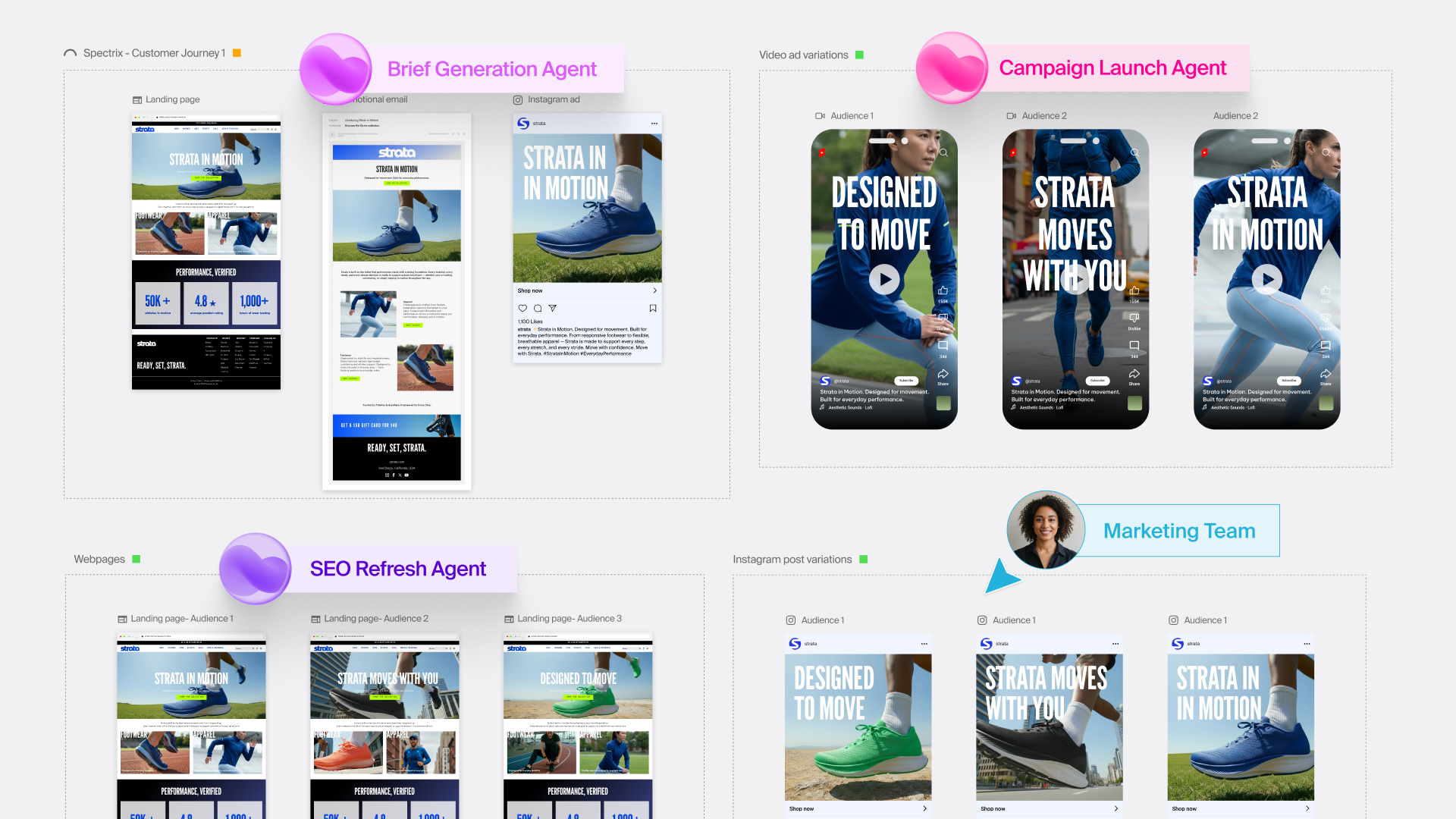
Typeface’s Arc Agents help your team coordinate multi-channel campaigns grounded in your audience data and brand style. Instead of relying on point solutions that create friction, you can run personalized campaigns from a single platform. Feed campaign performance back to agents and results keep improving.
Customer story:
A Fortune 500 company brought paid, web, and email campaigns under one workflow to coordinate messaging across channels. They went from manually creating audience variants from scratch every time to generating them with creative consistency intact.
How do you make a business case for AI transformation in marketing?
Connect what the technology is capable of to outcomes that are important to your organization. Where does AI close your biggest gaps and what is closing them worth? Those are the opportunities executives will say yes to.
Example business use cases for AI transformation in marketing:
Deliver a unified customer experience across touchpoints
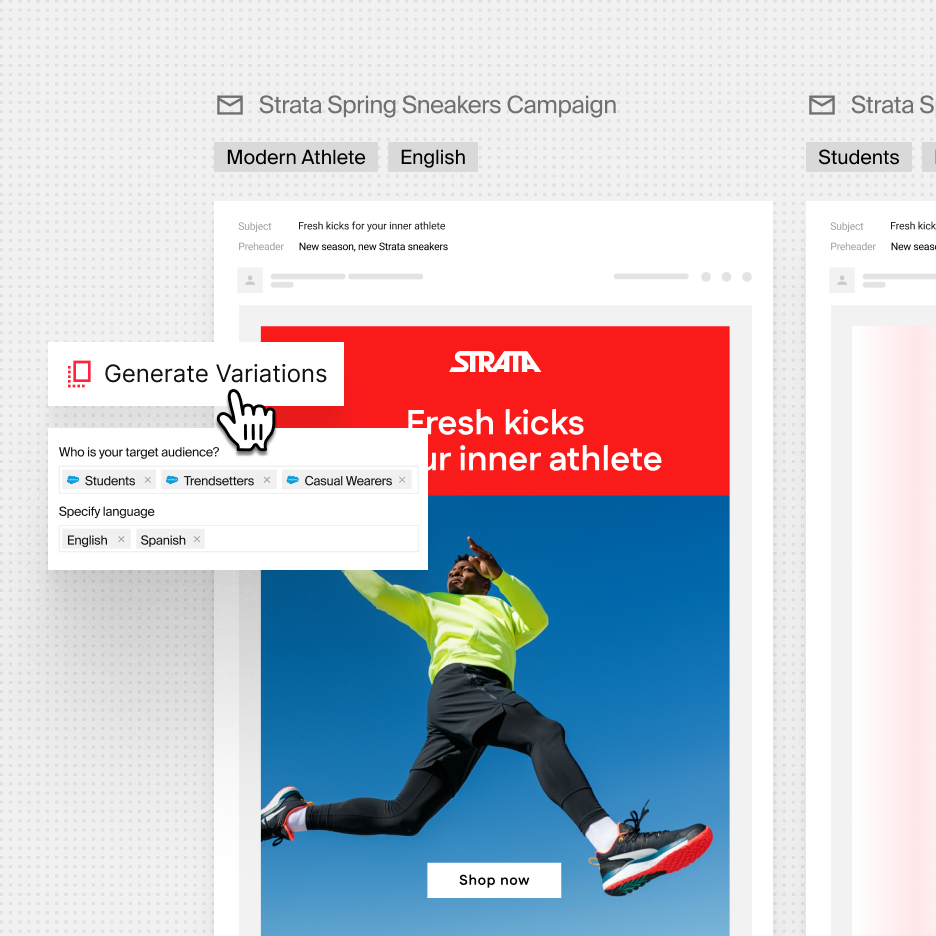
Deepen personalization across cohorts and expand personalization to new, high-potential segments
Free up time for work that differentiates your brand
Build custom agents for specialized marketing needs
Where does an AI marketing roadmap come in?
An AI marketing roadmap maps out how AI will make its way across your organization, making implementation both strategic and systematic. It sets expectations for executives to lead AI change management, and gives employees the knowledge and training support needed to make AI work for their team.
Bottom line: Make a case for outcomes, not technology. Identify early use cases and create a roadmap that aligns with goals.
How do you build an AI transformation roadmap for marketing?
Define a phased approach to moving from manual content creation to AI-powered workflows. These are the key steps to roll out AI across your organization:
1. Explore workflows with AI
Start by identifying which workflows should belong to AI and which ones should stay with your team. For example, AI agents are better suited to tactical execution, especially for repeatable and time-consuming tasks. Deeply strategic tasks should remain in the human domain.
Pull together the core members for your AI transformation rollout. The CMO identifies the strategic need for AI and makes the business case. The content director maps workflows and assesses tools. IT covers tool integrations and data governance. Creatives and writers experiment and iterate.
2. Implement AI agents
AI agents can enter your existing content workflows by connecting to your marketing stack, and use your latest brand intelligence to generate effective campaigns.
And, you can build AI agents without knowing how to code. Since an AI agent follows a series of predefined steps, you can define what happens at each step (through prompting or markdown), and then add the required tool connections via APIs or an MCP to create an orchestrated workflow. You give the agent instructions, then you give it the tools it needs to execute those instructions. Replicate that to build systems that continuously work alongside you.
Caveat: As you extend AI to more areas, the importance of getting compliance right becomes clearer. These steps keep you ahead of it:
Ensure your AI marketing platform has built-in controls for responsible AI use
Conduct an audit of your internal data sources and find the most suitables ones for your use cases
Centralize your brand intelligence for compliant AI outputs
Establish a review process for AI outputs
Maintain an audit trail of workflows for accountability
How it works in Typeface:
A comprehensive safety and trust framework ensures that your content reflects the integrity your brand stands for.
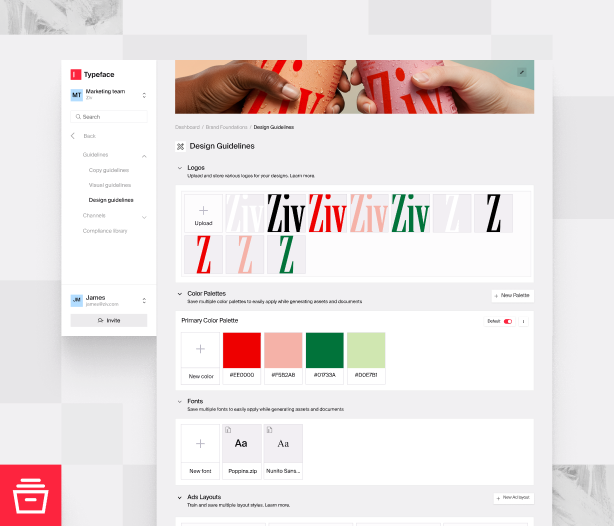
Brand intelligence system Arc Graph keeps messaging compliant and consistent across channels.
Marketing and legal reviews integrate into your content creation environment. Audit trails maintain brand and legal compliance.
3. Measure outcomes
It’s no surprise that early wins with AI show up as productivity gains. Your creatives may be able to take on more design work while your writers double blog output.
Then, the strategic wins begin to surface.
Because your team A/B tested emails across every segment for an upcoming webinar, attendance spiked to 60%. That sort of thing.
Of course, no AI rollout is without its challenges. Many are easily solvable and don’t keep teams from using the platform for more use cases. Vendors help clear the bigger blockers when they come up.
Over months and up to a year, you’ll start seeing marketing AI transformation ROI emerge, compounding as you optimize campaigns based on real-time performance signals.
Bottom line: AI transformation is a cross-functional effort with teams leading governance and output improvements. Early milestones are operational; business impact takes longer.
Orchestrate marketing campaigns with Typeface
Enterprise marketing is already surpassing point solutions, with teams using AI agents to orchestrate whole campaigns. As AI agents evolve, they’re likely to help with higher-ROI use cases like 1:1 personalization and real-time campaign optimization.
As a powerful marketing orchestration engine, Typeface solves the biggest problems facing enterprise marketing teams. Hit the ground running with our channel specialists or build custom agents for your most complex workflows.
Explore Typeface with a demo or contact sales.
FAQs
How long does AI transformation take for an enterprise marketing team?
AI transformation has no universal timeline because rollout and measurable results take months, and transformation can take up to a year. You’ll know you’re on the right track when you hit or exceed your success metrics and keep expanding to new use cases.
What is the difference between AI transformation and using AI tools?
Using AI tools means your team has access to generative AI for writing and image creation. While point solutions get the work done, they often result in tool-hopping, inconsistent outputs, and data privacy risks, which you can't afford to take lightly.
An AI marketing transformation strategy replaces individual tools with a multimodal platform that turns existing workflows into repeatable systems delivering quality, brand-compliant outputs. It prioritizes governance and responsible use to protect brand integrity.
Will AI transformation replace my marketing team?
No, because AI needs human managers. The marketing teams using AI effectively draw clear lines between what AI must do and what remains with them. They treat AI as an enabler for what they can achieve, not as a replacement they can offload tasks to.
How do you measure ROI from AI marketing transformation?
Transformation is an ongoing process that’s working if you hit success metrics consistently and the business outcomes you set to achieve start to show. Key metrics to track include production volume, cost per asset, sentiment score, and conversion rate improvement.
What marketing workflows should I transform with AI first?
Start with higher-volume, lower brand risk tasks that already have a repeatable process. Resizing ads to different platforms, repurposing content, and creating informational blogs are some early use cases to explore.
What are some areas where AI can genuinely help marketing teams?
Surveys show that personalization is among the top use cases of AI in marketing. Content repurposing is another high-impact area given how consumers use multiple platforms and cross-channel brand sentiment influences AI search performance. A/B testing is another area where AI directly helps improve campaign performance across channels.
Related articles

December 18, 2025
You've bought the AI tool. Your exec team is excited about the ROI projections. But three months in, adoption is stuck at 30%, and the creatives on your team are quietly finding workarounds to avoid u

September 10, 2025
When AI tools are introduced in an organization, the ripple effects extend far beyond simple workflow adjustments. Team members may feel anxious about the pace of change, creative autonomy, and also j

July 16, 2025
Picture this: You just invested six figures in a marketing AI platform. The tech is cutting-edge, the potential is obvious, and your team is eager to start creating better content faster. Three months