September 23, 2026
What Is Brand Intelligence? A Guide for Enterprise Marketers

Neelam Goswami
Senior Content Marketing Associate

AI summary
Brand intelligence connects signals like sentiment, share of voice, and message consistency into one view your team can act on. Here's what it is, how it works, and why it matters now.
Your brand doesn't live in one place anymore. It lives everywhere, all at once, and most of it is outside your direct control.
Right now, somewhere on the internet, an AI assistant is summarizing your company for a potential buyer. It's pulling from whatever it indexed — your website, some analyst coverage, a two-year-old G2 review, maybe a competitor's comparison page. The summary might be accurate. It might not be.
If you lead marketing at an enterprise, the core challenge — monitoring your brand across channels — isn't new. What is new is the speed. AI search has made the gap between what your brand says and what the market hears wider, and faster-moving, than it's ever been. Manual audits and quarterly brand reviews can't keep pace with a content environment that refreshes daily.
Brand intelligence is how you keep up. It's the practice of continuously collecting and analyzing data about how your brand shows up across channels like social, search, AI assistants, review sites, your own content, and pulling signals like sentiment, share of voice, message consistency, and creative performance into one place your team can act on.
This post covers what brand intelligence is, why it matters right now, what a real workflow looks like, what to look for in tools, and how Typeface works as the execution layer that turns brand intelligence insights into on-brand content and campaigns.
TL;DR — Key Takeaways
Brand intelligence ≠ brand monitoring. Monitoring tells you what's being said. Brand intelligence connects those signals to what your team should do next.
It covers three core dimensions: visibility (are you showing up?), consistency (does it sound like you?), and sentiment (what are people and AI engines saying?).
AI content velocity makes brand intelligence urgent. The faster your teams put out content, the harder it is to catch brand drift manually.
Brand intelligence isn't just for social. It also covers how your brand appears in AI-generated search results — a channel many companies aren't tracking yet.
Enterprise teams specifically need brand intelligence because scale amplifies inconsistency. One off-brand template multiplied across 50 markets is a real problem.
A dashboard is not a feedback loop. Brand intelligence only works when insights surface inside your content workflow. A strong marketing AI platform like Typeface pairs insights with brand context, so teams can act quickly without going off-brand.
What is brand intelligence?
Brand intelligence is a system for continuously tracking and improving how your brand shows up to the world. Unlike traditional brand tracking, which tends to be periodic, survey-based, and backward-looking, brand intelligence uses AI to process signals in real time and connect them to the decisions your content team needs to make.
How is it different from brand monitoring or social listening?
Brand monitoring and social listening tell you what's being said. Brand intelligence tells you what it means and what to do about it.
Social listening tools track mentions on social platforms. Brand monitoring tools expand that to include news, forums, and review sites. Both are useful. But they stop at the data layer — they give you a feed of signals without connecting those signals to your content strategy or your brand guidelines.
Brand intelligence goes further. It also tracks how your own content performs against your brand standards, how AI search engines describe your products, and how consistent your brand feels across different markets, content types, and contributors. It's broader in scope and more action-oriented in design.
The practical difference: A brand monitoring tool tells you that three customer reviews mentioned your product's tone felt "cold and corporate." A brand intelligence system connects that signal to the content your team is generating, flags which content likely deviates from your brand voice and audience, and surfaces that insight inside your content workflow — not just in a dashboard you check once a month.
Why has this become a priority for enterprise teams right now?
Two things changed at roughly the same time.
First, AI tools started generating marketing content at scale. Teams that used to publish 20 pieces of content a week are now publishing 200. That velocity is great for reach. But it also means brand drift happens much faster than before. The slow creep of inconsistency that happens when content is created faster than it can be reviewed can get out of hand quite quickly.
Second, AI-generated search results changed where brands actually live. When someone asks ChatGPT or Google's AI Overview about your company, they're not reading your website. They're reading a summary that an AI engine assembled from whatever it could find. You don't control that summary.
But your brand intelligence system can track it, measure how accurately it reflects your actual positioning, and give your team data to effectively update content where needed and reinforce the messaging.
Bottom line: Brand intelligence is now core infrastructure for marketing leaders who want to move from reactive reporting to proactive brand and demand strategy.
What does brand intelligence actually track?
Brand intelligence covers three dimensions. Each one is measurable, and each one connects to decisions your team makes every day.
1. Brand visibility — are you showing up where it matters?
Visibility means your brand is present and findable in the places your buyers are looking. That used to mean search rankings and share of voice in earned media. But it now also includes whether your brand appears accurately in AI-generated search results, AI summaries, and the third-party content that AI engines use to form their answers.
A visibility gap doesn't always mean an absence from search results. Sometimes it looks like your competitor showing up in AI answers when someone asks a question your product directly answers. Sometimes it looks like your brand being represented by an outdated description because the AI engine indexed a press release from three years ago.
Metrics to track:
Share of voice in AI search results
Keyword coverage
Citation frequency in third-party content
2. Brand consistency — does your content sound and look like you?
Consistency means that every piece of content your team publishes (regardless of who created it, what market it's for, or what AI tool was used) feels unmistakably like your brand.
This is where enterprise teams struggle most. When you have dozens of content contributors, regional teams, agency partners, and AI tools all producing content simultaneously, the odds of ending up with content that sounds off-brand are high. Not because people aren't trying but because the feedback loop between "this doesn't feel right" and "here's the template to fix it" is too slow.
Brand intelligence puts that feedback loop on a continuous cycle. It scores your content against your brand guidelines, flags inconsistencies, and surfaces them before they reach customers (or at least before they compound).
Metrics to track:
Brand consistency score across AI-generated content
Tone alignment by market/content type
Time to detect and correct brand drift
3. Brand sentiment — what are people actually saying about you?
Sentiment covers how your brand is perceived across all channels, and increasingly, in how AI engines characterize your company when asked about it.
Traditional sentiment analysis tells you whether mentions are positive, negative, or neutral. Brand intelligence adds to it by connecting sentiment signals to specific content or campaign decisions. If sentiment drops in a particular market after a campaign launch, a brand intelligence system may help you understand which content drove it.
AI-generated sentiment is a new category here. When an AI assistant says your product is "best for X type of customer," that's a characterization that's being served to potentially millions of buyers. Brand intelligence tracks whether those AI-generated characterizations are accurate, positive, and aligned with your actual positioning.
How does brand intelligence work in practice?
Brand intelligence is a system made up of three connected steps.
Step 1: Establish your brand baseline
Before you can track whether your brand is drifting, you need a clear definition of what "on-brand" means. That sounds obvious. But most enterprise marketing teams have brand guidelines that live in a PDF and not in the systems their content teams actually use.
A baseline for a brand intelligence program is structured, machine-readable, and continuously updated. It includes your brand voice and tone parameters, visual identity standards, approved messaging and positioning, terminology and naming conventions, and examples of content that hits the mark across different formats and markets.
In Typeface, this lives in the Arc Graph — a unified brand system that connects all your existing repositories to learn and remember everything about your brand. Both AI agents and human content creators across global teams can access your collective brand intelligence here when generating content.
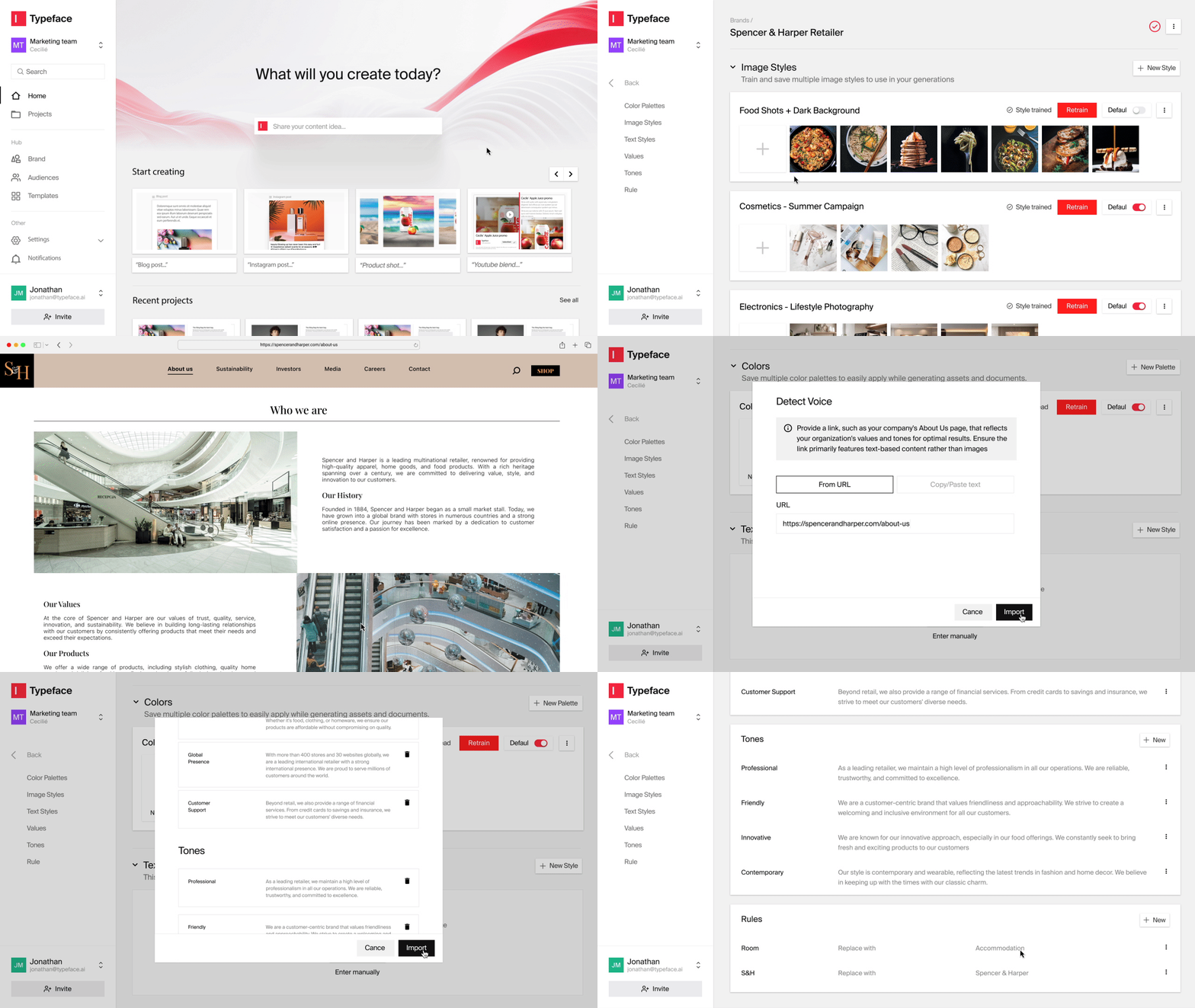
The difference between a brand guidelines PDF and a rich content graph like this is the difference between a brand that governs in theory and one that governs in practice.
Step 2: Monitor signals continuously across channels
Once you have a brand baseline, you can start measuring against it. This means pulling in data from the channels where your brand shows up: your own published content, social platforms, review sites, media coverage, and AI search results.
Continuous monitoring means this happens automatically rather than a quarterly brand audit someone runs when there's a budget for it. The intelligence layer scores incoming signals against your brand baseline, flags anomalies, and routes the right information to the right people.
Here’s a practical example.
A consumer tech company using Typeface found that the promotional emails they had been generating using AI used cold, formal language — inconsistent with their positioning as a joyful, warm and reliable brand. The Brand Agent flagged it before the next campaign went live and gave the team the insights it needed to optimize it before launch.
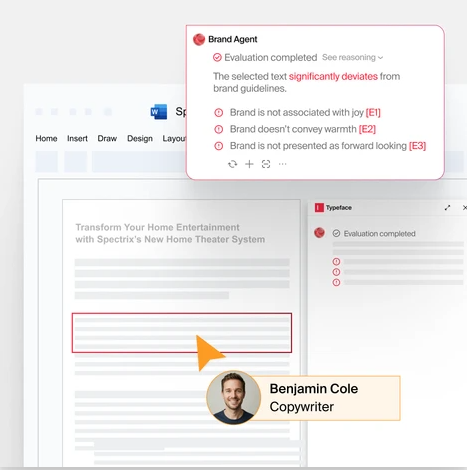
Without continuous monitoring, that copy would have run for weeks before anyone noticed.
Step 3: Feed insights back into your content workflow
This is the step most brand intelligence implementations get wrong. Data is only valuable if it informs what you do next.
Brand intelligence insights need to surface inside the tools your content team uses, and not in a separate analytics dashboard they have to remember to open.
When an AI agent flags that a draft is inconsistent with your brand voice, that flag should appear within the content creation environment rather than in a weekly report.
The feedback loop is what makes brand intelligence an operational system.
Bottom line: Brand intelligence works as a three-step system — establish a baseline, monitor continuously, and route insights back into your workflow. Each step is necessary. None of them works without the other two.
What should a brand intelligence system include?
The right brand intelligence platform fits your current stack, understands your brand, and helps your team act on insights. For most enterprise B2B teams, the best tools combine data, brand context, and AI-powered creation.
What core capabilities matter most?
Core capabilities should map to the way enterprise teams work. Look for strengths in coverage, interpretation, governance, and usability. Must-haves for many teams:
Multi-channel data coverage: Owned, paid, earned, social, reviews, and search/AI surfaces.
AI summarization and trend detection: Clear narratives, not just charts.
Brand context and governance: Guidelines, approved messaging, terminology, and asset control.
Role-based views: What a CMO needs differs from what a content lead needs.
Security and privacy: Enterprise controls, access management, and clear data handling.
Closed-loop workflow: Ability to turn insight into briefs, tests, and assets.
If possible, ask: “Can a leader answer ‘what’s happening with our brand?’ in minutes, and can the team act on it the same day?”
How should it integrate with your AI marketing workflows?
Brand intelligence should plug into the same environment where you plan, create, approve, and publish campaigns. Integration matters because:
Insights should feed directly into briefs and asset creation
Brand guidelines should automatically govern new content
Teams should be able to reuse approved assets and language
Results should flow back into the next cycle of decisions
Typeface is built around that loop. You can connect your brand knowledge in Arc Graph, use Arc Agents and Arc Fabric to create on-brand content faster, and run campaigns in Arc Spaces so execution stays coordinated.
Bottom line: Effective integration means the same AI that surfaces insights can also help create on-brand responses.
How do you evaluate partners and avoid hype?
Brand intelligence is an emerging category, which means there’s noise. A good evaluation focuses on workflows, governance, and proof. Questions to ask vendors:
Show how this changes what our team does in a given week.
How does your AI respect our brand guidelines and terminology?
What data sources can you reliably cover, and what’s excluded?
How do you handle data privacy, permissions, and retention?
How do you support multi-region or multi-brand complexity?
Run a small, time-bound pilot:
Choose one business priority
Pick a few questions
Define what success looks like (faster decisions, improved consistency, measurable lift)
Evaluate not just outputs, but adoption
How does Typeface fit into a brand intelligence strategy?
Typeface doesn’t replace your entire analytics stack; it helps you act on brand intelligence by turning insights into on-brand content, campaigns, and creative at scale. It gives AI agents a clear understanding of your brand so they create consistently across channels.
Brand intelligence answers “what’s happening?” and “what should we do next?” Typeface helps you do the “next.” That’s the difference between insight and impact.
If you’re mapping this into your broader stack, Typeface sits naturally alongside your analytics and data tools as an AI-powered enterprise marketing platform that helps teams plan and produce work faster.
How does Typeface use your brand knowledge?
Typeface uses brand knowledge to keep creation consistent, even when many teams and regions are producing content at once. The Arc Graph centralizes guidelines, messaging, and assets (visuals, docs, templates, etc.) so AI agents can follow the same standards your team expects.
When your brand knowledge is organized and accessible:
Content drafts start closer to “ready,” so reviews are faster
Regional teams don’t invent new language for the same idea
Agencies and internal teams can work from the same source of truth
You reduce the risk of off-brand content slipping into market
Brand intelligence becomes more useful here, too. Insights about what’s resonating can inform which messages and examples you standardize in Arc Graph.
How can Arc Agents support brand intelligence workflows?
Arc Agents can help teams translate insights into practical outputs across the marketing cycle. They can summarize what changed and generate first versions as well as variations of content that match your brand voice.
How can teams build a brand intelligence–driven content engine with Typeface?
A brand intelligence–driven content engine is a loop you can run again and again. It connects signals to creation, and creation back to outcomes. A simple loop many teams can adopt:
Connect signals: Bring in key performance and perception inputs.
Align in Arc Graph: Confirm the narrative, terminology, and proof points you want to lead with.
Generate campaigns: Use Arc Agents to produce on-brand assets.
Execute in Spaces: Coordinate approvals and publishing across channels.
Review results: Feed learnings back into the next cycle.
Bottom line: Typeface is the execution layer of brand intelligence—turning what you learn about your brand into consistent, on-brand content your buyers actually see.
How do you measure whether your brand intelligence program is working?
Brand intelligence data only matters if you're tracking the right things and connecting metrics to decisions.
Brand consistency score across AI-generated content
This measures how closely your AI-generated content aligns with your brand guidelines across tone, voice, terminology, and messaging. It's the most direct measure of whether your brand baseline is actually being applied.
Track this at the aggregate level (overall consistency score), by market or region (where is drift happening?), and by content type (which formats are hardest to keep on-brand?). Consistency scores tend to drop after major brand guideline updates, when new contributors are onboarded, or when new AI tools are introduced into the workflow.
Share of voice in AI search results
This measures how often your brand appears in AI-generated answers for queries relevant to your category. It's an emerging metric for Answer Engine Optimization. Most analytics tools don't track it yet but it's quickly becoming one of the most important brand visibility metrics for enterprise teams.
Tracking it requires manually querying AI search tools or working with platforms that have built this measurement in. The goal is to ensure that when your brand appears in AI search, it's characterized accurately and positively.
Time to detect and correct brand drift
This is an operational metric that measures the lag between when brand drift occurs and when your team identifies and fixes it. Before brand intelligence, that lag was often measured in weeks or months. You'd find out about a brand drift incident in a quarterly review.
With a continuous brand intelligence system, the goal is to get that detection time down to hours. A shorter detection window means less off-brand content reaches customers and less compounding damage to brand consistency over time.
What comes next
Brand intelligence is a foundational capability for any enterprise marketing team running content at AI speed. If you're already using AI tools to generate content, you need a system to make sure what those tools produce represents your brand accurately — not just the first time, but consistently, across every market, format, and channel.
Typeface is built for this. If you're thinking about how brand intelligence fits into your AI marketing stack, get a demo to explore how Typeface approaches AI-powered enterprise marketing or get in touch with us to see how teams are running AI campaigns at scale.
Frequently asked questions
How is brand intelligence different from social listening?
Social listening tracks mentions on social platforms — it tells you what people are saying. Brand intelligence is broader: it also covers how your brand appears in AI search results, how consistent your own content is across markets, and how your brand compares to competitors in third-party summaries. Social listening is one input into a brand intelligence system. You need both, but they're not the same thing.
How do I know if my brand needs a brand intelligence program?
If your team is producing content at scale across multiple markets, content types, or with AI tools you almost certainly need one. The faster you produce content, the harder it is to catch drift manually. Specific signals that you need brand intelligence:
Your brand sounds different across regions
You're not sure how AI tools like ChatGPT describe your products
Your brand guidelines exist but aren't actually being enforced in content output
If any of those hit close to home, brand intelligence is the system that fixes them.
How does brand intelligence work across multiple languages and markets?
This is where enterprise brand intelligence earns its cost. A well-built system can score content for brand consistency across languages — not just literal translation accuracy, but whether the tone, positioning, and messaging intent carry through. It can flag when a regional team's localized version of a campaign has drifted from the global brand standard in ways that a translation check wouldn't catch. The key is that your brand baseline needs to be built with multilingual and multi-market use in mind from the start, not retrofitted later.
Will brand intelligence replace my brand team?
No — and this is worth being direct about. Brand intelligence tools handle the monitoring and measurement work that would otherwise require a team of people manually auditing content around the clock. What they don't do is make judgment calls about what your brand should stand for, how to respond to a brand crisis, or what the right creative direction is. Think of it as giving your brand team real data to work from instead of gut checks and anecdotal reports. It frees up your team to do the strategic work only humans can do.
How does brand intelligence work with AI content generation?
This is where brand intelligence becomes critical. When AI tools generate content at scale, small inconsistencies in tone, terminology, or positioning compound fast. A brand intelligence system monitors AI-generated output against your brand baseline, catching drift before it reaches customers.
In Typeface, this happens through the Arc Graph and Brand Agent, which gives your AI agents an up-to-date, structured knowledge base of what your brand actually is, so every piece of content starts from a solid foundation.
What's the difference between brand intelligence and competitive intelligence?
Competitive intelligence looks outward. It tracks what your competitors are doing. Brand intelligence primarily looks at your own brand: how you show up, how consistent you are, and how you're perceived. The two overlap when you're benchmarking your brand against competitors in AI search results or tracking share of voice. Many enterprise teams use both, but brand intelligence is the foundation. You need to know your own numbers before you can meaningfully compare them to anyone else's.
Related articles

February 27, 2026
Most marketing teams face a common challenge: create hundreds of on-brand visuals every month without hiring more designers or blowing the budget on photoshoots. This is not without reason, of course.

June 17, 2026
From our conversations with clients exploring AI for marketing, two requirements consistently emerge. First, brand assets are non-negotiable — product imagery, company logos, and color palettes must
October 21, 2025
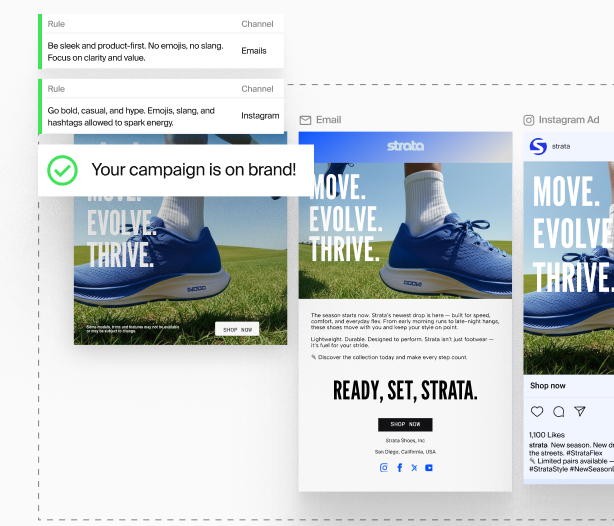
Every enterprise has brand guidelines. Most live in PDFs buried somewhere in a shared drive. These often have pages full of rules, tone guidance, and compliance requirements that no human could reason