September 23, 2026
Marketing Workflow Orchestration: The CMO's Complete Guide

Neelam Goswami
Senior Content Marketing Associate

AI summary
Discover how AI agents, automation rules, and deep integrations orchestrate your marketing workflows end-to-end, cutting time-to-launch and improving brand consistency, while boosting campaign performance.
The other day I caught up with a friend who is a content lead at a mid-size B2B company. She told me her team was gearing up for a product launch campaign, and this is how she described the process: "The brief is in Notion. The assets are in Figma. Approvals happen in email threads. And someone — usually me — is copy-pasting everything between them at 9pm the night before launch."
This doesn’t reflect an inefficient team, but rather a coordination problem that most enterprise marketing orgs have accepted as normal.
The good news is that marketing workflow orchestration can fix this. It's the coordinated use of AI agents, automation rules, and system integrations to move marketing work through your tech stack without manual handoffs. Instead of people acting as the connections between tools, AI agents carry the work and the context with them, triggering the next step automatically.
If your campaigns feel fast in a demo and frustrating in production, this is the gap you're looking at. This guide covers where orchestration fits in the marketing landscape, where your team sits on the maturity curve, what it's worth, how to structure ownership, and what to look for in a platform.
TL;DR - Key Takeaways
Marketing workflow orchestration connects your tools so work moves automatically — from brief to build to approval to publish — without manual coordination.
It's not the same as marketing automation. Automation handles isolated, rule-based tasks. Orchestration handles the connected, judgment-dependent handoffs between them.
Most enterprise teams are at Stage 2 of 4 on the maturity curve. The gap between Stage 2 and Stage 3 is where the biggest efficiency gains live.
Orchestration reduces coordination overhead without affecting creative headcount. Teams that adopt it report spending more time on strategy.
The CMO sets intent. Marketing ops owns the infrastructure. Both need to be in the room.
What is marketing workflow orchestration?
Marketing workflow orchestration is what happens when the systems in your marketing stack start working as a connected flow instead of working in silos. A brief goes in. A campaign comes out. AI agents support and accelerate your content generation process by formatting assets for the right channels, routing for approval, adapting for different markets, queuing for deployment, while humans in the loop ensure everything is on track from time to time.
Orchestration makes sure that you create better content and that content can also move through your organization reliably, at the scale and speed your business needs.
Marketing orchestration is just one of many terms that CMOs must add to their vocabulary in today's fast evolving landscape. Check out our guide on AI marketing terms for more such words that could come up often in real conversations with your team and clients.
Why is this emerging now?
Two things are at play here.
AI agents matured enough to act on context: AI does not just respond to prompts now. A modern AI agent can read a brief, apply brand rules, make decisions about what comes next, and pass work to the right system without waiting to be asked.
Enterprise marketing stacks got complex: With so many different tools, manual coordination became the primary bottleneck. The tools can generate and publish. What's missing is the layer that moves work between them.
Orchestration is that layer. And for most enterprise teams, it's where the largest untapped efficiency sits.
What does the marketing orchestration maturity curve look like?
Most enterprise marketing teams are starting somewhere in the middle. Understanding where you are is the fastest way to figure out what to focus on next.
Stage 1: Isolated workflows
Tools exist, but they don't talk to each other. Each channel team — email, paid, social, web — runs its own workflows with its own assets and its own approval process. Brand consistency depends entirely on individual judgment. Campaign launches require a project manager manually coordinating between every team.
Stage 2: Automated tasks
This is the intermediate stage where most enterprise teams sit today. Individual workflows are automated. For example, triggered emails fire on schedule, lead scores update on rule, social posts go out on a calendar. But the automation is isolated. Each tool runs its own logic with no awareness of what's happening in the channel next to it.
Stage 3: Connected campaigns
This is the first level of true orchestration. Workflows share context. A campaign brief flows from strategy into production into review into deployment through a connected system, with AI agents handling the handoffs. Brand rules travel with the work. Approvals are built into the flow rather than managed outside it. Teams can run multi-channel campaigns from a single brief without manually reformatting for every channel.
Stage 4: Fully orchestrated marketing
Performance data feeds back into creation. An underperforming ad variant informs the next generation cycle. Localization happens automatically as the campaign expands to new markets. Every new campaign starts smarter than the last because the system learns from what's run before.
This stage is where the compounding gains live. Each campaign cycle is faster and more effective than the previous one.
Which marketing workflows benefit most from orchestration?
The highest-return starting points share three characteristics:
They're repeatable
They touch multiple tools
They lose time at the handoffs rather than in the creative work itself
Three questions to identify your first orchestration candidate
Ask these about any workflow you're considering:
Can you draw the flowchart? If you can map the steps from start to finish, like who does what, in what order, in which tool, and so on, you can orchestrate it. If the process is still ad hoc, get the workflow defined first.
Where does it stall? If the answer is "waiting for approval" or "someone has to reformat it for the next tool," that's a handoff problem that orchestration solves.
How often does it run? The more frequently a workflow runs, the faster orchestration pays back. A campaign type you run monthly is a better first candidate than a one-off project.
Where enterprise teams typically start
The highest-ROI starting points are:
Campaign content production (moving from a single brief to multi-channel assets without manual reformatting)
Multi-market localization (adapting content for language or regional brand rules without building each version from scratch)
Performance creative iteration (generating new variants for underperforming assets and routing them for approval with minimal human intervention in the loop)
How orchestration could unfold in the real world
How orchestration could unfold in the real world
A B2B tech company's demand gen team was running ABM campaigns across 200 accounts. Every account required someone to manually pull the brief, adapt the messaging, get approval, and package assets for three channels.
Orchestrating that workflow, with AI agents from pulling account context to routing the generated assets for approval, __slashed the per-account production cycle from days to hours__ without adding headcount.
Who owns marketing workflow orchestration and how do you structure the team?
This is the question most orchestration projects get wrong. They start as a marketing ops initiative but stall because IT isn't aligned or stay a CMO vision that never gets infrastructure behind it. Getting ownership right from the start matters as much as getting the platform right.
The CMO vs. marketing ops split
The CMO owns intent: which campaigns run, which markets matter, what the brand should feel like at every touchpoint, and what success looks like.
Marketing ops owns infrastructure: the integrations, the workflow logic, the governance rules, and the approval gates inside the platform.
Neither can do it without the other. A CMO without marketing ops builds a vision that doesn't ship. Marketing ops without CMO sponsorship builds infrastructure no one uses.
Why IT needs a seat at the table early
Orchestration connects to your existing stack, such as your MAP, CRM, DAM, CMS, etc. That means IT needs to be in the room during vendor evaluation. They can tell you exactly how your agentic marketing platform would fit in with your current infrastructure.
The teams that implement fastest are the ones where IT scoped the integrations upfront.
What an orchestration lead does
The teams that get this right tend to create a single "orchestration lead" role between marketing strategy and ops. This person understands campaign intent well enough to configure workflows correctly and understands systems well enough to know when IT needs to be involved.
They're the one who can translate a CMO's campaign goal into a workflow spec and flag when the spec is missing something that will break at scale.
What should you look for in a marketing orchestration platform?
Most enterprise platforms can automate, but very few can orchestrate. Organizations that can orchestrate usually have:
Brand context that travels with the work. You need a central brand intelligence layer where your voice, visual rules, audience profiles, and compliance requirements live. Every agent and workflow pulls from it automatically. If brand rules have to be re-entered per workflow, the system will drift.
Agent-based handoffs. True orchestration uses AI agents that act on context, unlike trigger-based automation. When something changes mid-campaign, an agent adapts; a fixed trigger breaks.
Native approval workflows. If approval still happens in email or Slack, you haven't solved the coordination problem. The platform needs review and approval logic built into the same system where content is created.
Integration depth rather than breadth. A long list of integrations is less important than deep, reliable connections to the tools your team uses. Ask how context flows between systems instead of whether a connection exists.
Where Typeface fits in your marketing workflow orchestration initiative
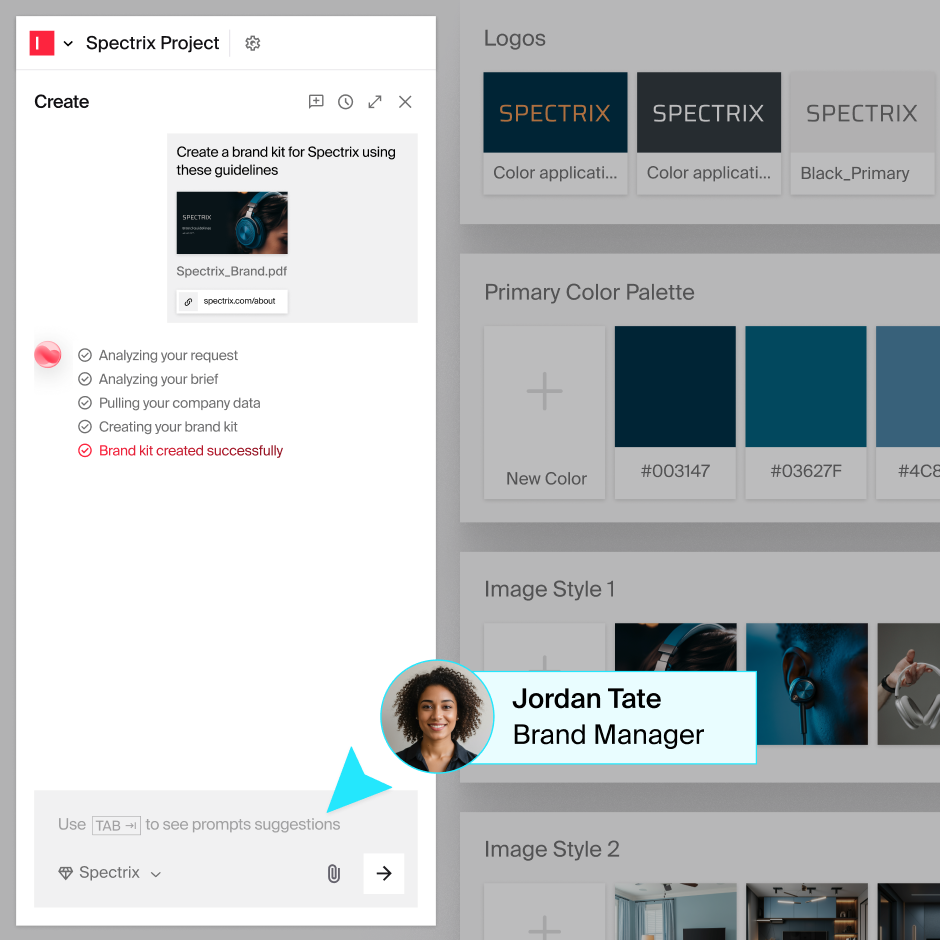
Typeface anchors orchestration in Arc Graph — a brand intelligence layer that carries your context into every workflow automatically.
Arc Agents handle channel-specific execution.
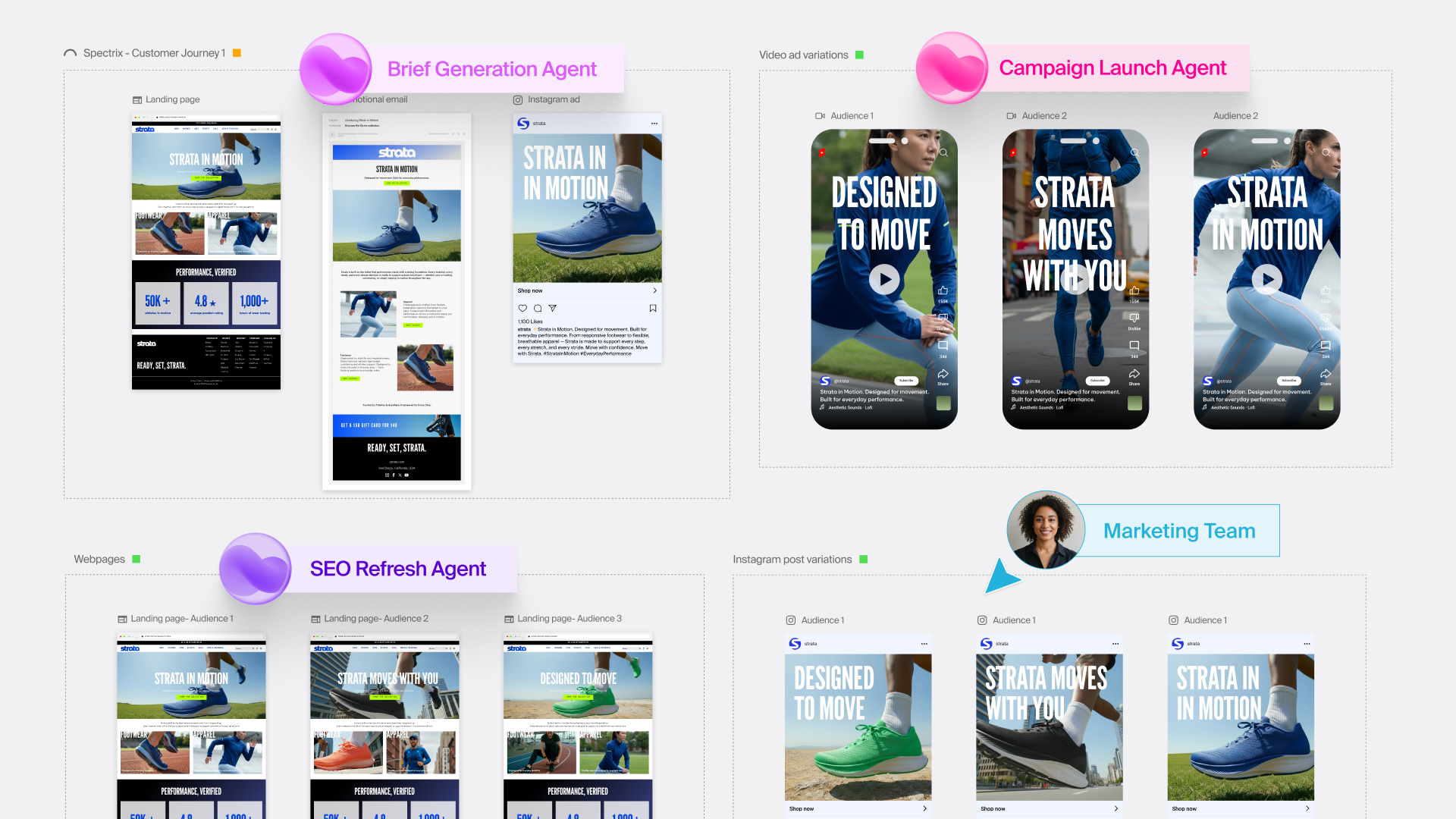
Arc Spaces gives teams a single place to review and approve.
Arc Fabric lets you build and extend workflows by creating custom agents, without rebuilding your existing stack.
For the step-by-step setup guide on how you can orchestrate your workflows with Typeface, check out this article: How to Orchestrate AI Agents Across Marketing Channels.
How do you measure the ROI of marketing workflow orchestration?
The teams that build the strongest business cases for orchestration measure three things: coordination cost reduction; brand consistency improvement; and campaign cycle acceleration. They also establish a baseline before they start.
Metrics that can prove marketing workflow orchestration ROI
Time-to-launch is the most visible metric. That is calendar time from approved brief to live campaign. Pair it with coordination hours per campaign (actual human time spent on handoffs, reformatting, and approval chasing), because that's where the real cost reduction shows up in headcount productivity.
Brand consistency rate is the percentage of assets that pass brand review without manual correction. This could be harder to track (but worth it). Every asset that comes back for revision is a hidden cost that coordination overhead creates.
Campaign cycle time (how quickly you can move from performance data to new creative) is the metric that compounds. Teams that can run a creative iteration cycle in 48 hours instead of 2 weeks run more experiments per quarter. Those experiments build lasting performance advantages.
How to build a baseline before you start
Before implementing, spend two weeks tracking your most common campaign type:
How long does it take from brief to launch?
How many handoffs does it involve?
How many assets come back for revision?
How many hours per week does your team spend on coordination versus creative work?
These numbers are your before state. Without them, you can't demonstrate ROI or prioritize which workflow to orchestrate first.
Pro tip: Don’t think of the ROI of orchestration as only speed. It's the compounding value of running more campaigns, more accurately, with the same team and being able to prove it.
Ready to see how Typeface orchestrates your marketing workflows? Get a demo or get in touch with our sales team today.
Frequently asked questions
How is marketing workflow orchestration different from marketing automation?
Automation handles isolated, rule-based tasks — send this email when someone clicks that link, update this score when a form is submitted. It works but has no awareness of other channels or workflows. Orchestration connects those isolated workflows into a system where every handoff is intentional and every channel runs from the same campaign logic. For the full breakdown, see Marketing Orchestration vs. Marketing Automation.
What are the four structural gaps that orchestration is designed to close?
Most enterprise teams hit the same four walls: fragmented orchestration (campaigns still move through manual approvals and coordination), disconnected knowledge (brand rules and audience context aren't part of the creation process), inconsistent quality evaluation (no shared standard for reviewing output), and an insights gap (performance data never feeds back into the next campaign). For a deeper look at how each shows up in practice, see this post: What Marketing Orchestration Really Means for Modern Campaigns.
Will orchestration replace our marketing team?
No. Orchestration handles coordination tasks that pull your team away from the work they're actually good at, such as reformatting assets, chasing approvals, routing briefs between systems. When AI agents handle those handoffs, your team gets that time back. Most teams report spending more time on strategy.
Orchestration removes the operational drag. The work your best people shouldn't be doing anyway.
What's the difference between an AI agent and a traditional marketing automation rule?
A rule fires when a fixed condition is met. For example, someone fills out a form or a score crosses a threshold. It doesn't understand context and can't adapt if something changes. An AI agent acts on meaning: it reads a brief, applies brand rules, decides what comes next, and hands work to the right system, even when the input isn't exactly what the workflow expected. The practical difference shows up at the edges.
A rule breaks when the input changes. An agent figures it out. Bottom line: rules handle predictable inputs; agents handle the real world.
How long does it take to see results?
Most enterprise teams get a first orchestrated workflow running in four to eight weeks. The fastest implementations start with one clearly mapped workflow and get it running end-to-end before scaling. The longest part is usually cleaning up the workflow definition, not configuring the platform.
Do I need to replace my existing marketing stack?
No. Orchestration layers on top of your existing tools — MAP, CRM, DAM, CMS — through APIs and integrations. The goal is a coordination layer, not a replacement. The most important prerequisite is a clean brand context layer every agent can pull from, and one clearly mapped workflow to start with.
Related articles

June 24, 2026
CMOs already laying the groundwork for agentic AI are asking: how do we show impact, and where do we go from here? Those in the wait-and-watch camp are facing pointed questions: what does this mean fo

June 24, 2026
AI campaign orchestration connects your marketing tools through AI agents that move through entire workflows, without manual handoffs. Instead of your team acting as the glue between systems, AI agen

June 15, 2026
AI has sped up a lot of the foundational work in marketing: planning, ideation, content production, SEO and keyword research, among other things. Most teams have that part down by now. What hasn't cha