

AI summary
The conversation around AI has shifted from point tools to connected workflows. As that reality takes shape, here are five predictions CMOs should have a view on:
- •Where AI takes over routine execution and what that means for team structure
- •How agentic workflows change the economics of content production
- •Why brand governance needs to become proactive, not reactive
- •What it takes to make personalization work at scale
- •How to build measurement frameworks that capture AI's full impact
CMOs already laying the groundwork for agentic AI are asking: how do we show impact, and where do we go from here? Those in the wait-and-watch camp are facing pointed questions: what does this mean for our business, and what structural changes does it require?
Both camps planning their next move can benefit from knowing what’s next for agentic AI, and how to get it right, from brand governance to AI ROI measurement.
These agentic AI predictions are a good place to start.
Prediction #1: AI agents will own routine campaign execution
Most enterprises will have AI agents handling the full production cycle, from brief to optimization. Strategists define the brief and agents run it. Human evaluations check on outputs before they enter the market. Performance data feeds back to agents to improve successive campaigns (and business outcomes).
Example: An agent launches an ad campaign, monitors click-through rates, and generates new variants based on this data, lifting performance by 20%.
What does this mean for team structure and marketing headcount?
Team structure stays the same. What changes is where your team’s time goes.
Rather than focusing on the middle of the process (content generation), they’ll split most of their time across the beginning and end — building a strategic approach, and refining the outputs based on their taste and experience before going to market.
As for headcount, there’s no question that smaller teams can get more done with AI. But the question worth answering is what you need people for. And the answer hasn’t changed: Your team sets the bar for AI and keeps campaigns consistently on target.
Which campaign types will agents take over first?
Generally, repeatable workflows with defined inputs and predictable outputs are the first to go to AI. This could be personalizing a B2B email to seven personas across the customer journey or location-specific pages for specific cities or neighborhoods. If your team can write a checklist for how to do it, AI can probably run it.
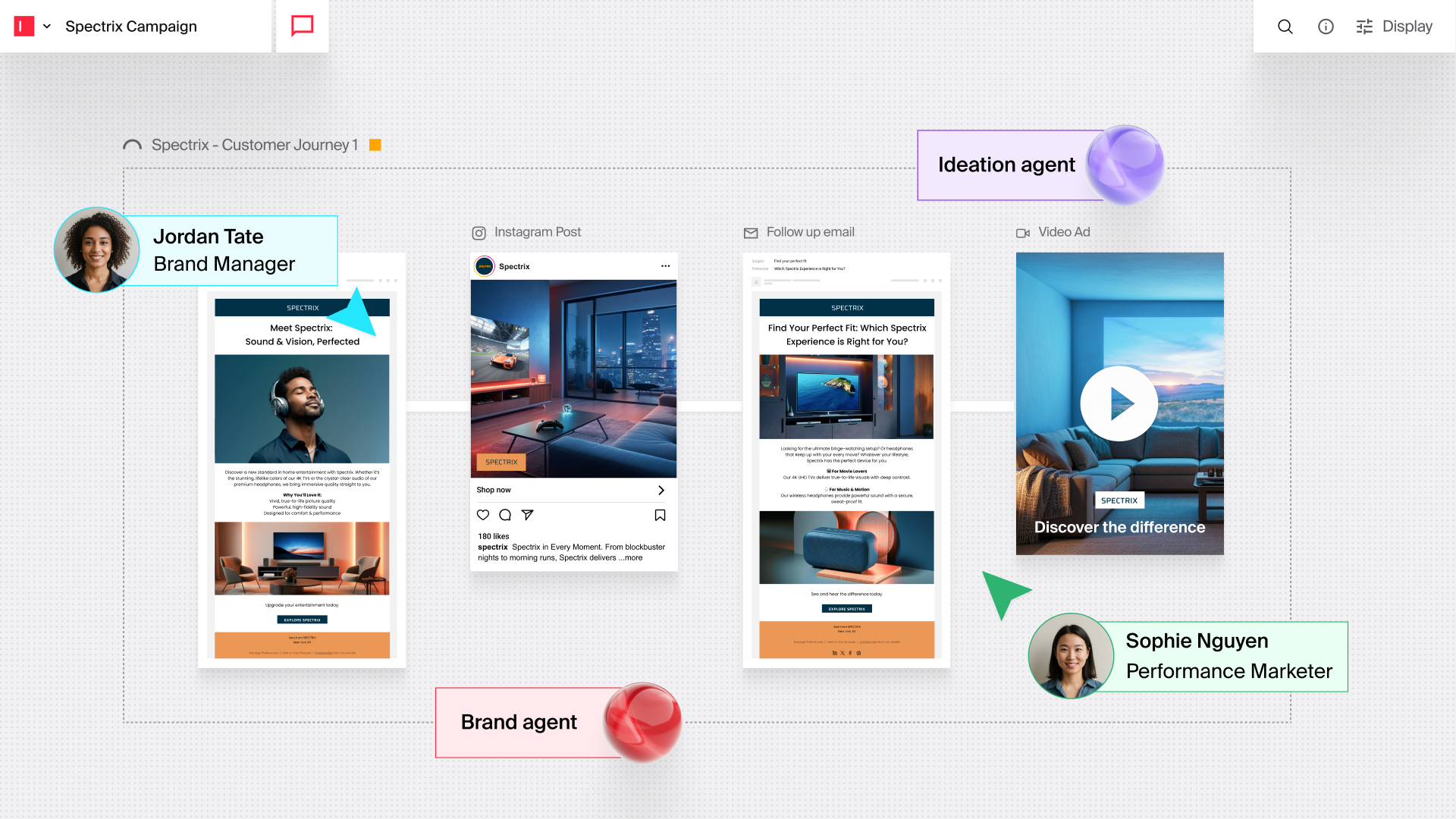
Prediction #2: AI will execute entire content workflows
AI can support every stage of content creation, across research, drafting, editing, and optimization. It can also take on new steps as they enter the workflow, like analyzing blogs for AEO, adapting a video into multiple aspect ratios, or converting long-form content into platform-specific formats like X threads and LinkedIn posts.
AI’s value boost is at the workflow-level
AI can speed up individual tasks, but the real unlock is when it executes entire workflows. The reason is that every handoff from AI to human adds friction and chips away at efficiency. The right balance is AI coordinating tasks end to end, with human review checkpoints where they’re necessary.
Agentic workflows are here
Agentic workflows are uniquely suited to the breadth of enterprise marketing operations. Teams can boost operational readiness, reduce production costs, and make more space for creativity and strategy.
In Typeface, marketing, IT, and creative teams work in a single platform that spans the full content lifecycle, from strategy through creation to activation. We call it marketing orchestration. AI grounds its outputs in your brand intelligence: voice, visual identity, and campaign briefs. Every team connects their preferred tools to Typeface, keeping work coordinated in one place.
Content marketers' skills remain valued and irreplaceable
The flip side of AI democratizing content creation is that it can just as easily produce commodified content or content that lacks strategic intent. Commodified content is a known risk. The subtler risk is when no one asks the right questions: For which queries does accuracy matter more than originality? Who exactly is the audience, and how should we be speaking to them? What can this content say that hasn't already been said?
Deciding what content should do and whether it's doing it requires judgment, knowledge, and experience. That's a uniquely human call only content marketers can make.
Prediction #3: Brand governance will become a real-time AI function
Content reviews after the fact are slow and reactive, especially when you’re managing hundreds of assets across multiple campaigns. With AI, brand governance becomes proactive, even happening in real time.
Real-time brand governance enforces brand rules at the point of creation, while automated reviews of completed drafts and published content help ensure compliance with brand and regulatory standards. Your teams focus judgment where it’s needed most and move faster through every approval cycle.
How real-time brand governance works in practice, with Typeface
Brand governance creates a system of guardrails and automated checks that uphold brand standards, addressing the consistency and safety risks most often cited when creating content with AI.
Here’s how it works in Typeface.
Arc Graph, the brand system behind on-brand, personalized content:
Arc Graph is a brand intelligence engine that connects to your existing repositories (DAM, CMS, and knowledge bases) to learn everything about your brand. Your teams and AI agents draw from this shared intelligence to work in context and produce more accurate content. What your brand system contains:
Copy guidelines (brand voice, positioning, style and formatting)
Channel-specific voice tones and author voices (e.g., a blog voice, an Instagram voice, your CMO’s voice)
Design guidelines (logos, color palettes, fonts, and email, ad, web, and push notification layouts)
Image guidelines (various image styles you train AI on)
Compliance documents specifying required words, spammy terms, misleading claims, and more
Assets (images, videos, and documents)
Audiences (demographics and interests of each segment)
Campaign performance data
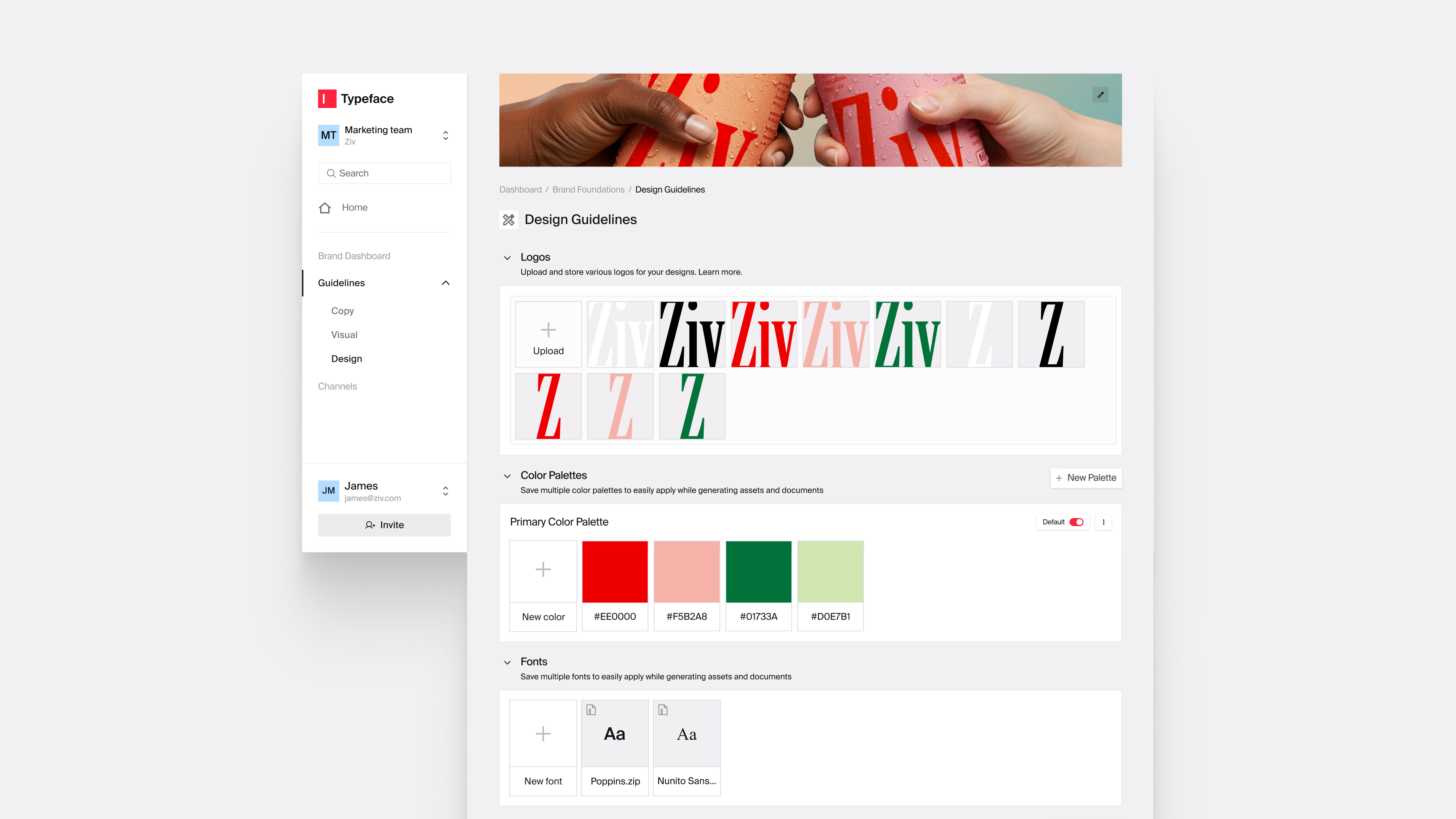
Brand Agent, the AI reviewer catching brand drift early:
Fluent in your brand, this is the agent you summon to evaluate your drafts for brand alignment. It flags inconsistencies and suggests fixes — assets are handed off to the next reviewer with brand checks in place.
54% of CMOs cite brand voice drift from untuned models as a top governance risk.
How do you audit your current brand infrastructure?
Most brands find their biggest gaps in public-facing content, which is often challenging to keep cohesive across touchpoints. AI can help, but its outputs are only as good as the brand data behind it.
Auditing your website, social media, and newsletters, and layering in findings from AI searches and customer feedback, tells you what to act on. You might need to update outdated messaging, consolidate visual guidelines, or describe what you do more clearly.
With this in place, you’re prepared to create a brand governance system when AI enters your workflows.
Prediction #4: Personalization will move from segments to individuals
Agentic AI makes 1:1 personalization feasible across segments. Agents already align content to audience segments, but as performance data flows in, they keep learning what resonates and personalize down to the micro-segment level. This requires a closed-loop feedback system where performance and engagement signals flow back continuously into how agents personalize content.
How does 1:1 personalization work in practice with AI agents?
AI agents use zero-party and first-party data to create relevant experiences for individual users. Unify customer data from your systems and create complete customer profiles in your AI marketing platform for 1:1 personalization.
What data does an AI agent need to personalize effectively?
AI agents may use demographic data, transactional data, and behavioral data for personalization. They evaluate engagement data and customer feedback to evolve their understanding of user intent and preferences.
How do marketing teams maintain quality control when personalization scales?
As personalization expands, a governance system becomes essential (see Prediction #3 above). In such a system, your brand guardrails — including audience profiles — are enforced during creation, controlling variability and focusing team oversight where risk is highest.
Automated personalization checks also help. In Typeface, Content Explainability scores content against your defined audience segments, helping you bring it into closer alignment as needed.
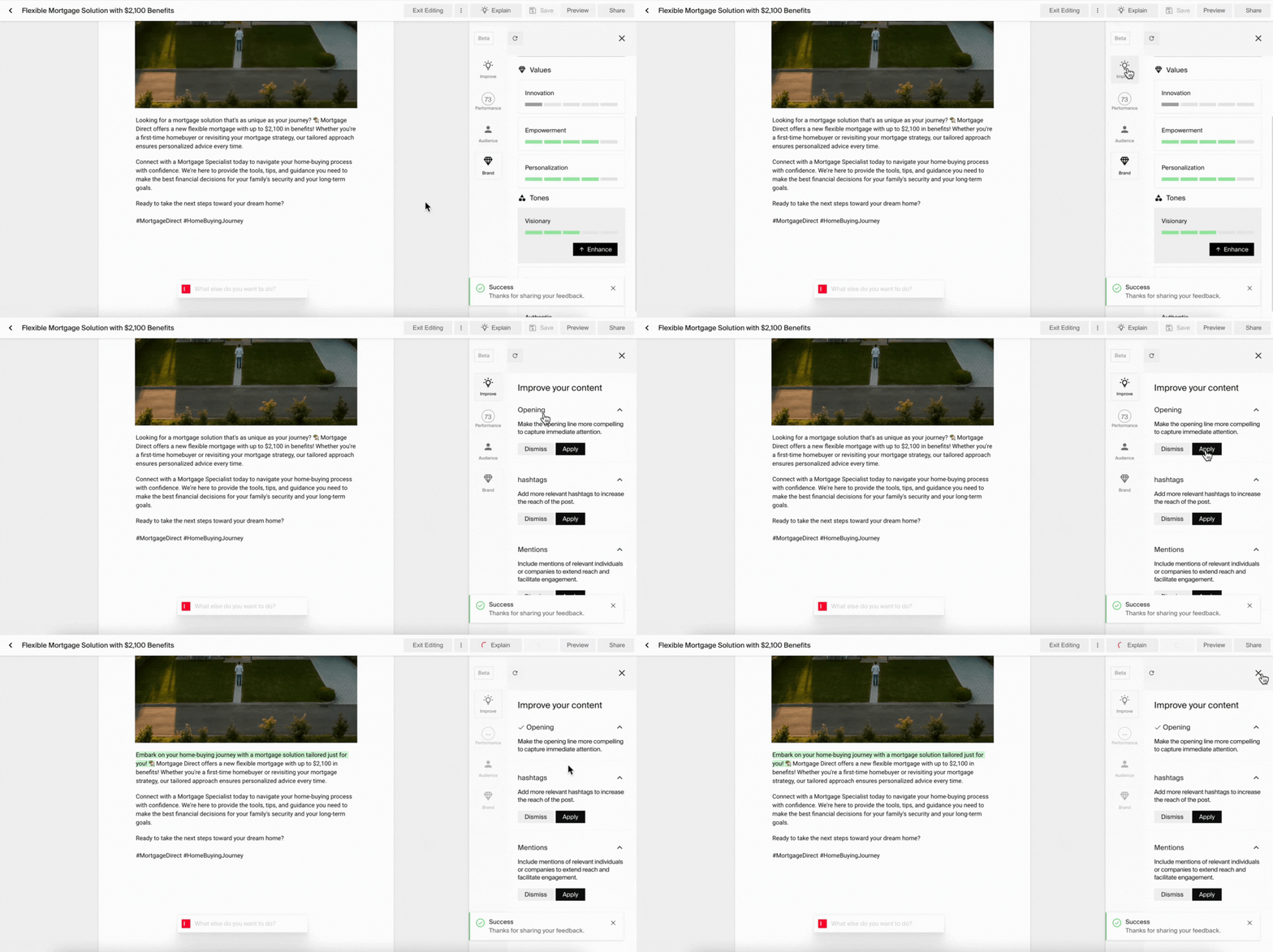
Prediction #5: CMOs will build new systems to measure AI’s impact
AI’s impact can be visible or silent. An increase in the number of personalized assets or content refreshes per week is plain to see. Whether those efforts improved marketing performance is harder to measure. To get a better picture of AI marketing ROI, CMOs are adding new metrics and building measurement frameworks.
How can CMOs get a clear view of AI’s impact?
By using metrics and systems that prove evidence of AI’s influence. Concretely, that means:
Unify performance data
Your CRM, analytics, and marketing platforms each capture a different part of the customer journey. When you consolidate data from these systems, you understand AI's influence through the funnel. For example, a rise in impressions and branded search followed by growth in direct traffic and conversions can point to AI's role, even when there’s no clear referral path.
Focus on correlation
Look at what shifted after AI activity. Did search performance improve following a period of multichannel campaigns? Did webinar sign-ups and product trials increase after email variant testing? Such consistent patterns build the case for AI's impact, even where direct attribution falls short.
Include signal-based metrics
Use a mix of quantifiable and signal-based KPIs to build a fuller picture of AI's impact. The goal is to capture both visible and upstream performance signals to make decisions that compound performance over time.
These are some examples of AI ROI metrics to track:
Operational metrics: Creative throughput (more assets tested and launched), time-to-market (faster from brief to publish), and iteration cycles (from linear funnels to continuous feedback loops)
Business metrics: Pipeline velocity (AI-driven enablement moves deals faster), conversion efficiency (higher quality of interactions across the funnel), and customer lifetime value (micro-segment personalization that increases retention over time).
Directional signals: Citations in AI answer engines, branded search lift, and engagement depth (time on page, scroll depth, click-through depth).
Measure impact over time
AI's impact becomes clearer over the medium term, generally a year or so after adoption. By then, workflows will have stabilized and content strategy will have had time to show up in traffic and conversion data.
AI ROI is real
AI ROI is real
61% of marketing leaders report ROI from AI investments
- Typeface Signal Report: The AI Speed Paradox
Go agentic with Typeface
Typeface drives autonomous campaign execution with accountability built in. Your team stays in control, with explainability, real-time brand checks, and enterprise-grade security providing the confidence to run entire campaigns and grow AI usage.
Take your marketing strategy further with Typeface. Get a demo or contact sales.
Related articles

June 15, 2026
AI has sped up a lot of the foundational work in marketing: planning, ideation, content production, SEO and keyword research, among other things. Most teams have that part down by now. What hasn't cha

June 5, 2026
AI agents are reshaping what it means to lead marketing at an enterprise. They automate tasks, compress timelines, remove bottlenecks between strategy and execution, and shift where your attention as
June 2, 2026
Welcome back to Feature Focus! Following our recent launch of new creative team solutions and native Figma integration, May's updates keep the momentum going. This month's focus: less manual work, fe