April 23, 2026
What Marketing Orchestration Really Means for Modern Campaigns

Arshkrit Chowdhury
Sr. Product Marketing Manager

AI summary
Drawing on Typeface's Signal Report and insights from President of R&D Vishal Sood, this blog unpacks four structural gaps holding marketing teams back: fragmented orchestration, disconnected business context, inconsistent quality evaluation, and performance data that never feeds back into creation.
The fix is the Marketing Orchestration Engine, a system that connects knowledge, workflows, approvals, and performance data across the full campaign lifecycle. You'll see how Arc Graph, Arc Agents, Arc Spaces, and Arc Fabric each close those gaps, plus real results from Fortune 100 and 500 companies that slashed campaign launch times from weeks to hours.
Last month, we shared that Typeface has evolved into a Marketing Orchestration Engine. That raised an important question: what does this evolution mean in practice for modern marketing teams?
The answer begins with a shift that most enterprise teams are already experiencing.
Campaign Orchestration Has Not Caught up with the Pace of Content Creation
Enterprise teams are no longer blocked by whether AI can generate content. They are blocked by whether they can turn that content into real campaigns across channels, teams, approvals, and systems.
Typeface’s research shows the gap clearly: 95% of marketing leaders report rising content demand, but only 14% feel completely confident they can keep pace.
As Vishal Sood, our President of R&D, describes it, the bottleneck has shifted. The real constraint is whether content can move through the organization.
Over the past few years, many teams have done the early work well. They ran pilots, tested guardrails, and built confidence around compliance and governance. What is still missing is the infrastructure required to make generated content usable at an enterprise scale. That is why AI can feel powerful in a demo and frustrating in production.
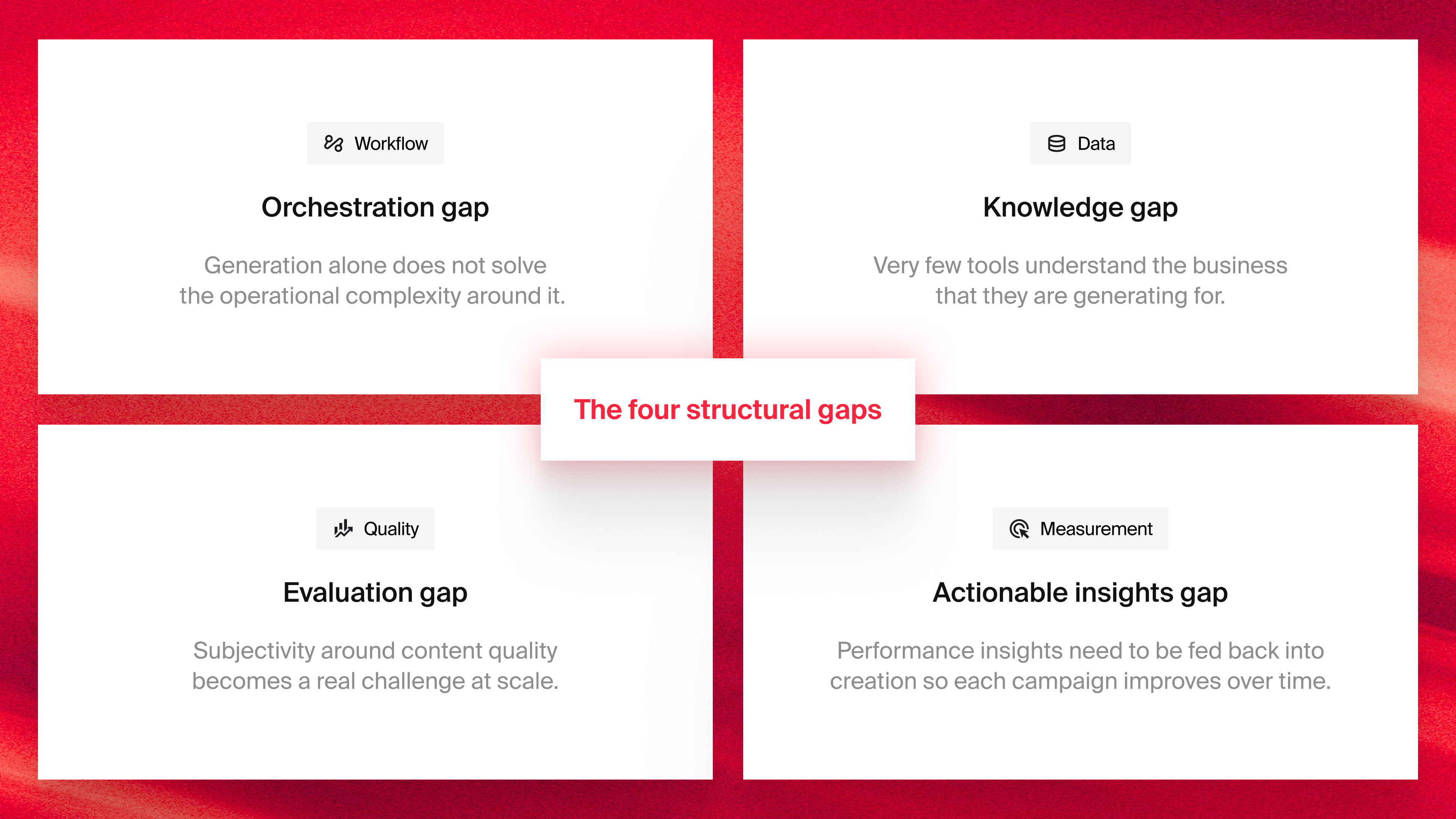
This challenge goes beyond technology. It comes down to how people, processes, and systems come together to move work forward. As Vishal frames it, this breakdown shows up in four structural gaps.
Bottlenecks to Enterprise-Scale AI Marketing
The limits of today’s generation-first approach show up in these gaps:
Orchestration gap: AI speeds up the first draft, but campaigns still move through approvals, governance, localization, channel formatting, and coordination. Marketing is a system of connected steps, and that system remains fragmented.
Knowledge gap: Most tools can generate content. Very few solutions generate from the full business context. Brand voice, product details, audience nuance, channel requirements, and regulatory constraints are often disconnected from the creation process.
Quality evaluation gap: Quality is subjective, especially at scale. Without shared standards and consistent review systems, maintaining quality across hundreds of assets becomes difficult.
Insights gap: Performance data rarely feeds back into creation in a meaningful way. Teams produce more content, but learning does not scale with it.
Solving the Gaps with a Marketing Orchestration Engine
Enterprise marketing now needs a system of execution that connects work across the full lifecycle.
The next wave of value lives in building a Content Operating System for marketing: one that connects knowledge, workflows, approvals, activation, and performance feedback in a single system.
That’s where Marketing Orchestration comes in. A Content OS is the architecture, and a Marketing Orchestration Engine applies that architecture to real marketing work, from the first brief through campaign launch. The Marketing Orchestration Engine brings cross-functional teams together on a shared foundation, making it easier to coordinate work from strategy through activation.
How Does This Show Up in Practice?
Grounded in real business context: Enterprise marketing teams constantly recreate context from scratch for every campaign, resulting in significant wasted time. The solution is a single knowledge layer that stays current across briefs, audience profiles, and brand standards. That’s what Arc Graph does: it connects performance signals, review logic, and audience and regulatory context, so teams create from live, connected information instead of outdated files. Brand Kits extend that consistency across regions, product lines, and use cases.
Multi-channel execution system: Adapting a single brief across email, ads, social, web, and video is where most campaigns lose time. Teams using Arc Agents move from a single brief to full campaign variants across email, ads, social, web, and video without the manual handoffs that slow everything down. The work shifts from producing assets to executing campaigns.
Single place to review, align, and approve: Fragmented review is one of the most expensive hidden costs in marketing. When feedback lives across emails, tools, and disconnected threads, alignment slows and quality becomes inconsistent. Arc Spaces gives teams one shared environment to compare versions, manage approvals, and move forward with clarity.
Built to fit enterprise workflows: AI only scales inside systems people actually use. Every organization has its own processes, and rebuilding them to accommodate new tools isn’t realistic. Arc Fabric lets teams define repeatable workflows, embed governance, and connect orchestration into existing systems through APIs, so scale comes without the rebuild.
From Theory to Results: Marketing Orchestration Engine In Practice
Marketing orchestration only matters if it changes how the work gets done.
When it is working, teams move faster without losing control. Campaigns come together across channels without constant rework and performance starts to feed back into how the next campaign is built. This is what that looks like in practice:
At a Fortune 100 financial services company, Typeface brought paid social, web, and email into a single workflow, reducing campaign launch time from 6 weeks to 7.5 hours. Audience variants no longer had to be rebuilt manually, and brand and regulatory guardrails were embedded directly into execution.
At a Fortune 100 insurance provider, AI-powered creative helped the team generate on-brand variations for always-on acquisition across Latin America, cutting production time from 6–8 hours to 15–30 minutes. In-market testing also reduced cost per lead by 90% versus traditional assets, while human review preserved governance and brand control.
At a Fortune 500 CPG brand, Typeface’s custom agents trained on product catalogs and retailer specs automatically transformed master PDP copy into compliant, retailer-specific versions. This cut time to shelf without adding proportional manual effort.
Across industries, the pattern is consistent. When marketing orchestration works, campaigns launch faster and that speed compounds with every cycle.
See the Marketing Orchestration Engine in action.
Related articles
September 30, 2025
Typeface surveyed more than 200 marketing leaders to get a better understanding of what’s driving their decision-making, and how their AI programs have fared so far. AI impact is already here: 53% of
March 4, 2026
Typeface has crossed a new frontier, evolving into the next generation of the Typeface Orchestration Engine — closing marketing's open loop by bringing brand context, AI agents, and real campaign perf
March 25, 2026
Welcome back to Feature Focus. This month marks Typeface’s biggest evolution yet: we’ve crossed a new frontier as a Marketing Orchestration Engine, bringing Marketing, IT, and Creative teams together