May 1, 2026
Marketing Orchestration vs Marketing Automation: What’s the Difference?

Neelam Goswami
Senior Content Marketing Associate
AI summary
Most enterprise marketing teams have automation. What they're missing is the layer that connects it. Learn how marketing orchestration works, where AI agents fit in, and how to get started without rebuilding your stack.
Marketing automation handles the tasks your team would otherwise have to do manually, on repeat, at scale. It’s useful — of course — but limited.
A CMO at a financial services company I spoke to recently had a valid concern. During a brand audit, they noticed that the tone in their email campaigns was warm and conversational. But their paid ads were formal and product-heavy. Their social content read like it was written by a third team entirely (because it was).
Their marketing automation tools helped them produce good content at scale, but to customers it felt like three different companies wearing the same logo, since the tools — and often teams — weren’t talking to each other.
Every automated workflow is usually isolated, with no awareness of what's happening in the channel next to it.
Marketing orchestration is the layer that connects those isolated workflows. So, instead of a collection of workflows running in parallel, you have a single system working toward the same goal. If automation is a set of gears, then orchestration is the engine.
This guide gives you a practical path to getting started with marketing orchestration, without rebuilding your stack from scratch.
TL;DR — Key Takeaways
Marketing automation = repeatable tasks running on rules. Marketing orchestration = connected workflows across the organization.
Most enterprise teams already have automation. Orchestration is the missing layer that makes it work together.
AI agents — like Typeface Arc Agents — handle the handoffs between systems, sitting on top of your existing tools to connect everything, from strategy to data, across the full campaign lifecycle.
You should prioritize orchestration when you manage complex campaigns across multiple brands or markets that require high-volume personalization.
What does marketing automation do — and where does it fail?
Marketing automation uses rules and triggers to run specific marketing tasks automatically, at scale, without someone pressing a button each time. Think welcome emails, retargeting sequences, lead-score updates when a contact opens a message, or social posts scheduled weeks in advance.
It's genuinely useful. Automation frees your team from the grunt work of manually executing high-volume, repeatable actions. It works well for independent workflows. But the catch is, every automation lives in its own bubble.
A prospect opens your email and clicks a LinkedIn ad within the same hour. Your email tool fires its sequence. Your paid social platform fires its sequence. Neither knows the other exists. Both send follow-ups. One's promotional, one's educational. The prospect gets two different stories about your product in the same afternoon.
That’s a coordination problem that automation alone can't fix, because automation was never designed to coordinate. It was designed to execute.
Bottom line: Automation is a proven time-saver for isolated tasks. But it was built for a world where your marketing tools are disconnected from one another. That world is disappearing fast with AI.
What is marketing orchestration and how is it different from automation?
Marketing orchestration coordinates your workflows into a unified system where every campaign, channel, and handoff is intentional. It doesn't replace your automation but it does give it more freedom. While automation handles the 'what' (send this email, update this score), orchestration handles the 'when, to whom, in what context, and in what sequence across every channel’ simultaneously. It's the difference between individual musicians playing their parts and a conductor making sure they're all playing the same song. What does orchestration coordinate?
Cross-channel timing and sequencing so email, paid, social, and web work from the same campaign logic
Content variants matched to audience segments ensuring the right message reaches the right person; not one-size-fits-all
Handoffs between systems ensures sharing context in real time
Approval workflows and team assignments so no more chasing people over Slack to green-light an asset
Automation vs. Orchestration: Side by side
Automation | Orchestration | |
Scope | A single task or workflow — one trigger, one action, one system. | An end-to-end campaign across every channel, team, and tool simultaneously. |
Trigger | Fixed rules: if X happens, do Y. Works until the rule breaks. | Context-aware and intent-driven. Adapts when campaigns or conditions change. |
Cross-channel awareness | Rarely. Each tool operates in its own bubble, with no shared context. | Yes. Every channel works from the same campaign logic and audience data. |
Brand consistency | Enforced manually — someone has to check each output against guidelines. | Built in. AI agents reference brand intelligence system so every asset follows your standards. |
Team involvement | Low for execution, high for coordination. Someone still has to connect the dots. | Strategic. Humans set intent and direction — agents handle the handoffs. |
Adaptability | Static. Change one workflow and you may break several others. | Dynamic. Workflows update in real time as campaign goals or inputs shift. |
Best for | High-volume, repeatable tasks that don't need to talk to anything else. | Complex, multi-channel campaigns where coordination is the bottleneck. |
Where do AI agents fit in?
Agents are what make modern orchestration possible. They interact with your tools and handle the handoffs that would otherwise require constant human intervention.
AI agents act on signals instead of just simple triggers. They can read a creative brief, apply your brand rules from a central repository, or pull insights from performance data to make decisions. They understand the context of the work.
In Typeface, for instance, Arc Agents pull brand intelligence from Arc Graph to generate on-brand content, route assets through approval workflows with content workflow automation, and push finished work to the right channel.
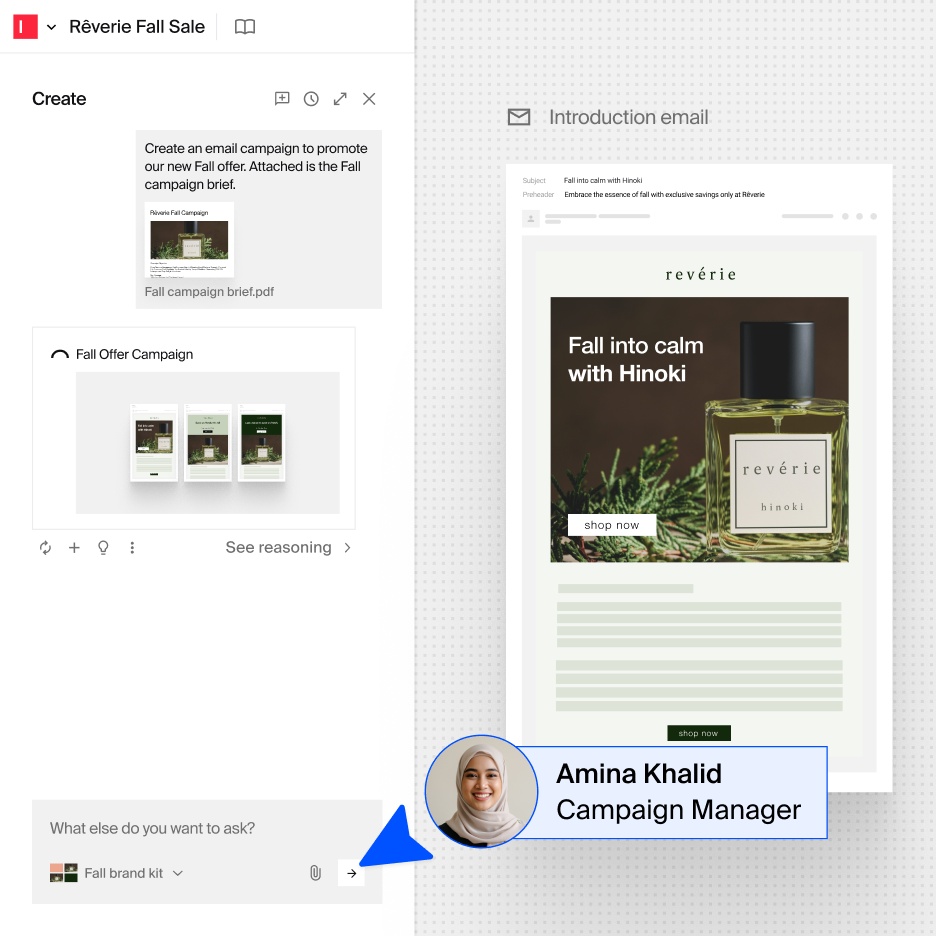
Or, lets say, the Email Agent might see that an email segment is underperforming as it doesn't align with the target audience’s interests or buying behavior. Based on this insight, it can generate a few variations with new subject lines and a new hero image within Typeface, then push these new variants into your email platform to run an A/B test.
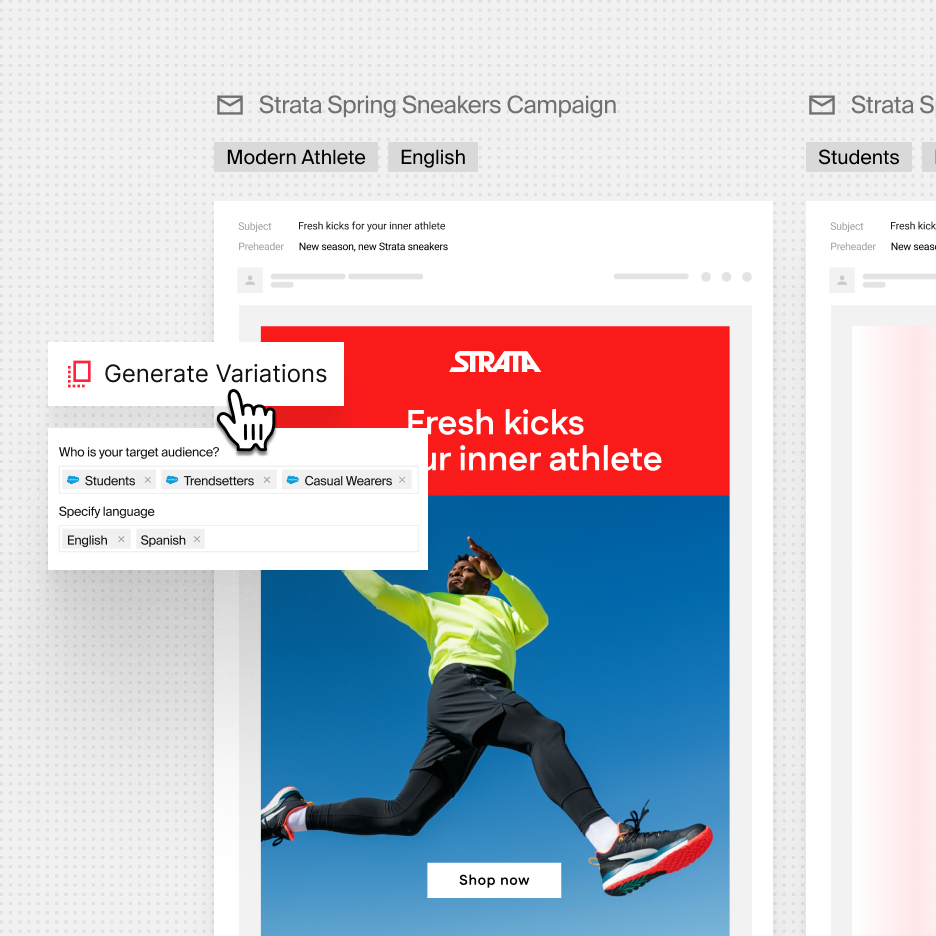
They act on the strategic intent you set, not on rigid rules, which means they adapt as campaigns evolve rather than breaking when something changes.
How do you know if your team has outgrown pure automation?
If your team runs campaigns across more than two channels and spends more time on coordination and approvals than on strategy, that's your signal. Adding more automation to a broken coordination layer doesn't fix the problem; it only creates more noise. Here are the signs that your team has hit the automation ceiling:
You manage three or more marketing tools that don't share data in real time
Campaign approvals happen over email or Slack, not inside a system
Content gets created for one channel and manually adapted for every other
You can't tell which assets are on-brand without chasing someone down
Your CMO is asking for faster time-to-market, but headcount isn't growing
How do you get started with marketing orchestration?
You don't need to replace your stack. The fastest path to orchestration starts with an audit.
Audit your handoffs. Where does work stall or get lost between tools? Map the friction points before you start fixing them.
Define your brand’s source of truth. Orchestration only works if AI agents know your brand rules. In Typeface, that lives in Arc Graph — one place your entire team and every agent references.
Start with one workflow. Pick your highest-volume, most repetitive coordination task (a product launch or a multichannel campaign) and get it running end-to-end before you scale.
Measure the right things. Track metrics like brand consistency and hours spent on coordination; not just output volume.
What does an orchestrated campaign flow look like in practice?
Let's walk through a common scenario: a new product launch across email, paid social, and your website. The process becomes a connected, intelligent flow.
Strategy: The marketing lead sets the objectives, target audience, and core messaging for the launch.
Content creation: Using this brief, an AI marketing orchestration engine like Typeface can leverage its brand intelligence system and AI agents to create a wide range of on-brand concepts and assets tailored for each channel.
Distribution: AI agents then route these assets into the appropriate systems. Email templates in your MAP are populated. Ad groups on your social media platforms are created. Landing pages on your CMS are updated with consistent visuals and messaging.
Optimization: As the campaign runs, performance data from each channel is fed back into the system. The AI agents can then trigger the creation of new creative variants to test for different audience segments.
Will orchestration replace your marketing team?
No, and that's not what it's designed to do.
Orchestration automates the coordination tasks that pull your team away from the work they're really good at. This includes reformatting assets, chasing approvals, copying data between tools, or resizing content for every channel. When AI agents handle those interconnected tasks, your team gets its time back.
The teams adopting orchestration are only getting faster. They're able to test more creative variants and cover more markets with the added resource hours.
How do teams stay in control when agents orchestrate work?
Effective marketing orchestration platforms are built with enterprise governance in mind. So, handing over work to AI agents does not mean giving up control.
Your team sets the guardrails such as brand guidelines, compliance checks, and approval workflows. Leaders still define the objectives and success metrics. The AI agents propose actions and execute within those boundaries.
Ready to see marketing orchestration in action?
Typeface connects your content, tools, and teams into a single orchestrated workflow, so your marketing moves faster without losing the brand consistency that makes it work.
Get started with Typeface.
Frequently asked questions
Do I need to replace my marketing automation platform to get started?
No. Orchestration layers on top of your existing tools; it doesn't replace them. Typeface connects to the stack you already use — MAP, CRM, DAM, and more. The goal is to give your current tools a coordination layer, not to rip them out.
Can we start with just one campaign or workflow?
Yes, and that's actually the recommended path. Pick your highest-friction workflow (a multi-market content series, a recurring campaign type, etc.) and get that single loop running end-to-end before you scale. Teams that try to orchestrate everything at once usually end up orchestrating nothing. One working workflow beats a half-finished overhaul every time.
We run campaigns in 20+ markets. Does orchestration get harder or easier at that scale?
Easier. This is one of the clearest arguments for orchestration over manual coordination at enterprise scale. The complexity that makes multi-market campaigns painful without orchestration (like inconsistent messaging or approval bottlenecks across time zones) is exactly what orchestration is designed to absorb.
You define the campaign logic and brand standards once; the system handles the local variation.
How is orchestration different from just using a project management tool?
Project management tools track work. Orchestration platforms move it. A project management tool tells you that a brief is due; Typeface takes the approved brief, generates the content variants, routes them for approval, and distributes them to the right channels — without manual intervention necessary at each step.
How long does it take to implement marketing orchestration?
Most enterprise teams see meaningful results within four to eight weeks of a focused implementation. The fastest path: audit where coordination breaks down, pick one use case, and get that single workflow running end-to-end before scaling.
Who owns orchestration — marketing ops, the CMO, or someone else?
In practice, it's both. The CMO sets the strategic intent: what campaigns run, which markets matter, what the brand should feel like at every touchpoint. Marketing ops owns the infrastructure that makes that intent executable — the integrations, the workflow logic, the governance rules inside the platform.
The teams that get this right early tend to assign a single "orchestration lead" who sits between both functions. Someone who speaks strategy and systems, acting as a bridge between the CMO and the ops side.
Related articles

August 4, 2025
The worst thing that can happen in an Amazon exec review isn't getting your numbers wrong. It's getting asked: "Tell me what you mean by this word." I learned this the hard way when presenting to exe

June 27, 2025
The pressure to deliver personalized, on-brand campaigns at scale has never been greater, but manual processes and fragmented tools often slow down even the most experienced marketing teams. In our d
March 4, 2026
Typeface has crossed a new frontier, becoming a Marketing Orchestration Engine that brings Marketing, IT, and Creative teams together to operationalize AI across the entire marketing lifecycle. Regist