August 21, 2026
Foundations for Scale: Why AI Adoption Starts With Operating Model, Not Tools

Arshkrit Chowdhury
Sr. Product Marketing Manager
AI summary
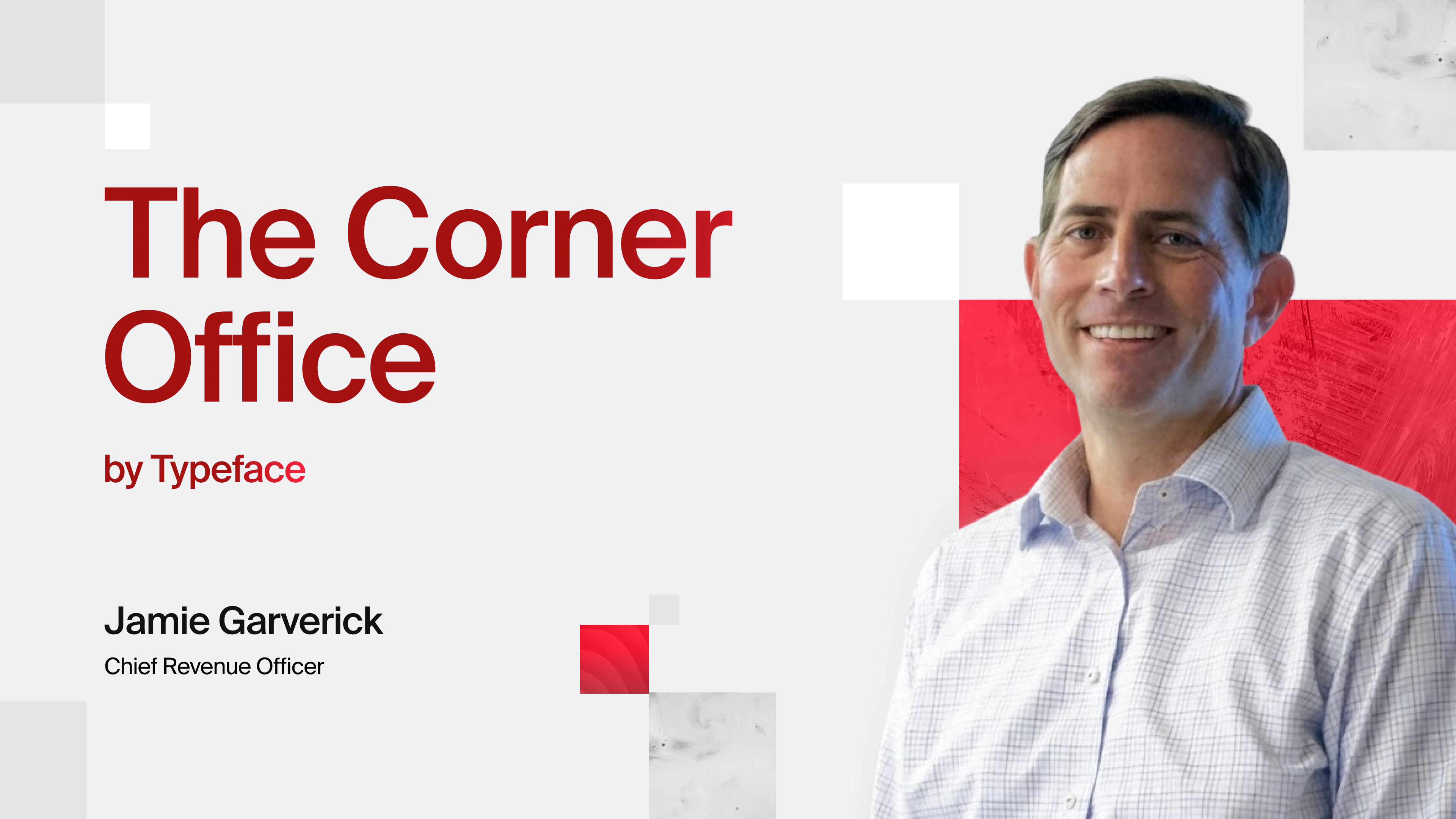
Chief Revenue Officer Jamie Garverick shares what it takes to scale AI across the enterprise, from executive sponsorship and internal champions to redesigned workflows and measurable business outcomes.
In our first two conversations, Typeface's Chief Customer Officer, Satya Krishnaswamy, laid out the formula for AI adoption—people, then process, then technology—and showed how Typeface supports customers through that shift.
Now, with Chief Revenue Officer Jamie Garverick, we look at how enterprises can turn that framework into execution—aligning sponsors, champions, workflows, and technology around measurable business outcomes.
Q: What does "being ready to adopt AI tools" mean for an enterprise organization?
What is currently happening at many companies is that there are people who experiment with models such as Claude or ChatGPT. They use these tools on an individual basis—what we can call single-player mode. An email marketer on one team prompts AI each time they want an email written, and a designer on another team prompts images for a social media post. However, this is not the same as an enterprise as an organization “being ready to adopt AI tools.”
An enterprise shifts to truly “adopting AI” when they shift to what we call “multiplayer mode”—when AI is embedded into the workflows where teams actually collaborate, make decisions, and move work forward.
Across a global enterprise, you have many teams working together—you need AI to be integrated into all of those different processes.
Q: What people are needed for a strong AI adoption framework?
In enterprise deployment, you need exec sponsors and you need champions.
Exec sponsors bring the cross-functional support enterprises need. As Typeface specializes in marketing orchestration, our business exec sponsors tend to be CMOs, but the CMO also needs support from the IT side, as this is a technological shift. In addition, enterprises need direction. There must be outcomes that can be measured, processes to improve, and a defined current state versus the future state—an exec sponsor brings this into focus.
I’ve also learned first-hand from leading Typeface the value of what we call AI Champions. I’ve got a handful of Account Executives who have built various skills and tools, and they have helped me understand what the opportunity for AI is within the sales organization. Champions at the user level also encourage better adoption and stronger interest within teams.
The strongest AI adoption frameworks combine top-down sponsorship with bottom-up advocacy. Executives set the outcomes and remove barriers, while champions help teams understand how AI applies to the work they do.
AI adoption works best when executives invest with their teams in mind, not just their tech stack. Adopting AI must be bottoms-up as well as top-down.
Q: What foundational investments actually lower the cost of scaling with AI?
AI has the potential to be a productivity improvement. The same size team can do more, faster—once they understand how to leverage the technology. As a leader, you can support this through communicating the project process and providing training and enablement to ensure teams are well-equipped. And supporting your champions, who pave new and more effective processes, will further assist the rest of the user community in learning and adapting.
To drive the best results and the best ROI, the foundational investment enterprises need is to re-engineer the business. Take the time to really understand the existing workflow, what obstacles teams encounter, and then identify what AI can solve, as opposed to just adding an AI tool on top of the current process.
Q: After adopting AI, what changes for teams?
What some people don’t consider when adopting AI is that it’s not a one-and-done. When first adopting AI, you define the current state and the future state and deploy it against the future state. But that future state is a snapshot in time, and both your goals and the technology available are going to change. You must be willing to evolve and continuously improve these business processes and take advantage of the AI technology advancements.
Because of that, it is important for the customer to partner with the AI provider. The provider benefits from seeing deployment across organizations and may have suggestions for best practices.
Our customers who experience the greatest return on investment are the ones who stay engaged on both levels: executive sponsors who keep the initiative tied to business outcomes, and champions who help translate the technology into day-to-day adoption.
Want to know what the right AI operating model could look like for your organization? Talk to us today.
Related articles
July 31, 2026
Previously, Satya Krishnaswamy, Typeface's Chief Customer Officer, shared the framework for AI adoption: people first, then process, then technology. He also told us what separates the teams that succ

July 30, 2026
AI is changing marketing economics, and the numbers back it up. The 4th edition of the Typeface Signal Report, surveying 200+ marketing leaders at VP level and above, found that 61% had captured ROI f

September 25, 2026
AI rollouts fail when leadership hands teams the technology without the context to use it well. Team being introduced to AI need a clear purpose, defined success metrics, the authority to experiment,