July 31, 2026
From Framework to Reality: Operationalizing AI in Enterprise Marketing

Arshkrit Chowdhury
Sr. Product Marketing Manager
AI summary
In our first conversation, Satya Krishnaswamy, Typeface's Chief Customer Officer, laid out the framework for AI adoption: people first, then process, then technology. This time, we dig into how Typeface puts that into practice. He walks us through the core layers of an AI marketing platform, what a strong deployment team should look like, and the metrics that actually prove success.
Previously, Satya Krishnaswamy, Typeface's Chief Customer Officer, shared the framework for AI adoption: people first, then process, then technology. He also told us what separates the teams that succeed from the teams that stall.
To bring this formula to life, we went back to Satya with the harder question: how does Typeface put it into practice? Here's the system underneath the platform, in his words, and why he believes Typeface is built to lead on the hardest parts of AI adoption.
Q: What does Typeface's framework look like in practice?
Operationalizing AI takes more than software. It starts well before any software goes in. What we bring is a clear point of view on how to restructure the work and where new roles fit, drawn from what we've seen succeed across customers in every industry we serve. Then we carry those lessons to the next customer, so each rollout starts smarter than the last.
The product works the same way. We built it from the ground up for marketers, to solve the challenges every team in this domain faces, then tailored it to the specific use cases your industry runs on. Most teams get excited about generating content with AI. But this is increasingly getting commoditized. The real value is in everything after: the reviews, the workflows, the approvals, the integrations, the performance tracking. That's what we mean by orchestration, and it's what actually gets a campaign out the door.
One CMO put it well: their channel teams had run omnichannel campaigns for 20 years, but each channel had its own tool, an unfortunate side effect of the legacy martech stack. Every launch came down to crossing their fingers that the messaging stayed consistent across email, web, and social. The Typeface Marketing Orchestration Engine closes that gap: the teams now work in one place, review and approve all the channel content and audiences together, then publish.
Underneath that sits a reference model Typeface recommends to every customer. Creation to production to publishing looks broadly the same across companies, with the nuances coming from the industry, like the compliance checks a bank or life sciences brand needs that a retailer may not.
Typeface's platform runs across three layers:
Content creation: The starting point, where the work begins. This spans across creating a specific ad, generating an image, or writing an AEO/SEO-focused blog or webpage.
Marketing domain agents: Scoped to email, web, images, video, and ads, each built with channel-specific best practices. These agents scale across channels and departments, whether that's marketers using them for ideation and brief creation, creative teams creating variations across audiences, or IT and marketing ops teams activating across channels. Teams can also build a custom agent to adapt these workflows for their own needs or create new flows. As an example, for email, that means more than generating copy. It means understanding layouts or building them dynamically based on the campaign context, personalizing the content for various audiences and building out a full campaign while staying grounded in the brand context.
Activation layer: Where ecosystem interoperability happens. It pulls source content from your digital asset manager (DAM) and pushes finished work out to channels like Salesforce Marketing Cloud, your web CMS, or social platforms.
Tying it all together is Arc Graph, which holds your brand kit and your brand rules, so they're enforced everywhere instead of re-litigating on every campaign. Here’s what the system looks like in motion:
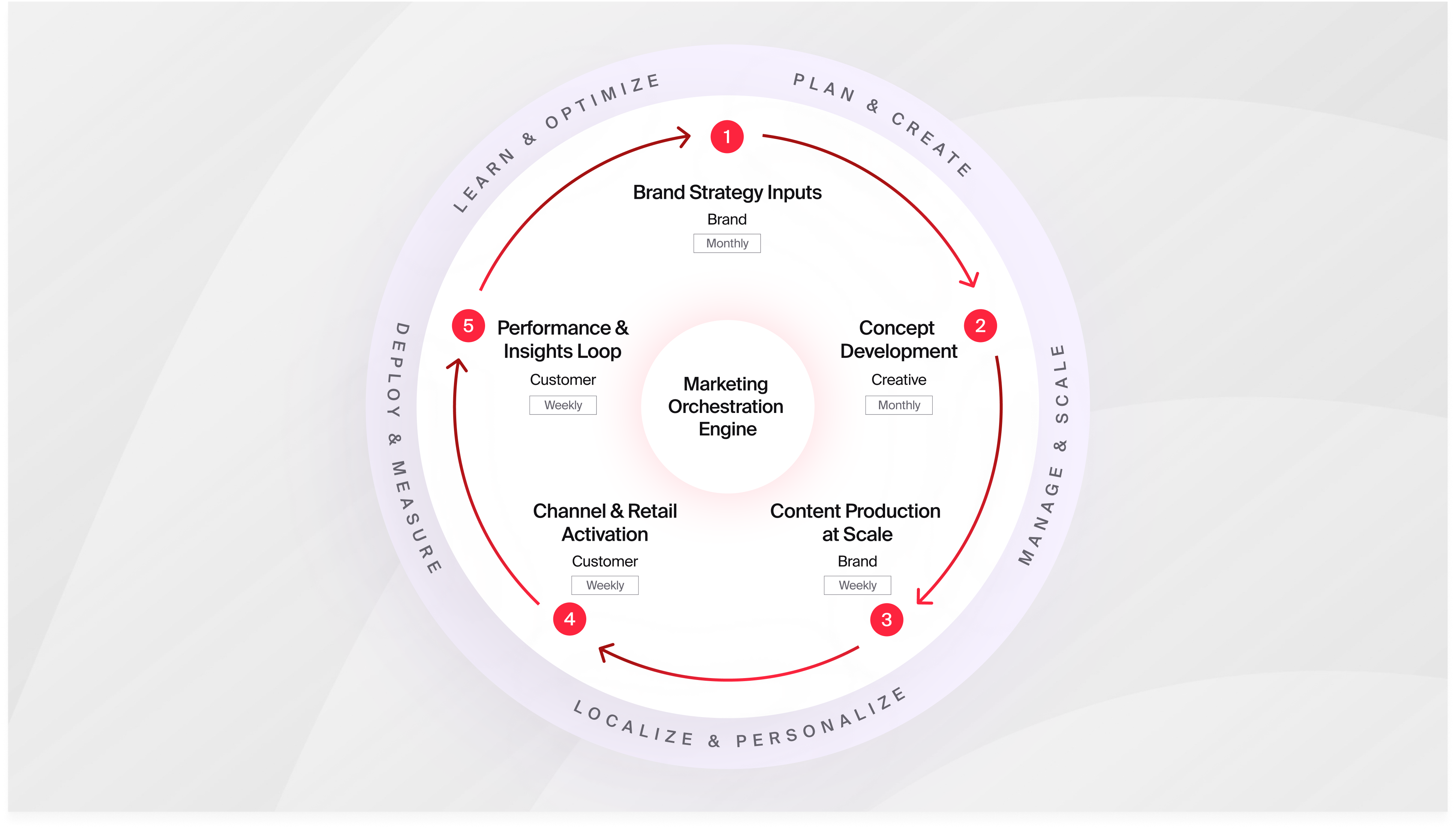
One continuous loop made up of five simple steps. Our team at Typeface helps enterprise teams design and work through each one. Brand strategy inputs feed concept development. Concepts turn into content, produced at scale. That content activates across channels . Performance data flows back into the loop, and the cycle starts again, sharper each time.
Most teams run these steps in a line, start to finish, then stop. Typeface turns it into a wheel. The brand kit you build in step one gets tuned with performance data from each new campaign and becomes the asset every future campaign inherits, so each new round takes less work than the last.
Q: Most vendors treat change management as an afterthought. How is Typeface different?
Generating content isn't the hard part anymore. The hard part for a CMO is keeping the whole team on-brand, strategically aligned, audience-centric, and aware of the bigger context while they do it.
That's where Typeface’s Arc Graph comes in. It's Typeface's living brand intelligence layer: it holds your brand kit, learns your rules, and applies them automatically. It sits in the middle as a governance layer, so your brand rules travel with every asset. That governance is what makes AI usable at enterprise scale.
There's also an architecture reality. You can bolt AI onto a legacy stack at a few points. But a genuinely agentic workflow, where agents run multi-step work on their own, usually means rebuilding how the pieces connect. That's a heavy lift for systems that weren't designed for it, and it's part of why this is so hard to retrofit and why Typeface built it from the start.
Anyone can generate content. The hard part is keeping it on-brand at scale across every channel. That's what we own: brand consistency, cross-channel orchestration, and one seamless campaign across email, web, social, and ads.
Change management is different at Typeface too. We didn't want to hand customers a methodology slide, so we built a team for it instead.
Typeface learned early that customers didn't want advice alone. They wanted to be told what to do. So, every deployment is staffed around three kinds of success, with people who've done this work before at large global enterprises:
Engagement managers own business success. Part project manager, part customer success manager, part business consultant - they bring real experience from inside marketing teams and agencies. They run the change management, get you live, then keep driving adoption and new use cases.
Solution architects and forward-deployed engineers own technical success. They help you understand how Typeface will fit into your tech landscape, and build the integrations, connectors, and custom agents that fit Typeface into your stack.
Creative technologists own content quality. They set up the brand kit and tune content to your standards in an iterative, collaborative manner. Given the non-deterministic nature of AI, this is the part that requires dedicated focus and time to ensure that the brand kit is tuned to your guidelines and standards. With the system and the team in place, the last question is how you know it's working.
Q: How should a team measure success, beyond usage stats?
Decide what success looks like up front, then measure against that, not against logins. Typeface aligns with every customer on the business metrics they want to move before a project begins, so the work gets judged on outcomes rather than activity. Active-user counts tell you people showed up. They don't tell you whether the business has improved.
Two kinds of metrics matter:
Bottom-line metrics move quickly and are easy to prove: production cost, cost per lead, time to market. One large banking customer went from six weeks to launch a campaign to six hours. That number is measured, documented, and cleared to share publicly.
Top-line metrics take longer: audience engagement, impact on buying behavior, and eventually revenue attribution, though most companies aren't ready to measure that last piece yet. This takes time because a campaign has to run for at least a few weeks before you can make statistically significant comparisons of ‘before’ and ‘after’ numbers
With Arc Loop, Typeface is building a feedback loop that connects published performance back into the next campaign, so the system learns what worked for which audience. A few customers are piloting it now.
The formula from last time still holds: people, then process, then technology. What Satya's walked us through here is proof: a system with a governance layer, a delivery team, and a way to measure what matters.
Want to know what our team would recommend for your rollout? Talk to us today.
Related articles
July 2, 2026
Enterprise marketing has embraced AI fast. In Typeface’s latest Signal Report, 86% of leaders already run AI agents in their campaigns, and 61% report ROI. Technology is no longer the hard part: the r
May 7, 2026
AI can transform how you do marketing, but the move from manual creation to AI-powered campaigns is rarely linear. Governance must be in place and early wins need to be visible before AI becomes part

July 30, 2026
Marketing teams have adopted AI almost everywhere, but the metrics to measure success haven’t caught up yet. In the 4th edition of the Typeface Signal Report, 86% of senior marketing leaders said they