July 2, 2026
People, Process, and Technology: The AI Adoption Formula for Successful Marketing Teams

Arshkrit Chowdhury
Sr. Product Marketing Manager
AI summary
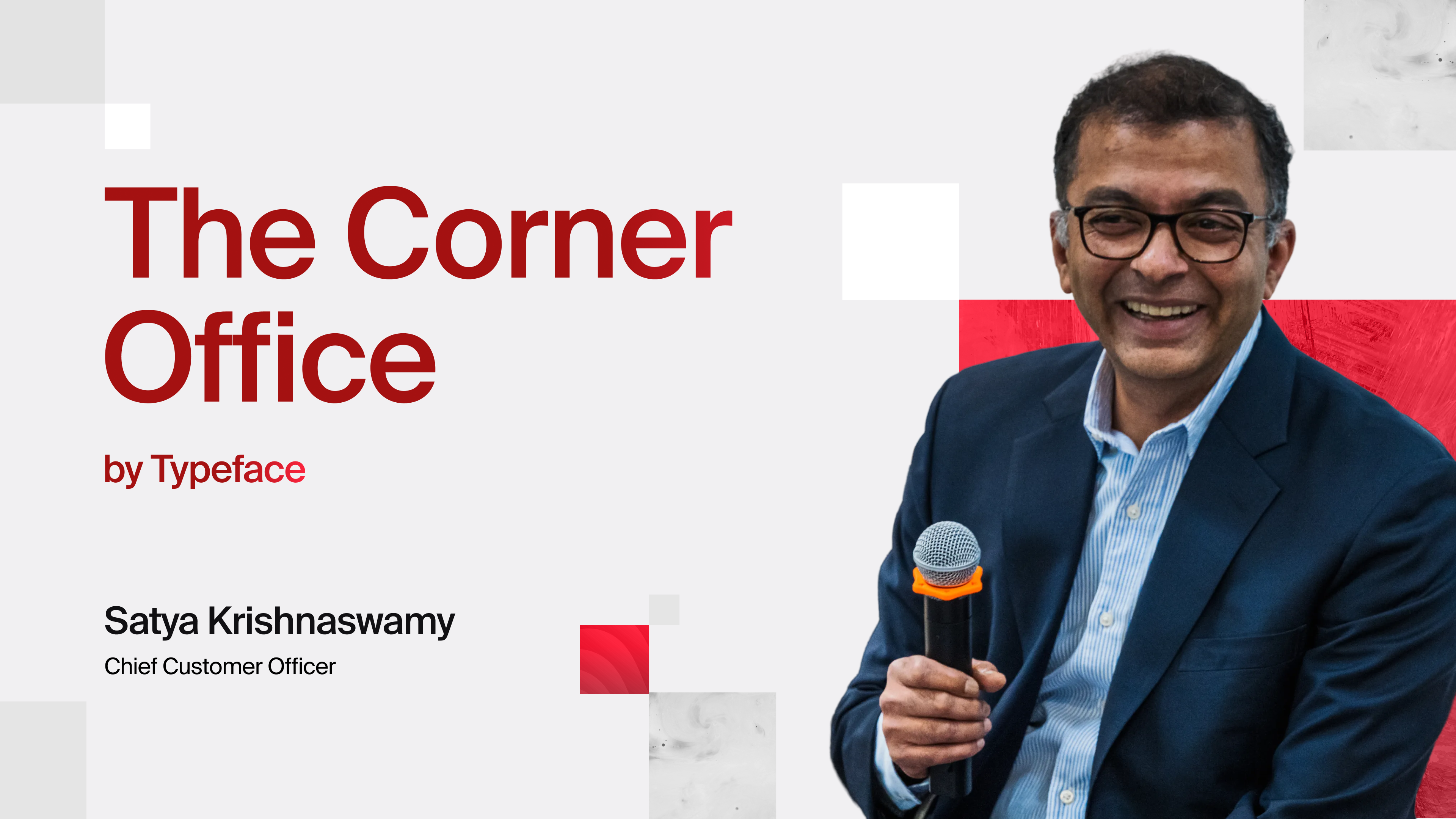
Welcome to The Corner Office, a new series from Typeface where we sit down with our C-suite for candid conversations about where enterprise marketing and AI are headed. No press-release talking points. Just honest perspectives on how these leaders think about their roles, the industry, and what's changing.
In our first conversation, Chief Customer Officer Satya Krishnaswamy shares why the most important part of AI adoption is often the one teams overlook: change management. He explains why the organizations seeing the greatest success start with people, not just the technology.
Enterprise marketing has embraced AI fast. In Typeface’s latest Signal Report, 86% of leaders already run AI agents in their campaigns, and 61% report ROI. Technology is no longer the hard part: the real opportunity is operational.
Satya Krishnaswamy, Typeface's Chief Customer Officer, has noticed a clear pattern among teams pulling ahead. The gap comes down to people and processes, more than the tool itself.
Across 25 years in enterprise software, he’s helped companies turn new technology into real results. At Typeface, he leads the team that gets customers out of pilot mode and into production, in some cases cutting campaign cycles from weeks to hours.
We sat down with Satya to talk about the part of AI adoption that rarely comes up in discovery conversations, even though it's the crucial first step that ends up shaping the rest of the adoption curve: change management. Here's his take:
Q: What are the biggest challenges enterprise organizations face when adopting AI today?
AI is driving genuinely useful change; one focused on enhancing both productivity and performance. The biggest mistake is treating AI as a technology decision. Every adoption actually moves on three dimensions at once: people, process, and technology. The companies that get it right, work them in that order. Most start with the technology and wonder later why it stalled.
People come first, because that's where the resistance lies. In traditional marketing organizations, agencies handled much of the production. Today, AI is shifting more of that work in-house, creating uncertainty for creative teams about how ideation and craft will evolve, while asking marketers to produce content they once simply briefed and approved. Technology can't deliver value until the people expected to use it are fully on board.
Process is the second dimension, and the one most teams skip. How does your review, approval, and publishing workflow change to absorb a platform like Typeface? That usually goes unanswered until something breaks mid-campaign.
Technology comes last, and that’s deliberate. The platform is the easy part. It only pays off once you’ve worked out how the people and the process around it are going to operate.
The companies that succeed with AI don’t lead with the technology. They think about the people first, then the process.
Q: How is AI changing the roles of creative and marketing teams?
Agents take over the work that was already mundane, so teams stay focused on the work that matters.
On the creative side, the change gives creators more time for what they do best: the core ideation and the key art, the hero assets that carry a campaign. AI earns its place in the production grind. Resizing one asset 20 times for every channel is the work creatives always hated, and that’s exactly what AI is absorbing.
On the marketing side, the shift is less obvious but more profound, and it’s a gain for the marketer. The old model was send-and-wait: write a brief, hand it to an agency, then review and approve what came back, round after round. As that work comes in-house, marketers shape the content directly instead of describing it secondhand, and the lag disappears. Because everyone is now hands-on in the same process, teams need one place to orchestrate it all, so they can move at the speed of their own ideas.
None of this takes the human out of the work. The real win is people freed from the grind, with more room to focus on the judgment, the taste, and the ideas only they can bring.
Looking further out, the most valuable new role is the creative technologist: someone with the eye and taste of a designer or copywriter, fluent in AI. I already staff my own team this way. Entirely new roles are emerging alongside them, like the AI Operator, a role we defined with one customer to own the AI operating system and keep all the pieces running. Even IT is getting closer to the work, building custom agents in Arc Fabric. The operating model now reaches well past the creative and marketing floor.
For the first time, the marketer shapes the work directly, at the speed of their own ideas.
Q: Why does change management get left off the requirements list, and what makes AI different from past technology shifts?
The gap is a hangover from how software used to be bought. For decades, enterprise software was a technical purchase: choose the tool, plug it in, train a handful of admins, done. AI breaks that pattern, because the value comes from how your people and processes change around it. Most teams haven’t had to work that way before, so change management rarely makes the requirements list.
In one sense, none of this is new. Every enterprise rollout in history has run on the same three dimensions: people, process, and technology. The teams that learned that on earlier waves of software carry a real advantage into AI.
What is new is the nature of AI itself: it’s non-deterministic. Unlike a CRM, which always gives you the same answer, no two AI outputs are the same. The teams that get comfortable iterating are the ones that pull ahead.
AI is non-deterministic. The teams that get comfortable iterating are the ones that pull ahead.
Q: What do the teams that succeed with AI do that the others don't?
Success comes down to a few things. The strongest adopters start with an executive champion: someone senior who believes in the value and can carry that conviction across the organization. Belief at the top only counts when it travels.
They also have operational evangelists, the people inside the marketing and creative teams who carry the change day-to-day. A CMO can set the direction, but the daily momentum comes from the team. With those two roles in place, the rest gets practical fast.
From there, the playbook is consistent. Map the use cases that matter, agree on the metrics you want to move, and pick a first campaign to ship together. That first campaign is the line that counts: getting live on it is what turns a deployment from a plan into something real.
When teams stall, it’s almost always before that line, and usually for one of three reasons: a capability gap in the product, a mismatch between what they expected and what the tool actually does or change management they never worked through.
Q: If a leader is starting this journey, where should they begin, and what should they expect?
Begin with something concrete. Pick one clear use case and run it end to end: ground it in a campaign brief, then review and publish. But before you write that first brief, get your people and process in order.
A good starting point is content you already own. One customer had thousands of videos from their annual conference, pulled them into Typeface, and cut short sizzle reels for the website, keeping engagement high after the event and building interest in the next. The more advanced move is to go upstream, building smarter briefs that pull in market, competitor, and audience context before a single asset is made.
One more thing carries real weight: expect to iterate, and plan for it. Deployment is a back-and-forth to dial in quality, and nothing is perfect on day one. The teams that thrive build that rhythm into their plan; the ones that struggle assume it will all click in a week.
Start small, do the change work up front, and plan to iterate. That’s the whole playbook.
Starting small is the easy part to say and the hard part to do. In our next conversation, Satya walks through how to operationalize AI, and how his change management framework plays out in practice.
Stay tuned for part two.
Related articles

July 1, 2026
Enterprise marketing teams that move through AI adoption in sequence — pilot, brand governance, cross-functional integration, and full maturity — build something that teams without a framework rarely

September 23, 2026
You planned a solid campaign for a product launch and everything is already in place — amazing graphics, great copy, a distribution plan. Post launch, however, the campaign does not get the expected t

September 25, 2026
AI rollouts fail when leadership hands teams the technology without the context to use it well. Team being introduced to AI need a clear purpose, defined success metrics, the authority to experiment,