September 23, 2026
How to Build Cross-Functional AI Literacy in Your Marketing Team

Neelam Goswami
Senior Content Marketing Associate

AI summary
You can build AI literacy across your marketing team with phased training and champion-led rollouts. Learn how tools like Arc Graph and Arc Fabric help scale on-brand AI use.
You planned a solid campaign for a product launch and everything is already in place — amazing graphics, great copy, a distribution plan. Post launch, however, the campaign does not get the expected traction in the first few days.
Your performance team now wants to try a few different variations of copy and visuals to see what works, but the content lead has already picked up the next project and has no bandwidth. The others aren’t familiar with the AI tools to use to execute this in time.
The result: A promising campaign that fails to deliver.
This happens when your organization is lacking cross-functional AI literacy, and only a handful of people are fluent in AI tools, creating a bottleneck.
Building cross-functional AI literacy means giving every team member, be it creative, content, performance, or ops, the practical skills to work with AI in their daily workflow.
This guide walks you through how to assess where your team is today, how to roll out AI literacy in a way that sticks, and how to measure whether it's working.
TL;DR — Key Takeaways
Cross-functional AI literacy = practical AI skills distributed across all marketing functions, not just specialists.
The bottleneck is almost always knowledge sharing rather than tooling.
A phased rollout that starts with champions first, then cohorts, reduces disruption and builds internal proof points.
A centralized brand intelligence system and purpose-built AI agents help standardize AI use without sacrificing brand quality.
Teams that build AI literacy early outperform competitors on speed and consistency, while boosting campaign ROI.
What is cross-functional AI literacy, and why does it matter for marketing teams?
Cross-functional AI literacy is the ability of every marketing function, from creative to ops, to use AI tools accurately and confidently in day-to-day work. It matters because siloed AI knowledge undoes the speed benefits of AI use: a few power users carry the load while the rest of the team waits.
Why can't one AI-fluent person carry the whole team?
If only your content lead knows how to use AI well, creative is still waiting on briefs. Performance is still running manual A/B copy. Ops is still building decks one slide at a time. Every function needs enough fluency to operate independently, because the time savings compound across the entire team.
What does AI 'literacy' look like in practice? AI literacy is not about becoming an AI expert but more about knowing which tasks to hand to an AI agent, how to prompt well enough to get usable output, and how to review and improve that output quickly.
How this could unfold in the real world
How this could unfold in the real world
Let’s say a global B2B SaaS company rolls out AI prompt training to their 40-person marketing org. Within six weeks, content production time drops by 35% without hiring more writers, because designers and PMs can now draft first-pass copy themselves.
Most team members can get there in a few focused sessions. The challenge is building the habit of using AI for the right purposes.
How do I assess where my team's AI knowledge gaps are?
Different individuals or functions within your team could be at different levels of AI knowledge. Start with a simple skills audit before you roll out any training or tooling. Map each function such as creative, content, SEO, performance, brand ops, etc. against three literacy levels:
Aware (knows what AI can do)
Capable (can use AI tools with guidance)
Fluent (can prompt, iterate, and review AI output independently)
What questions should a skills audit ask?
Keep it short. Three questions can get you most of what you need:
Can you name three or more tasks in your role where AI could help?
Have you used an AI tool in the last 30 days?
Can you evaluate AI output for brand accuracy without a checklist?
Anyone who answers yes to all three is a candidate for your first champion cohort. Anyone who answers no to all three is a newcomer. Start them with one simple, high-value task.
Champions (team members who are already fluent in AI tools) can be your internal trainers and help bring the rest of the team up to speed.
What's the right way to roll out AI literacy across marketing functions?
A phased rollout works better than a company-wide launch. Start narrow, prove value, then expand; one function or workflow at a time. Trying to train everyone at once usually means no one gets enough time or attention to learn well.
What does each phase of AI literacy training look like?
For Phase 1, pick one high-frequency, low-stakes workflow. This could be email subject lines, social copy, or brief templates. Train your champions on that workflow first. Let them demonstrate ROI before widening access. This builds trust in the tools and in the people running them, helping you address emotional resistance to AI from users.
Phase 2 widens to your learner cohort (intermediate), adding two or three more workflows.
Phase 3 is org-wide access, with AI agents doing the heavy lifting to keep output consistent even when the newest team member is doing the prompting. Team members who are already confident can now help newcomers with their queries and challenges.
How does Typeface help structure the rollout?
Typeface's Arc Graph gives every team member access to approved brand guidelines, tone-of-voice rules, and content standards, so AI-generated output stays on-brand even when it's created by someone who joined last month.
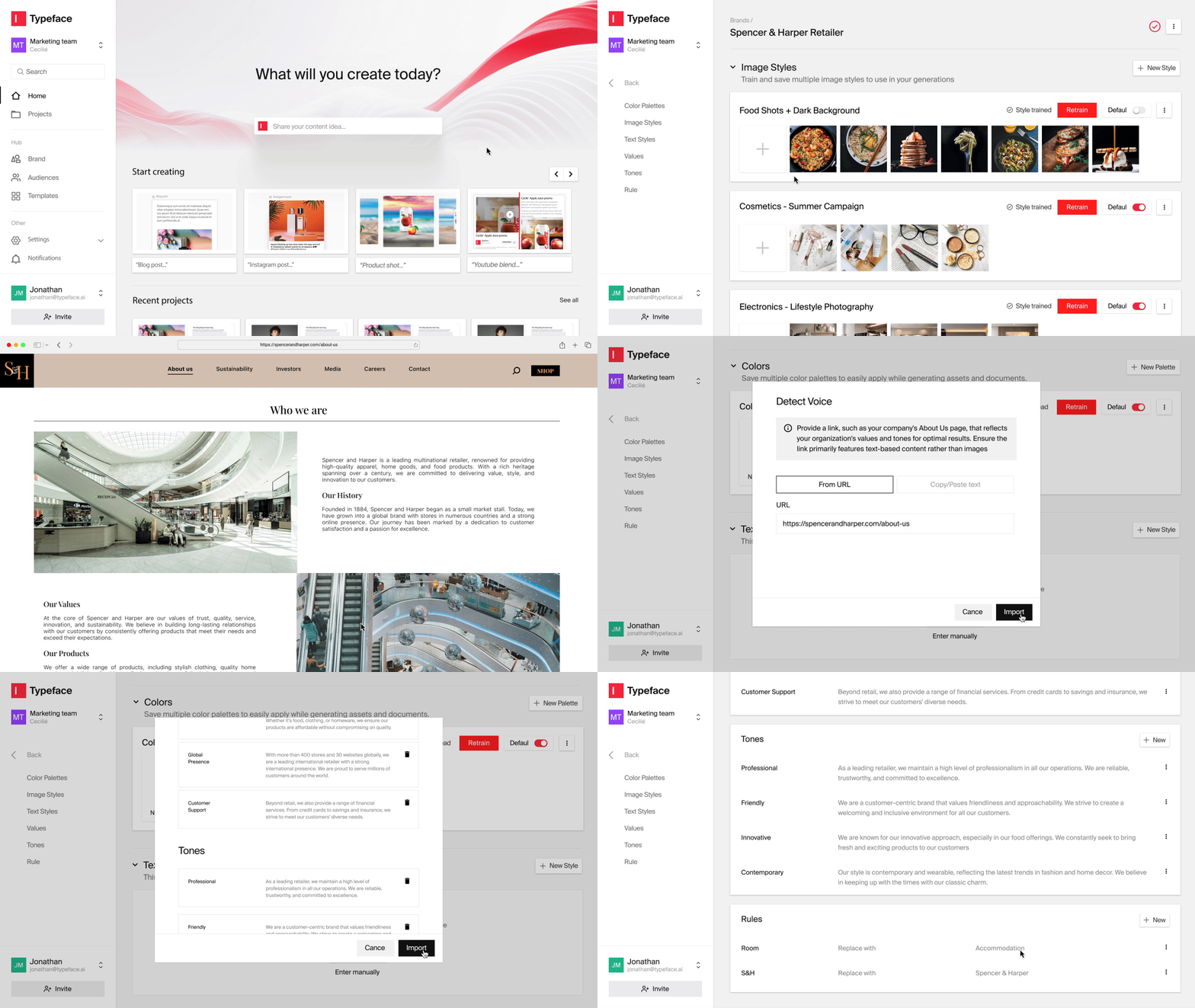
Arc Fabric lets teams build repeatable AI workflows with custom agents for specific campaign types. This means each new function you bring on doesn't start from scratch.
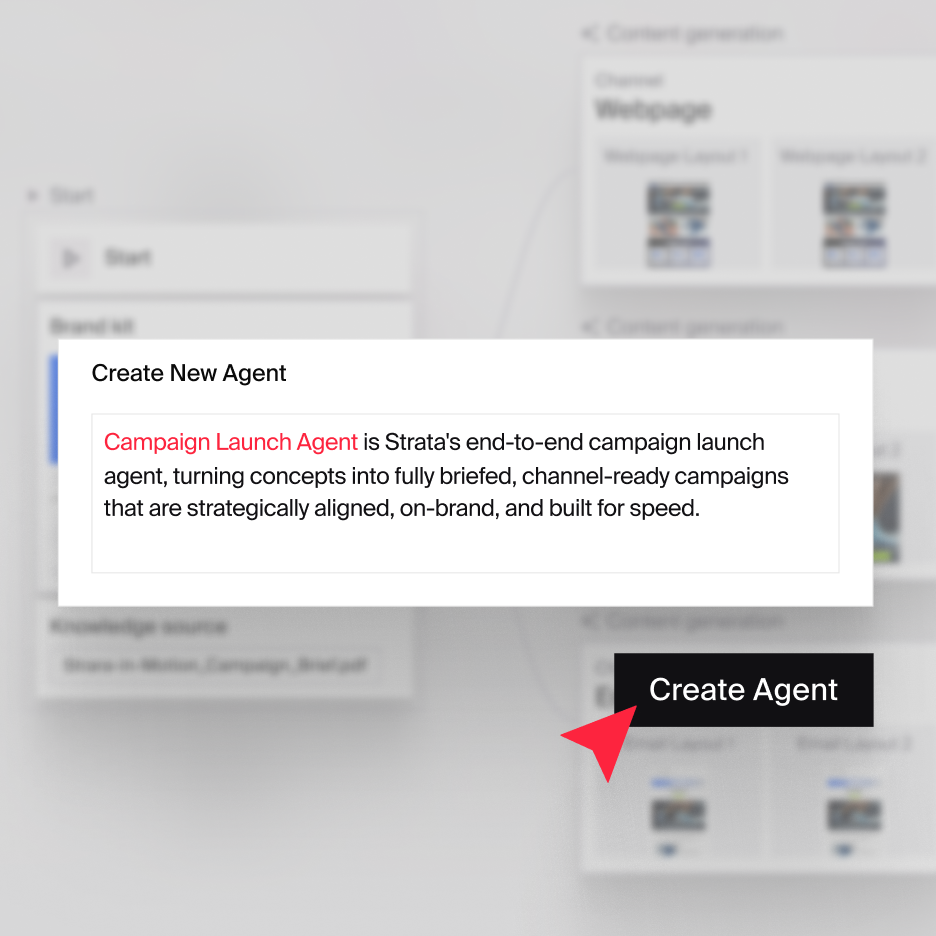
Your frequently used prompts can be templatized in the form of custom AI agents, so your team doesn’t have to worry about writing the perfect prompt with exact brand guidelines every single time.
Real world results
Real world results
A Fortune 500 automaker used Arc Fabric to lock in visual and copy standards before rolling out Typeface’s AI tools to their team for a year-end ad campaign. They achieved a 4x increase in content production and 57% productivity savings, even with a team that had no prior experience working with our AI agents.
How do I measure whether the AI literacy initiative is working?
Track two types of signals: productivity metrics (time-to-first-draft, assets per sprint, revision rounds) and quality metrics (brand compliance scores, campaign performance, approval rates).
Set a 30-day checkpoint after each function goes live.
What's a realistic improvement to aim for in the first 60 days?
Teams that get proper AI literacy training should typically see almost 2x faster first-draft production within 60 days.
More importantly, they may see fewer off-brand surprises, which saves time downstream in approval and QA.
If you're not seeing speed improvement by week four, the bottleneck is usually prompting confidence rather than tool access.
What should I report to leadership?
A simple before/after table updated monthly is enough to show the ROI. Keep it simple with metrics like:
Time saved per content type
Campaign output volume vs. previous quarter
Revision round reduction
These metrics should be enough to tell the story without a complex attribution model.
How do we make AI literacy an ongoing capability instead of a one-time training?
Build it into your operating rhythm. Monthly AI office hours, a shared Slack channel for prompt wins and fails, and quarterly skill refreshes keep knowledge from decaying. These combined with incentivizing AI use in new projects or even day-to-day work, that requires some amount of upskilling, can be a great way to encourage your team.
The teams that sustain AI literacy treat it like they treat brand standards: always on, always evolving.
Who should own AI literacy long-term?
Ownership usually sits best with marketing ops or content strategy; someone close enough to the work to spot where literacy gaps are causing friction.
It doesn't need dedicated headcount. A 20% ownership split across two or three champions is often enough to keep the program alive and moving.
Bottom line: Culture beats curriculum. Aim to make AI learning a habit instead of a one-time event.
Want to know how Typeface can support your cross-functional AI literacy efforts? Get a demo or contact our sales team for a clear picture of how our agentic AI platform for enterprise marketing fits into your long-term strategy.
Frequently asked questions
How do I know if my marketing team is ready for an AI literacy initiative?
If your team is already using AI tools inconsistently — some people rely on them heavily, others not at all — you're past ready. Rather than whether to build AI literacy, the question is whether the inconsistency is costing you enough to prioritize it now. A quick audit takes less than a day (it can even be a Slack poll) and gives you everything you need to start.
Will building AI literacy replace my content and creative team?
No — and this is worth being direct about. AI literacy makes your existing team faster and more capable. It doesn't change headcount but changes what your team can produce: more content variations, faster turnaround, and less time on low-value tasks like reformatting and resizing.
What most creative directors should focus on instead is not falling behind teams that have already built this muscle.
How do I get buy-in from resistant team members?
Start with a win they care about. If a designer's biggest frustration is waiting two days for copy briefs, show them how AI literacy cuts that to two hours. Don't lead with 'AI is the future.' Lead with 'this makes your specific problem go away.' Champions who can share real before-and-after experiences in your own org are far more persuasive than any external case study.
Make it personal and specific. Generic AI enthusiasm doesn't move skeptics but a real time-save does.
What's the right tool stack for building cross-functional AI literacy?
The stack matters less than the standards. The biggest AI literacy failures happen when different functions use different tools with no shared guidelines, resulting in off-brand output and revision chaos. Whatever tools you choose, you need a shared source of truth for brand standards — like Typeface's Arc Graph — so AI-generated content across functions meets the same bar.
Related articles

September 25, 2026
AI rollouts fail when leadership hands teams the technology without the context to use it well. Team being introduced to AI need a clear purpose, defined success metrics, the authority to experiment,

June 8, 2026
When AI adoption in enterprise marketing fails, it’s usually not because of the technology. The issue is that most teams are buying AI tools and not changing anything else. Workflows stay the same. B

May 7, 2026
AI can transform how you do marketing, but the move from manual creation to AI-powered campaigns is rarely linear. Governance must be in place and early wins need to be visible before AI becomes part