July 17, 2026
AI Governance Best Practices for Enterprise Marketing Teams

Ashwini Pai
Senior Copywriter

AI summary
Content governance is an imperative for marketing teams using AI. Here's what it takes to make governance foundational and maintain brand integrity:
- •Brand rules embedded in workflows: Every AI-generated asset pulls from the correct brand context
- •Defined ownership: Clear roles for setting rules, reviewing content, and handling escalations
- •Structured reviews: A consistent process of automated and human checks
- •Feedback loops: Guardrails update as performance data flows back in
It's a well-known trope for marketing teams to say that AI content “doesn’t sound like us,” or “isn’t insightful enough,” or “could get us into trouble.” That lack of confidence, in most cases, comes from not having good AI governance.
When you expect to use AI across your brand, product lines, and partner communications, governance best practices keep you in control of content quality — which is non-negotiable in the era of AI content generation.
Now, AI governance may sound like an IT responsibility, but marketing plays an equally important role. If IT provides the technical foundation, marketing defines how AI should be used in content creation. Together, they ensure AI outputs are compliant and aligned with the brand.
This article focuses on the marketing side of AI governance for enterprise brands. The best practices discussed here are for marketing teams to act on.
TL;DR
AI governance keeps campaign quality and brand consistency in check
Auditable workflows bring accountability and transparency to every content decision
The four layers of AI brand governance are: brand rules, defined ownership, structured reviews, and feedback loops
Enterprise AI marketing platforms build governance in and extend it to the external tools and LLMs your team already uses
In Typeface, Arc Graph, Arc Loop, Brand Agent, and Visual Brand Evaluator enforce brand governance from generation through review
Start with the content types that move fastest and get the least review; prove it on one workflow and expand from there
What does AI governance mean for marketing teams?
AI governance for marketing controls how teams use AI to create content. It keeps outputs accurate and on-brand while ensuring consistency as adoption (and volume) grows. A shared foundation for creation and review helps teams co-create with confidence.
Why is AI marketing governance important?
Without clear guidelines, the volume of AI content your team produces quickly outpaces your ability to review it. Regulatory and brand risk follow, and operational chaos isn't far behind.
Governance aligns your team around an established way of creating with AI. That means:
Training (and putting guardrails on) AI to match your communication style, visual identity, and brand values
Giving teams a standard process for creating and reviewing AI content
Establishing clear accountability throughout the campaign lifecycle
Building a governance foundation that scales with your AI capabilities
Four layers of enterprise AI content governance address each of these.
Layers of enterprise AI content governance
Brand rules: AI always generates with the right brand context
Defined ownership: Clear roles for rule-setting, content reviews, and escalations when content doesn’t pass
Structured reviews: A standard process of automated and human review checks
Feedback loops: Guardrails and knowledge that update as campaign performance data flows back into the system
The first three should be in place from day one. Feedback loops come in as AI usage produces enough performance data to inform improvements.
Layer 1: Brand rules
Best practice: A brand intelligence layer that informs every piece of content
Enterprise brands have hundreds of brand rules at the corporate level, with additional guidelines for sub-brands, products, and regions. Add tone variations across channels and distinct executive voices, and the complexity of creating on-brand content grows exponentially.
When AI enters your workflows, PDF guidelines and visual brand books don’t help. A brand intelligence layer that carries your brand rules and knowledge into every piece of content does.
In Typeface, this is Arc Graph.
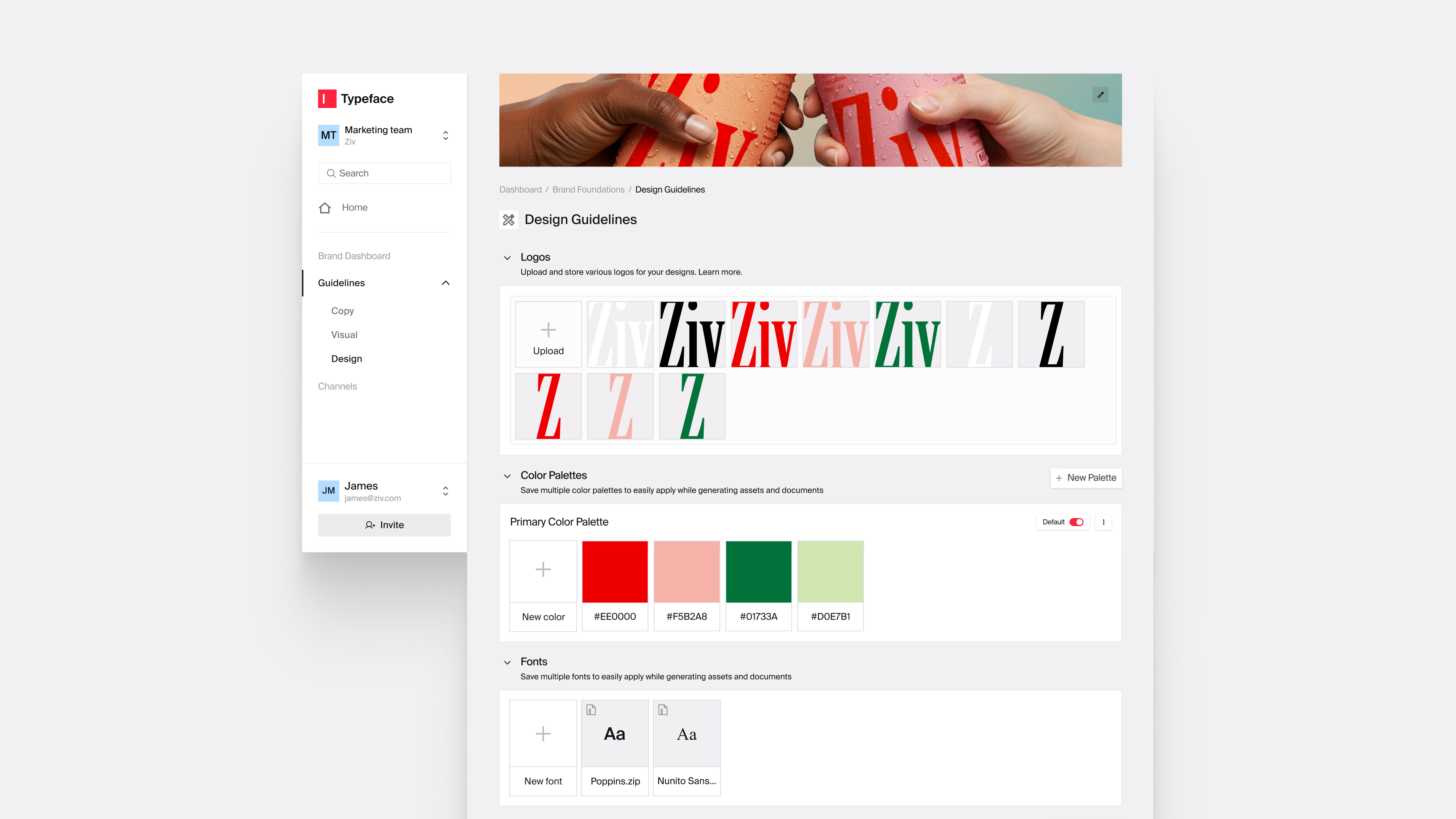
What is Arc Graph?
Arc Graph turns brand guidelines, assets, and knowledge into a context graph that informs every piece of content and evolves with new insights. This makes it a living brand system that embeds governance into the fabric of content creation.
How do you feed it?
By connecting it to your:
Design and asset tools like Figma and Dropbox, to pull in brand guidelines and templates
DAM, to build searchable asset libraries of approved copy and visuals
CDP, to pull in audience segments and attributes for personalization
When do you see it in action?
When you orchestrate a campaign in Typeface, agents pull context directly from Arc Graph to complete their tasks. For example, Ad Agent uses approved layouts, audience context, and brand guidelines to generate compliant emails with on-brand copy and visuals.
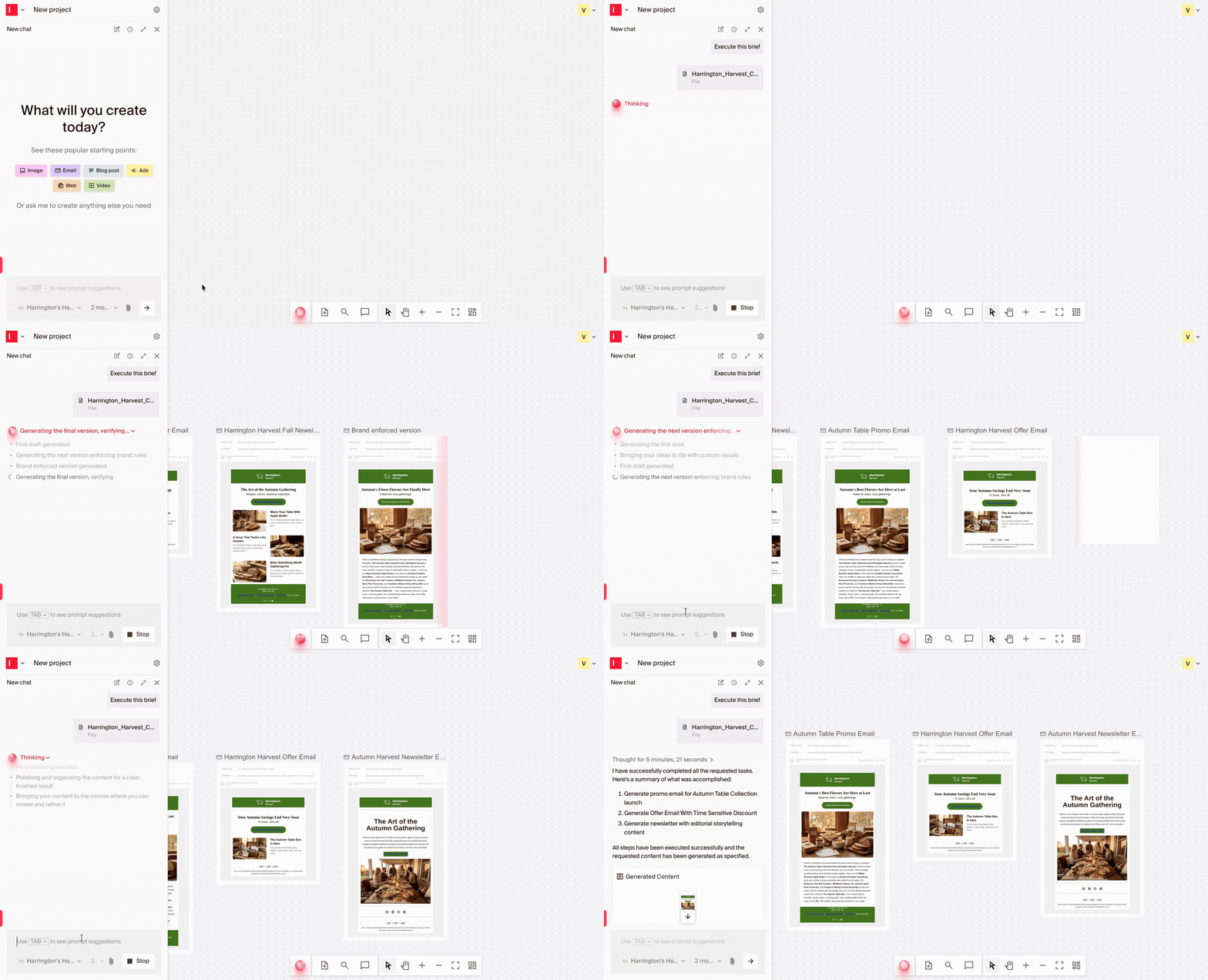
How does it stay updated?
As brand rules change or new intelligence comes from performance data and monitoring, Arc Graph updates to keep content aligned with what performs best.
Layer 2: Defined ownership
Best practice: Named accountability and audit trails
Effective AI governance needs clear ownership. Define who holds what roles and keep a record of how campaigns move from creation to publication.
RACI (Responsible, Accountable, Consulted, Informed) roles in AI marketing
RACI is a useful framework to clarify roles when adopting generative AI. It helps your team avoid confusion about who creates content, owns results, reviews it, and receives updates.
A simple framework:
Responsible: Copywriters and visual designers create multi-channel campaigns (web, email, social, and video)
Accountable: The Content Director owns the outcomes and signs off on tasks
Consulted: Legal teams provide input before work is approved, and may be involved in final sign-off on tasks that need legal review
Informed: CMO and sales teams receive updates on progress
What does RACI look like for individual tasks?
Defining and updating brand rules:
The Brand Director is responsible for defining the rules and ensures they’re transferred to the shared brand foundation
The CMO owns accountability for the strategic boundaries of AI usage
Legal counsel is consulted to ensure that nothing breaches copyright laws
Creating and approving AI output:
Copywriters and visual designers create campaigns using AI
The Content Manager is responsible for reviewing and editing AI content against brand guidelines. No content ships without a human-in-the-loop review.
The Brand Director owns outcomes or offers consultative advice for high-stakes campaigns.
Escalating compliance concerns:
Content creators and Content Manager share responsibility for flagging issues immediately. These include hallucinations, privacy issues, or irrelevant outputs.
Legal Counsel is accountable for mitigating compliance risk, investigating, and issuing verdict on whether an asset can ship.
Audit trails
Named accountability works if there's a record to back it up. In Typeface, that record is built into the workflow itself. You get real-time visibility into content status at every stage and see exactly where a piece is in the review process without chasing anyone for updates. Every status change is logged, creating an audit trail of who approved what, when, and at which stage.
Usage tiers
Each type of content has its own risk profile. A short social post can be good to go without multiple checks, but not a product landing page or a customer case study. Good governance maps review checkpoints to content type, so high-risk content gets appropriate scrutiny and low-risk content doesn't get stuck in a queue.
Layer 3: Structured reviews
Best practice: Human in the loop (HITL) plus automated checking
When AI enters workflows, teams turn their focus from creating every piece of content from scratch to reviewing whether AI drafts meets the bar and making them better. If anything, their judgment comes to the fore and keeps the human imprint on every campaign.
You can bring existing workflows into Typeface, keeping or adjusting review checkpoints to match your creation and approval process. Add team members at the right points in the workflow, assign tasks, update status, and send Slack or email notifications without jumping to another tool.
Automated checks
Teams can also benefit from automated checks where AI scores content against different criteria, saving review time without pulling a brand manager into every piece. That's especially useful for quick checks or low-risk content.
In Typeface, Brand Agent checks content against guidelines, flags issues, and suggests improvements. (Just ask "is this on brand?" right after creating something new or before updating an older piece.)
Visual Brand Evaluator extends governance to image and ad assets, evaluating visuals against your guidelines so you can see what's on brand and what needs adjustment.
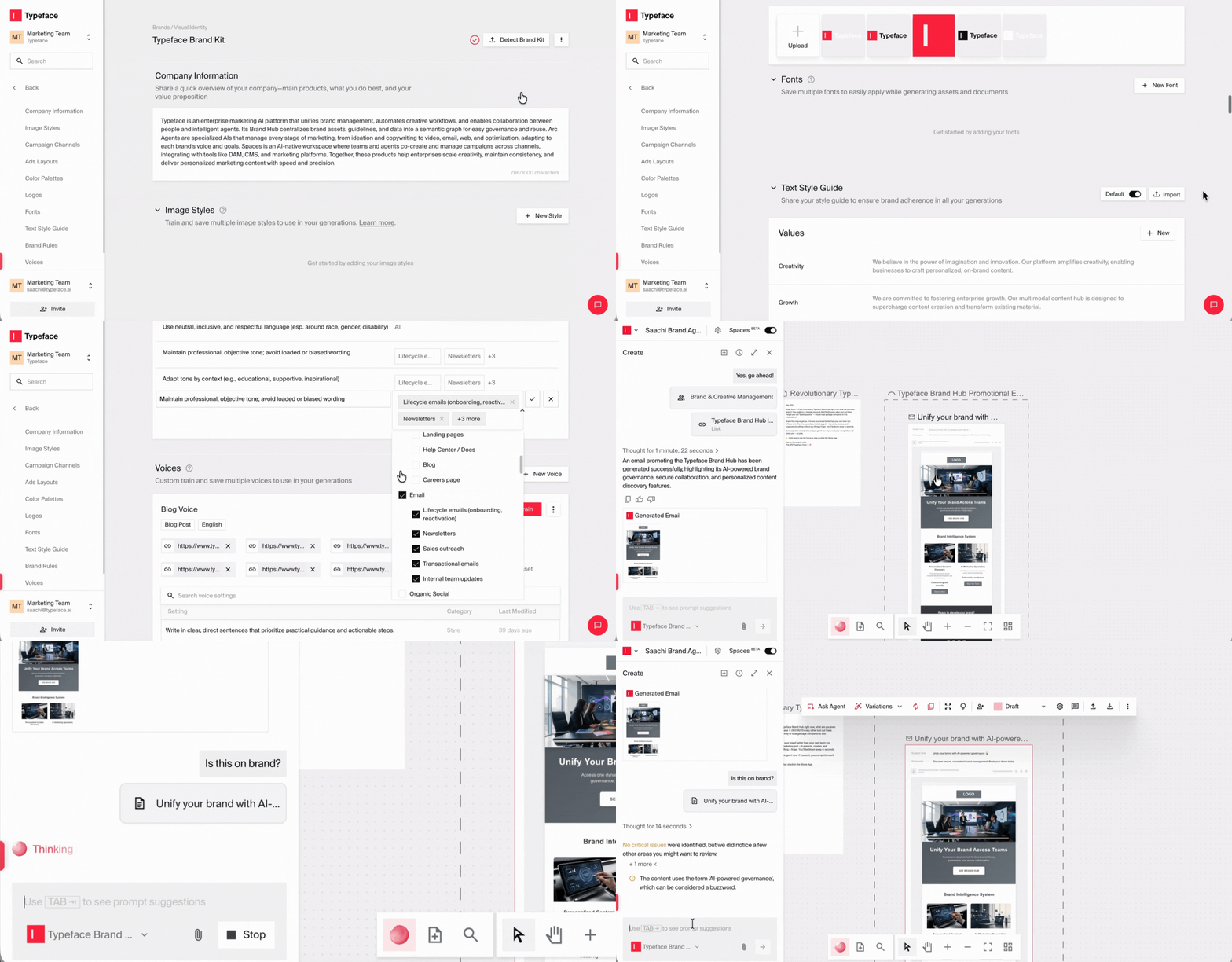
What does an AI content review process look like?
A functional review process for AI content typically looks like this:
Content is generated within guardrails (brand rules, tone guidance, and approved templates)
Brand Agent and Visual Brand Evaluator check the output in real time, flagging tone inconsistencies, off-brand phrasing, and visual compliance issues, with specific recommendations before the content leaves the creation step.
Creator does a first-pass review against a short checklist (on-brand? accurate? appropriate for channel?)
Content that clears first pass moves to the relevant approver based on content type and risk level
Approved content is published; flagged content is revised or escalated
Patterns in flagged content are reviewed and fed back into the rules
Layer 4: Feedback loops
Best practice: Closed-loop feedback
Governance should improve over time. Failed reviews highlight where AI inputs, rules, or review criteria need updates. A simple feedback process assigns ownership for changes and helps prevent repeat issues.
Beyond review feedback, campaign performance insights are the foundation of closed-loop feedback. They refine upstream inputs such as brand rules, prompts, and review criteria, connecting governance to business outcomes.
Every review cycle generates signal that makes the next one better. Over time that compounds. Quarter on quarter, you're going beyond maintaining standards to raising them with less effort.
Typeface is building Arc Loop, a closed-loop system where content performance data flows back into Arc Graph to enrich brand intelligence and audience understanding.
Bottom line: The longer you use it, the better it gets.
How to build an AI governance framework for your marketing team
Start small and refine before you roll out. A contained setup lets you first stress-test rules and outputs and then hand your marketing teams across locations a governance framework that holds up. Use these steps:
1. Audit one workflow
Pick the content type your team produces most often and map how it currently moves from idea to published. Who creates it, who reviews it, who approves it, and where does it get stuck?
2. Document your hard rules
Start with the non-negotiables, like a clearly defined brand voice, mandatory disclaimers, or audience restrictions. Keep them distinct and write each one in plain language.
3. Identify your governance gaps
Where in your current workflow does AI output go unreviewed? Where are review standards inconsistent across team members? Where have things gone wrong in the past?
4. Assign ownership
Use your audit to map who should own what. Keep it simple: one person per decision type and one clear escalation path for anything that doesn't fit.
5. Pilot, then expand
Run the governance model on one team or one campaign type for four to six weeks. Measure review cycle time, revision rates, and brand consistency issues. Fix what's broken before you scale.
What to look for in an AI marketing platform when it comes to governance
If you're evaluating or using an AI marketing platform, governance capabilities should be part of your criteria. Key questions to ask include:
1. Does the platform enforce brand governance or just suggest it?
Enforced governance builds brand rules into the generation layer (like Arc Graph), making it less likely for non-compliant content to make it to review in the first place. Without it, the burden of governance falls on your team, slowing them down and wearing them out as output volumes grow.
2. Does the platform run the full workflow, not just the generation step?
A typical enterprise campaign runs through multiple requirements — copy and creative, localization, channel adaptation, and brand and legal approvals. When governance sits separately from content creation, it becomes something teams check after the fact instead of a part of the process. A platform that runs the full workflow keeps governance embedded at every stage.
3. Does the platform offer visual governance?
Foundation models can review copy and visuals against guidelines when prompted, but become unwieldy for large design workflows. Enterprise AI marketing platforms like Typeface integrate automated visual checks directly into the creative generation pipeline, so visual governance holds across workflows of any size.
4. Are the workflows auditable?
Good records are part of good governance. Auditable workflows capture logs of how content was generated and who approved it, maintaining accountability and compliance. In regulated industries especially, this isn't optional.
5. Does the platform integrate with the tools your team already uses?
If the platform doesn't fit into existing workflows — whether that includes Claude or ChatGPT — teams find workarounds and governance goes missing in the gaps. Enterprise platforms let teams connect the foundation models and marketing platforms they already use, as layers of the same stack, each doing what it does best.
Typeface MCP is built on that logic. Your teams run governed marketing workflows from inside their regular LLMs and tools, while keeping Arc Graph's brand intelligence in the loop throughout.
Common mistakes in enterprise AI governance
These are the patterns we see most often in teams that are struggling to make governance work.
Treating governance as a compliance project, not a workflow project
Legal and IT are important stakeholders in AI governance, but marketing teams should define how AI fits into content workflows. Marketing has the operational context needed to create governance that reflects how teams work, making it easier to adopt and enforce.
Starting with the whole organization
Trying to govern every team, tool, and content type at once creates unnecessary complexity. Start with one workflow, prove the approach, and expand from there.
Separating governance from the tools
Brand rules documented in a style guide that isn't connected to your AI platform aren't enforcing anything. Governance only works when you build it into the content workflow, not when they store it separately and expect teams to follow it.
Skipping the feedback loop
AI should get better with use, and solid governance makes it safe to update rules with every campaign. Without a feedback mechanism, you don’t capture what's working and what isn't, and governance goes stale fast.
FAQs
Q. What's the difference between AI governance for marketing and general enterprise AI governance?
Enterprise AI governance focuses on data security (AI accesses only needed data), model risk (prevents harmful outputs), and compliance (meets ISO/IEC 42001 and advertising standards). Marketing governance adds a layer of brand-specific concerns like text and visual compliance and auditable workflows. The stakes and metrics are different enough that marketing teams need a governance model built for their context.
Q. What brand safety metrics do brand managers use?
The brand safety metrics that enterprise brand managers use are:
Brand violation rate: Off-brand flag rate by content type and channel
First-pass approval rate: The percentage of AI-generated content that clears review without revisions.
Approval turnaround time: How quickly content moves through the review cycle.
Rework rate by violation type: The share of flagged content broken down by violation category (tone, visual, legal, and claims)
Legal routing rate: The percentage of content flagged as high-risk and routed to the legal team for review
Q. Does AI governance slow down marketing teams?
No, good governance speeds teams up by cutting revision cycles and reducing approval friction. It ensures that AI outputs land the first time and establishes a clear plan for when things go wrong. Instead of fighting fires when hallucinated or off-brand content goes out, your team can publish with confidence and use performance insights to improve governance over time.
Q. How does AI brand governance help protect a brand across regions and agencies?
When brand guidelines live within the AI platform, every team works from the same foundation, whether they are internal teams or agency partners. Arc Graph gives your regional teams and external agencies access to market-specific brand kits with channel-specific guidelines already applied. They can create confidently without hunting through documents or waiting for a brand manager to sign off on the basics.
Q. Does AI governance apply to all content types or just long-form?
It applies to all content types, but not all content carries the same risk. High-volume formats like social posts and outbound email tend to get the lightest review — which is where brand risk accumulates. Long-form content typically gets more editorial scrutiny by default. A good place to start is the content that moves the fastest and gets the least review.
Related articles

June 17, 2026
From our conversations with clients exploring AI for marketing, two requirements consistently emerge. First, brand assets are non-negotiable — product imagery, company logos, and color palettes must

August 18, 2025
In the race to capture attention and drive results, marketing leaders are under constant pressure to deliver ad campaigns faster and at greater scale. AI in digital advertising is taking a lot of thi

September 23, 2026
Your team is excited to use AI. Leadership has approved a budget. And in a vendor demo, everything looked seamless. But once you are in your actual environment, the real question arises: How do we ge