

AI summary
AI agent orchestration assigns marketing tasks to specialized agents and manages the handoffs between them. Instead of one AI trying to do everything, a content agent, brand agent, and channel agents each handle a piece of the work and pass it along. This removes the bottleneck of a human shepherding every task by hand.
AI agent orchestration is the system that assigns marketing tasks to specialized AI agents and manages the handoffs between them. Instead of one AI trying to do everything, orchestration assigns roles: a content agent drafts copy, a brand agent checks it against your guidelines, a channel agent adapts it for email, social, and paid. Each agent hands its output to the next, the way a well-run marketing team passes work between specialists — minus the scheduling overhead of getting everyone in a room.
This post is part of a broader look at what separates a real agentic marketing platform from a single AI tool wearing an "agent" label. For the full picture — including how orchestration fits alongside governance, integration, and evaluation — see Agentic Marketing Platform: Must-Have Capabilities.
How does orchestration work inside a marketing workflow?
Orchestration starts with a single campaign brief. From there, the platform routes the work: a content agent produces the core copy, a brand agent verifies tone and compliance, and channel-specific agents reshape the approved copy into an email sequence, a set of paid social ads, and a landing page — each running in parallel rather than waiting in a queue. The output arrives as a coordinated set of assets rather than a series of disconnected drafts a person must stitch together.
Why does orchestration matter more than any single agent's output quality?
A single AI agent, however capable, still creates a bottleneck if a human must shepherd every task by hand. Orchestration removes that bottleneck by letting agents trigger each other's work. That's what turns a collection of AI tools into a system that can absorb high-volume, repetitive production — freeing your team to focus on strategy, creative direction, and the judgment calls only a person should make.
How does Typeface orchestrate AI agents?
Typeface's agents choreograph entire campaigns across channels, each with a defined role:
Agent roles:
Email Agent builds personalized email journeys
Ad Agent designs banners and social ads
Video Agent produces social reels and video snippets
Web Agent creates landing pages, blogs, and web resources
Brand Agent checks messaging for brand and compliance alignment
Agent Studio lets you design, train, and build custom agents in a no-code environment
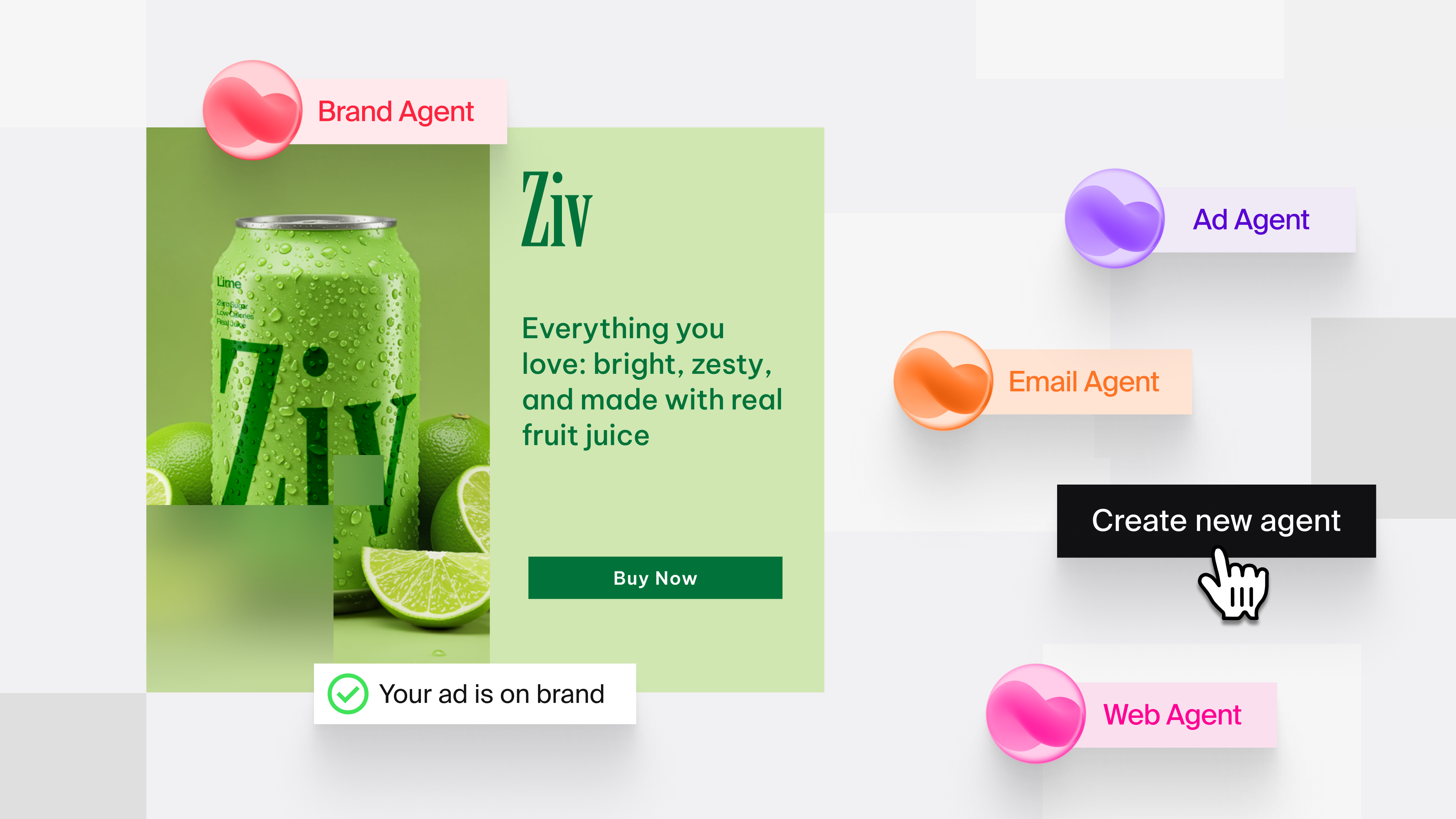
You stay in control of how these agents work. Train them in your brand voice, leadership tone, and visual style so output is recognizable as yours. Review AI-generated content with assistance from Typeface's AI editor before it goes further. And set up review processes so only approved content reaches publishing — orchestration handles the coordination; you still decide what gets the green light.
FAQs
What's the difference between an agentic platform and an AI writing tool?
An AI writing tool generates a draft when you prompt it — one input, one output, repeated for every asset. An orchestration layer takes a single brief and runs it through multiple agents that hand off work to each other, producing a coordinated set of channel-ready assets with far less manual prompting in between.
How many AI agents does a typical campaign use?
It depends on channel mix, but a mid-size campaign commonly runs a content agent, a brand agent, and two or three channel agents — email, paid social, and web — working from the same brief in parallel.
Related articles

August 12, 2026
An agentic AI marketing platform runs marketing tasks autonomously — drafting, adapting, approving, and publishing content across channels without needing a human to trigger every step. Unlike a promp

September 23, 2026
The other day I caught up with a friend who is a content lead at a mid-size B2B company. She told me her team was gearing up for a product launch campaign, and this is how she described the process: "

April 17, 2026
In 2026, agentic AI has moved from experimentation to practice, delivering measurable outcomes. Agentic marketing platforms are autonomously (or semi-autonomously) managing workflows to scale content