April 17, 2026
State of Agentic AI in Marketing 2026: Insights for the Enterprise

Ashwini Pai
Senior Copywriter

AI summary
From manual workflows to multi-agent platforms that run campaigns end to end, enterprise marketing teams are working smarter in 2026. They’re expanding AI across more use cases, supported by platforms with strong brand controls and simple agent building. Typeface brings this together in one place, so you can orchestrate multi-channel campaigns without changing how you work.
In 2026, agentic AI has moved from experimentation to practice, delivering measurable outcomes. Agentic marketing platforms are autonomously (or semi-autonomously) managing workflows to scale content to new channels, audiences, and markets.
In this post, we discuss the latest on how marketing teams are using agentic AI and the actionable steps to apply it to your marketing operations.
TL;DR
An agentic marketing platform has specialized agents that manage workflows end-to-end with human oversight.
A brand intelligence system informs AI outputs and updates dynamically to keep your brand identity recognizable across channels.
Marketing teams commonly use agentic AI to create copy and creatives, as well as to personalize content, and are rapidly expanding to new use cases.
A strong business case for agentic AI ties use cases to measurable ROI, brings key teams together, and proactively addresses brand safety.
Typeface is an enterprise AI marketing platform that uses purpose-built agents to run marketing and creative workflows in one unified system.
What is agentic AI in marketing?
Agentic AI is a form of artificial intelligence that can think and act on goals without a human directing at every step. At its core are AI agents, each built for a specific marketing task.
An agent breaks down a task into steps and completes each using reasoning, data, and tools.
A team of such specialized agents drives campaign scale and speed.
An agentic marketing platform puts AI agents to work across your marketing operations. Agents handle different tasks and channels using your existing tools and workflows while you retain control through team approvals at every critical step.
How is agentic AI different from earlier forms of AI?
Traditional AI mainly analyzes data and makes predictions but can’t act on its own. E.g., it can score leads but can’t draft and send personalized emails to them.
Agentic AI can. It coordinates AI agents, each designed to reason and act within its domain, to run entire workflows. So, one agent scores leads and another drafts personalized emails, which your team member reviews and approves before sending. In a fully autonomous system, emails go straight from agent to recipients.
What are the benefits of agentic AI marketing systems?
Agentic AI helps marketing teams launch campaigns in days, not weeks, making operations more agile and responsive to changing demands. It turns scale into a daily capability rather than a whole-team effort, letting you manage more channels and more audiences without additional support. Crucially, it does all this while maintaining brand voice, visual quality, and compliance standards.
How are marketers using agentic AI in 2026?
According to survey findings, brands have clearly defined their agentic AI marketing use cases, which range from content personalization to marketing strategy. Insurance leads AI agent adoption for marketing and sales, followed by technology and media.
Most common agentic AI use cases today — and rising trends
According to a Databricks study, 40% of AI use cases focus on driving better customer experiences through support, advocacy, onboarding, and personalized marketing. Personalization ranks among the top ten AI use cases across all industries. Data from Salesforce supports this finding, with 75% of marketers using AI to close the gap between the personalized content they need versus what they can produce.
Copy and image generation remain top agent use cases for marketing, and the clearest sign that teams are using agents where the volume pressure is the highest. But this is a fraction of what AI can help marketing achieve.
GWI’s latest survey reflects how vast that potential is, as marketers are open to using AI for a wide range of tasks, from strategy building to market analysis.
80% would consider agentic AI for competitor or market analysis
79% are likely to use AI to help with brand positioning
66% would not hesitate to ask an AI agent to suggest a marketing strategy
72% of marketers would use agentic AI to summarize data
Bottom line: For marketing teams, agentic AI has moved beyond execution and into research, strategy, and branding decisions.
Components of an agentic AI marketing platform
An agentic AI marketing platform uses agents, workflows, tools, and brand intelligence to execute campaigns end to end. It has two levels of governance: 1) automated safety features and audit trails; and 2) what your team puts in place, such as data access controls, editorial reviews, and legal sign-offs. These are the typical components:
A unified system to create, review, and publish: Integrations with your tech stack allow agents to execute campaigns with the right context and in smooth workflows. Connect your CMS, CDP, DAM, email, social and ad platforms, any LLMs you use, and communication channels like Slack and email.
Centralized brand intelligence: Your brand intelligence like voice, visuals, and rules, as well as audience data and approved images, videos, and email and ad layouts live in the platform. They give agents the context they need to keep your content consistently recognizable and credible across channels.
Continuous campaign optimization: AI agents learn from performance data and apply those insights to every campaign that follows. A closed-loop agentic AI marketing platform feeds performance signals directly back to agents so they can continuously adapt their outputs towards better results.
Safe by design plus human oversight: An agentic AI marketing platform built for the enterprise offers strong controls and monitoring. It blocks harmful inputs and keeps your prompts private while your team controls what agents access and what they do.
With this in mind, here’s how an agentic marketing platform works in practice — let’s take a closer look at Typeface.
Example: How Typeface implements this model
Typeface brings enterprise marketing, creative, and IT workflows in one place. You connect your tools, build agents that turn workflows into repeatable systems, and track campaigns from ideation to launch. Rather than repeating context across tools and signing in and out of disconnected systems, you collaborate in a unified platform that protects your focus and time.
How it works
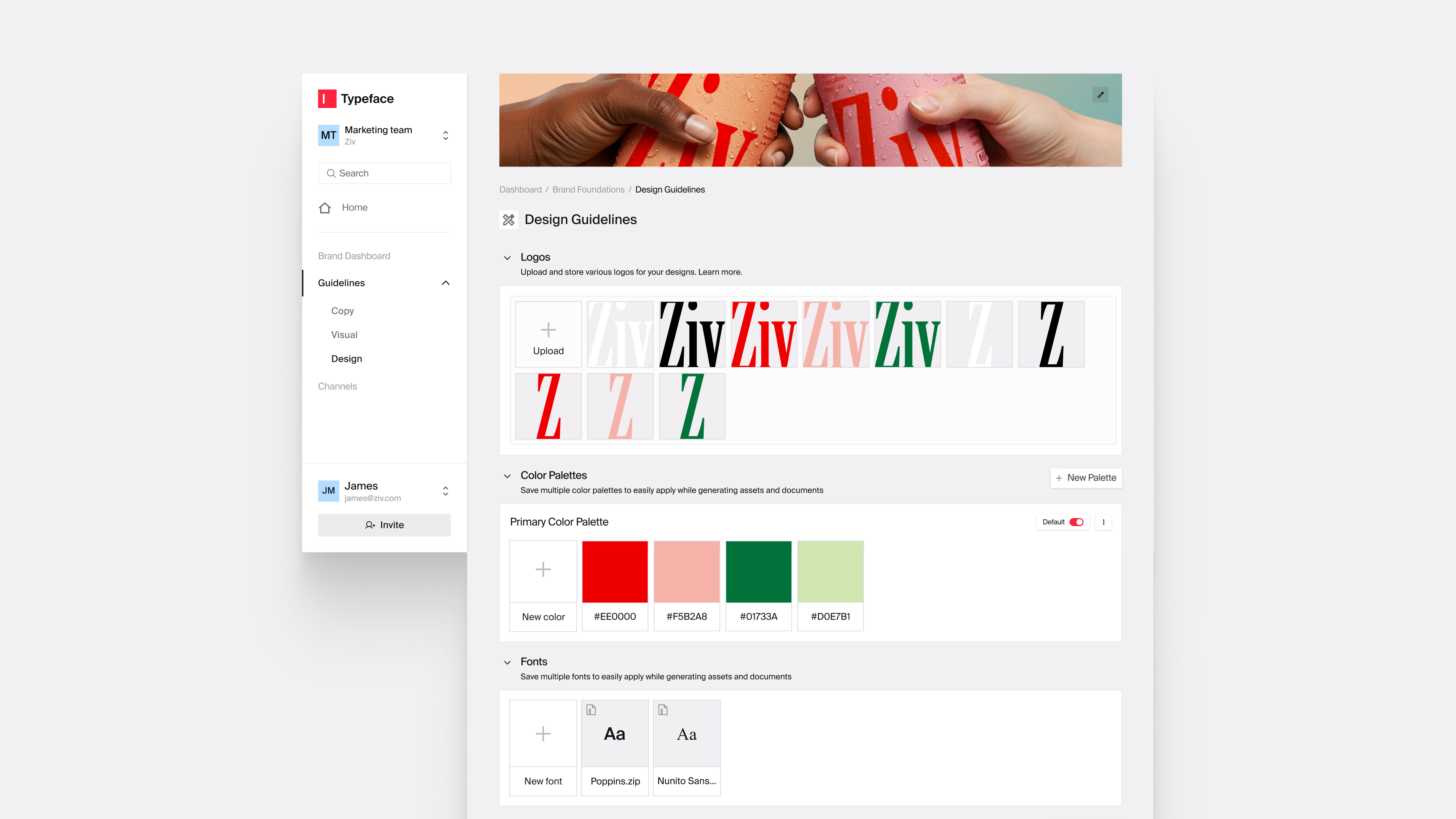
Connect your CDP/CRM and DAM to Typeface, which organizes your brand intelligence into a knowledge graph, Arc Graph. AI agents pull context from it to create relevant, brand-consistent campaigns.
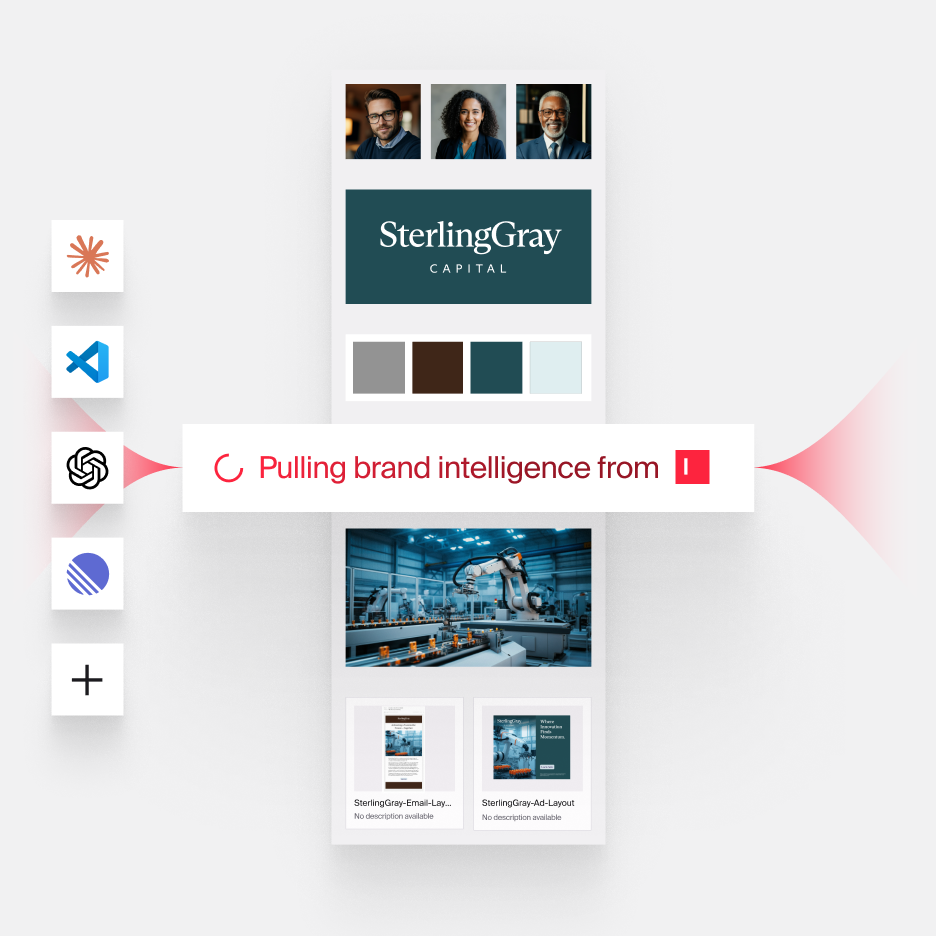
Bring your existing workflows into a collaborative visual canvas, Arc Spaces. If your workflows span multiple tools and LLMs, use Typeface’s Model Context Protocol (MCP) to ensure your brand context travels with you.
Use AI marketing agents, Arc Agents, to scale ad, web, social, and email campaigns.
Here’s a simple ads workflow:
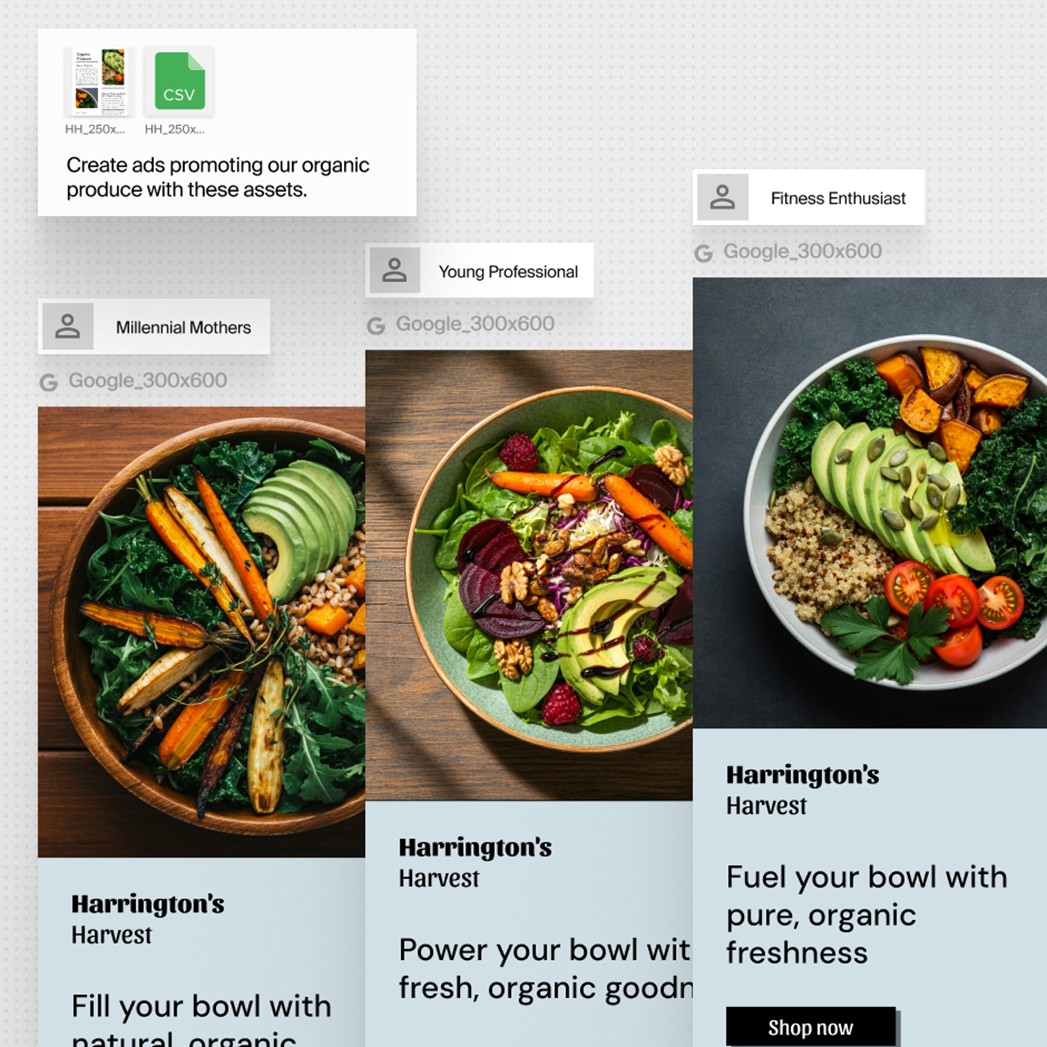
Type your prompt (e.g., Create a banner ads campaign) and attach brand context (e.g., campaign brief, ad layouts, images). Select your Brand Kit to apply your brand rules.
Create personalized variations in one go by simply selecting multiple audiences.
Make copy edits using the built-in editor. Change CTA button colors. Replace banner images with your own or regenerate them.
When your campaign assets are ready, route approvals to editorial and legal teams, all in one place.
(You can bulk create ads this way from your CSV data. Explore more in our academy guide.)
Build more agents in Agent Studio. Identify where they can make a meaningful difference and assemble workflows without complex code.
Typeface is ISO 42001 certified, with the necessary enterprise controls to use generative AI safely and responsibly.

How to build a business case for agentic AI in marketing
Nine out of 10 marketing leaders are betting on agentic AI to improve the customer experience. But they still expect brand safety and visible results. Here’s how you can build both into a strong business case:
Identify use cases that prove the point fast
Pick use cases where you can see impact quickly and let the numbers do the talking. For example, say your team tests more persona-specific email variations, leading to a 30% increase in webinar registrations. Or you produce 25 posts in four weeks compared to 12 in the previous month with the same team size. It’s the kind of data that builds confidence and encourages wider adoption.
Involve the right people
Rolling out AI in the enterprise is both strategic and phased, requiring a clear understanding of workflows, integrations, and pain points. Marketing, IT, and creatives each bring a different lens to implementation and together, help build a clearer vision for expansion. Among them will be enthusiasts and skeptics, and you need both to ask the tough questions and make the best decisions.
Address compliance concerns head on
Enterprise AI marketing platforms are designed with brand safety in mind, but you need to make these assurances visible. A cross-functional team led by IT and marketing should show the compliance architecture like approval checkpoints, brand guardrails and audit logs, upfront. Also make it clear that your team will continue reviewing AI content, keeping brand reliability and relatability intact at scale.
Get AI-ready with Typeface
Create on-brand campaigns at scale with Typeface using your existing workflows. With strong brand controls and no-code agent building, you can confidently expand your generative AI capabilities to create greater impact. Explore Typeface with a demo or get in touch with sales.
FAQs
Q. How do I keep agentic AI output on-brand?
The more precise your brand context, the better the output. Start by training AI agents in your brand voice, visual styles, and messaging rules. Learn the mechanics of prompting and note what works. Copy prompts typically need a clear goal, tone, and word count. Image prompts need more details like the subject, composition, style, and mood. Even as you scale content, monitor AI outputs regularly and flag issues early.
Q. How do I get started with agentic AI in my marketing team?
Identify a repetitive task, map your agentic workflow for it, and set up platform integrations. Bring in your brand intelligence, from audience data to guidelines, and train agents in your brand voice, channel-specific voices, and as needed, author voices. Run the workflows, iterate based on results, then expand to more complex workflows or use cases, keeping IT and vendor support close.
Q. How long does it typically take to see results from an agentic AI marketing platform?
Operational gains like time savings on campaign creation show up within days. Within weeks, the impact on personalization and testing becomes visible, with more audiences reached and more variations tested. In a month or two, you could see a measurable lift in engagement, click-through rates, and sign-ups. Over three to four quarters, higher conversion rates and lower operational costs become apparent.
Q. What are the best marketing use cases of agentic AI?
Top marketing use cases for agentic AI include at-scale personalization, multi-channel campaign execution, and continuous campaign optimization. The teams seeing the most value are moving beyond experimentation and applying agentic AI where speed and scale matter most. You can consider starting with a high-volume workflow like content creation or testing, where agents can create rapidly and learn from signals to improve outcomes over time.
Q. What are the key challenges to adopting agentic AI in marketing?
Data quality issues and legacy systems can delay implementation. In highly regulated industries, a lack of awareness around built-in safety and governance features can slow adoption even when the platform is designed to meet those standards. A third challenge is job anxiety around AI’s impact on roles. It’s a near-universal concern, but one that effective change management can meaningfully address.
Related articles
March 4, 2026
Typeface has crossed a new frontier, evolving into the next generation of the Typeface Orchestration Engine — closing marketing's open loop by bringing brand context, AI agents, and real campaign perf

August 28, 2025
Gartner predicts that by 2025, 30% of outgoing marketing messages from organizations will be generated by AI. But the real game-changer isn't AI writing your emails. It's agentic AI that can make deci

March 4, 2026
Marketing leaders understand AI's potential. They've run pilots, seen the results, and watched their teams get excited about what's possible. Then, they walk into the budget meeting, and that’s where