July 3, 2026
AI-Powered Brand Intelligence — A Guide for CMOs

Akshita Sharma
Senior Content Marketing Associate

AI summary
Brand drift usually happens because brand knowledge lives outside the tools teams use to create content. This post breaks down how AI-powered brand intelligence fixes that, by connecting your brand standards, campaign learnings, and audience context to every stage of how content gets made, reviewed, and executed.
A recent survey put branding at the top of the priority list for marketing leaders. Which tells you something important about the moment we're in: the pressure to differentiate is real, and everyone feels it.
But for most enterprise teams right now, AI has scaled content production without solving the differentiation problem. Generative AI is remarkable at what it does, but without something to anchor it to your brand specifically, it drifts. It defaults to producing the average of everything it has been trained on.
So, the real problem for CMOs today isn’t scaling content (at this point, generation is commoditized). The real problem is now scaling on-brand content. And that's a question of whether your brand intelligence is built for AI to use. This post breaks down what that looks like in practice.
TL;DR
Most enterprise brand programs break at the same point: the gap between knowing what good looks like and producing it consistently at scale.
When brand knowledge lives in PDFs, guidelines get referenced at the brief stage and forgotten by execution, and reviews happen after content ships, brand drift becomes inevitable.
The fix is connecting brand knowledge to the workflow. When AI draws from your brand foundation at the point of creation, consistency becomes a starting condition.
In Typeface, brand intelligence works across three stages: Arc Graph centralizes your brand knowledge into a single, queryable foundation. Arc Agents and Brand Agent ensure content is generated and reviewed against your actual brand standards. Arc Spaces keeps campaigns coherent across teams and channels.
You'll know your brand intelligence system is working when review cycles shorten and drift gets caught in draft rather than post-publish.
Where does brand compliance break down?
Brand compliance breaks down when teams try to scale decisions that were never fully documented in the first place.
Every marketing team runs on two kinds of brand knowledge.
The explicit kind lives in your guidelines. Documented voice and tone parameters, naming conventions, visual standards.
The implicit kind lives in the heads of your most experienced marketers. Why does a particular headline work for this audience but not that one. What "too formal" looks like for your brand specifically. Which approved claim lands with enterprise buyers, and which one falls flat. It's the judgment your best people built from years of pattern recognition.
When content volume is low and marketers are reviewing every asset, brand compliance is manageable. The guidelines provide the framework, and experienced judgment fills in the gaps. The implicit knowledge your best people carry stays in the room.
But when your team is generating hundreds of assets a week, brand drift becomes inevitable. Guidelines get referenced at the brief stage, then set aside while content gets made. Someone flags "this doesn't sound like us" three weeks later, and by that point, dozens of assets are already in the market.
An AI-powered brand intelligence system fixes this by moving brand knowledge from an afterthought to a starting point. When your explicit guidelines and your accumulated implicit knowledge (from past campaign learnings and performance signals) live inside your content creation environment, brand context is present when content gets made, not applied afterward.
Brand intelligence is embedded at every stage of how your marketing team works.
What is AI-powered brand intelligence?
AI-powered brand intelligence is the infrastructure that connects what your brand knows to what your AI produces. It's how your documented standards, accumulated campaign learnings, audience context, and the implicit knowledge your best marketers carry get structured get structured in a way that AI can draw from during content creation.
Typeface is built around this idea. Its brand intelligence layer sits at the center of how content gets created and reviewed, so brand context isn't something your team has to manually reintroduce at every stage.
How does brand intelligence move through a real content workflow?
Fixing the gap between brand knowledge and brand action requires connecting intelligence to the workflow at every stage, from how brand knowledge gets stored, to how it shapes what gets created, to how it holds together across a full campaign.
Here’s how that looks like in practice:
Stage one: Centralizing your brand knowledge
Most brands have brand knowledge scattered across multiple owners and formats: visual standards guide owned by design, messaging frameworks with marketing, campaign learnings that live in individual teams' institutional memory, and audience insights sitting in a separate tool. None of it is connected in a way that can be used as a coherent source of truth during content generation.
To create a brand intelligence system that scales, you’ll need to get your brand knowledge out of PDFs and into a structure your AI tools can draw from. This brand system updates when your brand evolves. It's queryable: your AI can pull from it in real time rather than working from a snapshot. And it's connected to the tools your team uses to create content.
In Typeface, Arc Graph provides this layer. It's where your brand standards, approved assets, audience data, and campaign context live together in a single system that AI agents draw from whenever they create content.
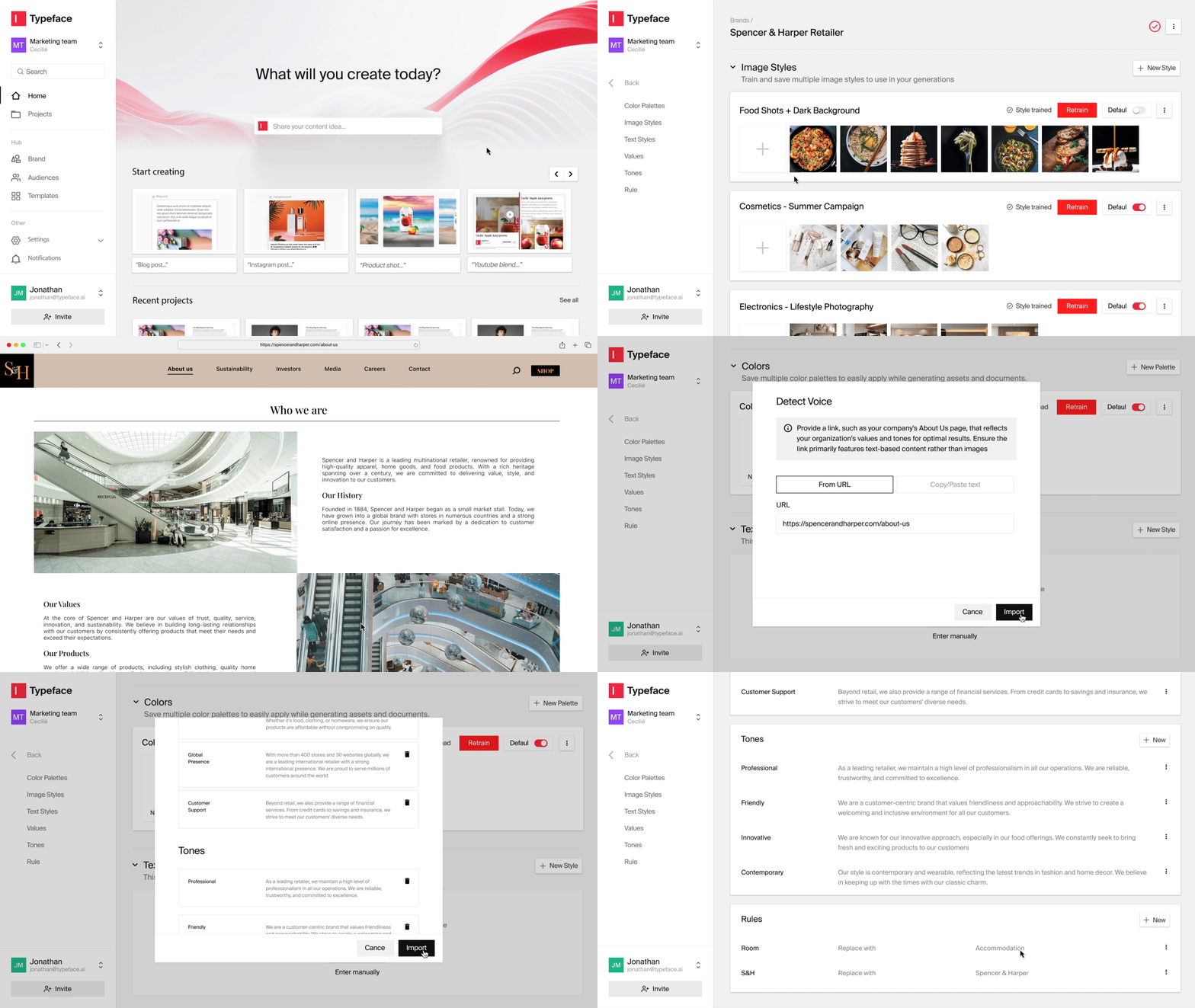
When your team generates a campaign, they work from a centralized brand foundation that already knows who your audiences are, what your messaging priorities are, and what good looks like.
Real world impact:
Real world impact:
A Fortune 100 insurance company cut creative production time by 90% without sacrificing brand control and governance. Their approach: trained brand inputs (guidelines, approved assets) fed directly into the workflow, with human review kept in the loop at every stage.
Stage two: Creating content that starts on brand
Once your brand knowledge is centralized and structured, the next question is how your team creates content from it. (This is where most platforms stop short.)
They give you a knowledge repository and a separate generation tool, leaving your team to bridge the gap manually.
Your brand knowledge should inform content generation automatically, not because someone remembered to paste in the right guidelines.
An AI-powered brand intelligence system eliminates that gap. In Typeface, for instance, the creation environment is built on top of the brand foundation. Arc Agents draws from Arc Graph when generating content, which means every draft starts from your current brand standards and audience context rather than from generic AI defaults.
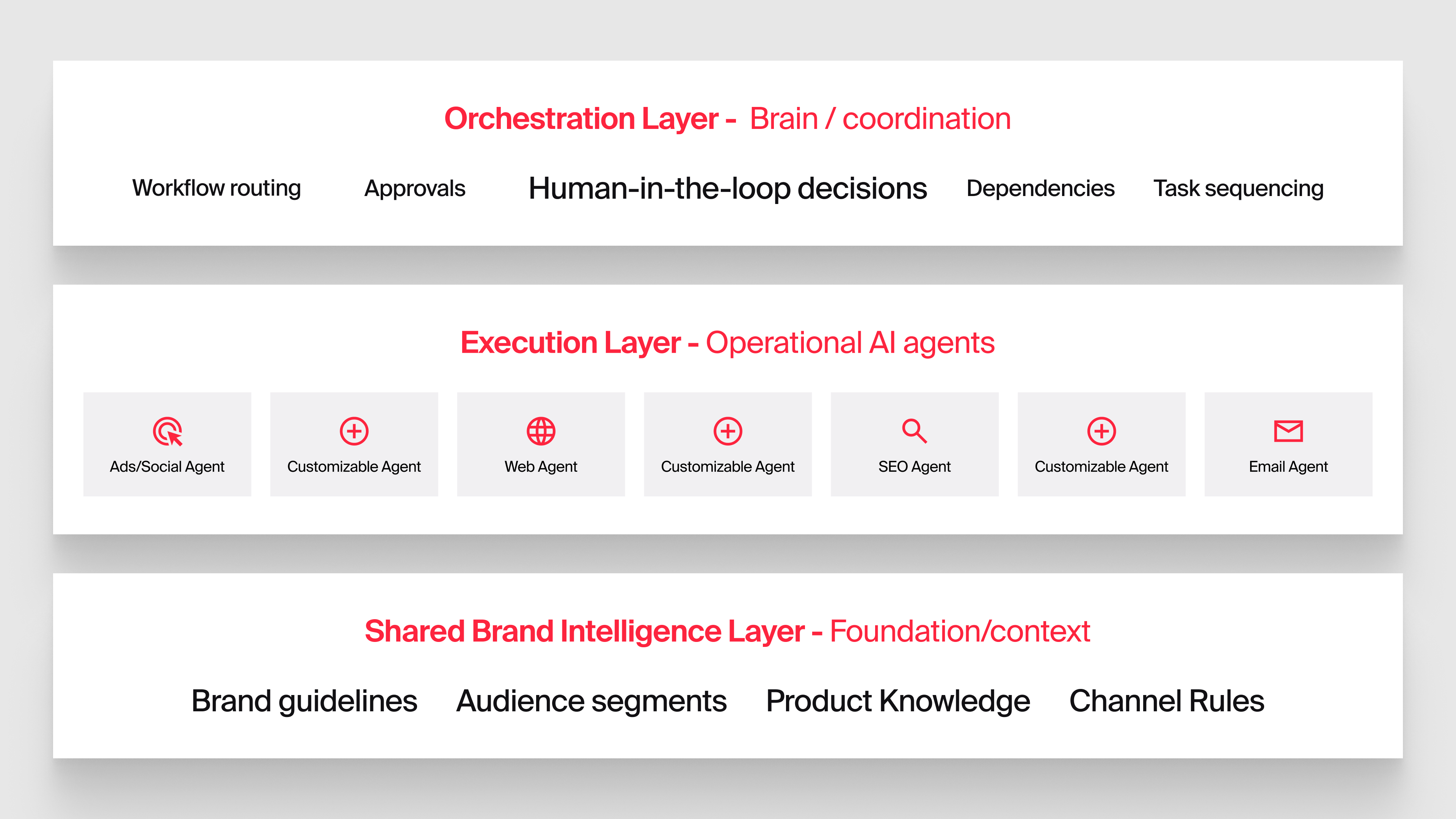
But generation is only half the equation. Content gets edited after it's generated, and that's often where drift creeps back in. Brand Agent closes that gap.
Before anything moves forward, you can use Brand Agent to evaluate the draft against your Arc Graph: voice, tone, messaging alignment, terminology, and positioning. It flags what's off and why, so the fix happens before the content moves to the next stage, not after it's already shipped.
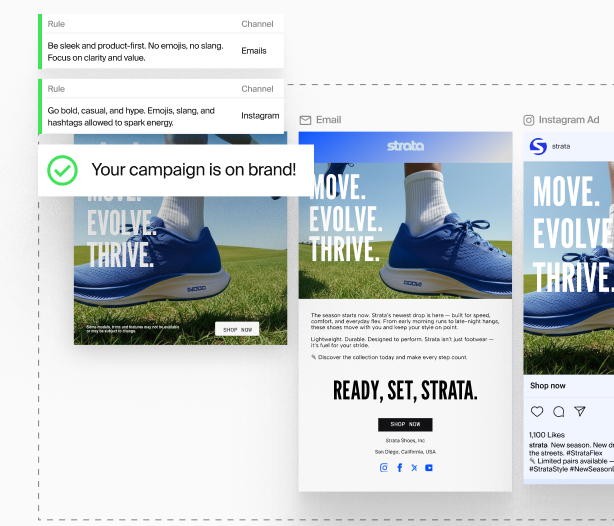
That governance extends beyond copy. The Visual Brand Evaluator automatically checks images and creative assets against your visual guidelines as content is produced, so brand consistency holds across text and creative.
And for full visibility into how content evolved, Typeface shows the progression from original draft to brand-enforced version to final validated output, so reviewers can see exactly what changed and why.
Stage three: Running campaigns without losing brand coherence
Your marketing team can produce on-brand individual assets and still run campaigns that feel fragmented. That could be because the assets weren't created in a shared context, the review process happened in disconnected tools, and the teams responsible for different channels never had a synchronized view of what was going out.
This is the execution problem that your brand intelligence system has to solve.
Arc Spaces is the shared workspace in Typeface where campaign content moves through coordination and reviews in one environment. Instead of content traveling through email/Slack threads and disconnected approval tools, it lives in a space where your internal team, regional marketers, creative leads, and agency partners all have visibility into the status of campaigns.
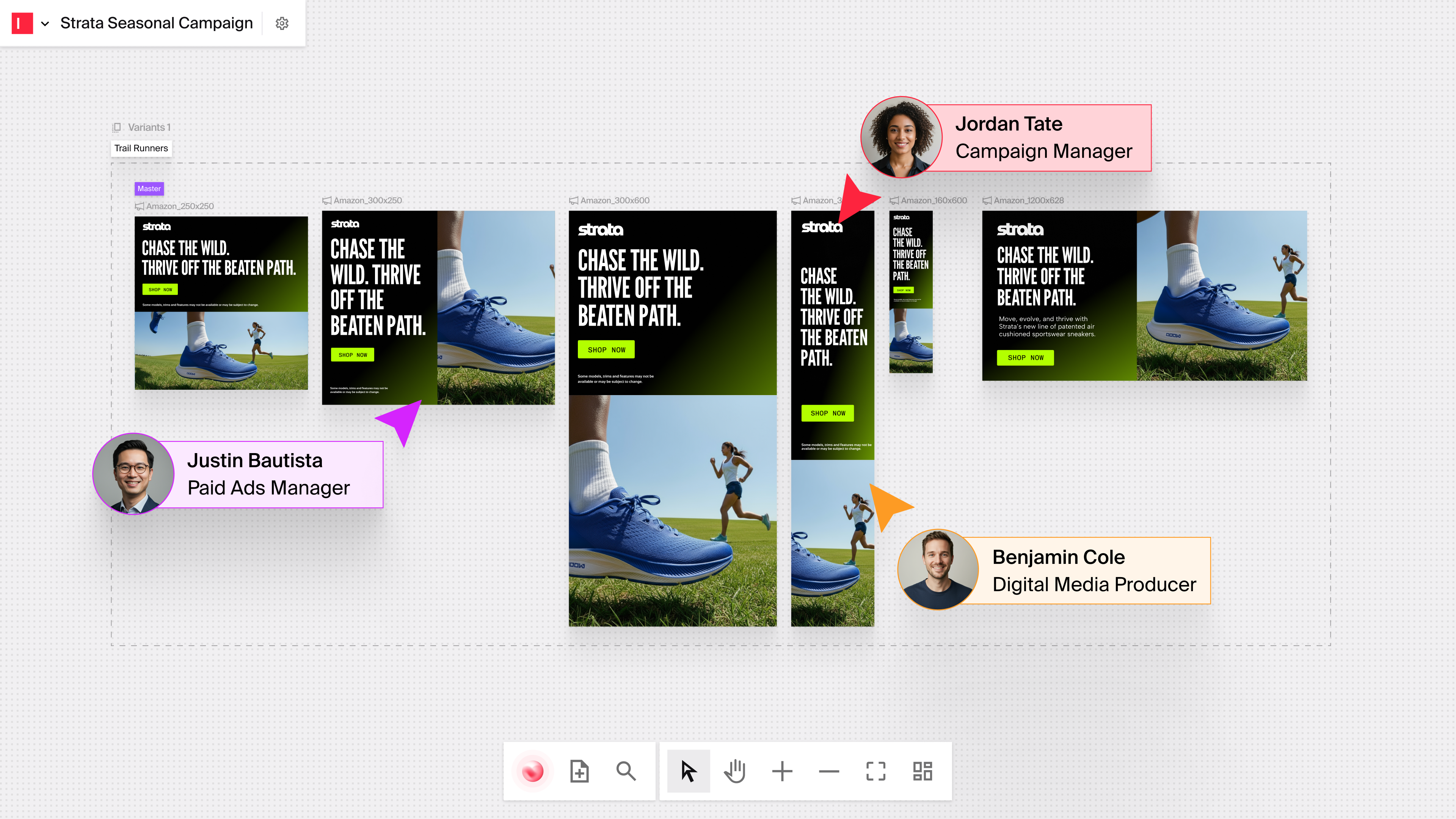
When everyone works in the same environment, feedback loops are shortened. Drift that would have slipped through disconnected handoffs gets caught in the workflow.
How you know your brand intelligence system is working
Three signals tell you whether your brand intelligence system is doing its job:
Brand consistency scores trend upward across content types. It improves over time as Arc Graph gets richer and Brand Agent gets more specific in its guidance. If scores plateau, you’ll know that the knowledge layer needs updating.
Review cycles time come down. If AI-generated drafts are reaching approval faster with fewer revision rounds, your brand baseline is working. Drafts start closer to ready because the AI is generating from current, specific brand context rather than a generic prompt.
Brand drift gets caught earlier. Track when brand deviations are caught: in draft, in review, post-publish. A system that's working catches more in draft. The earlier in the cycle enforcement happens, the less expensive brand drift becomes to fix.
AI search share of voice is a longer-horizon metric worth tracking alongside these. As your brand intelligence system produces more consistently on-brand, well-structured content over time, the probability of appearing accurately in AI-generated answers grows. It's a slow-building return, but one that rewards sustained consistency.
The infrastructure under all of this
Brand intelligence is infrastructure you build over, connecting your brand knowledge to your content creation to your campaign execution in a way that's usable by everyone involved.
When that infrastructure is in place, your organization can start generating consistently, from a shared brand foundation that doesn't require constant manual correction. Typeface makes that possible today.
Get a demo to see how enterprise teams are using Typeface to scale on-brand campaigns.
FAQs
Q. How is brand intelligence different from brand monitoring?
Brand monitoring tracks what's being said about your brand across channels: social, reviews, AI search results, media coverage. A brand intelligence system takes those signals and connects them to how your team creates content and runs campaigns.
The difference between brand intelligence and brand monitoring is where the intelligence lands. Monitoring gives you a dashboard. A brand intelligence system gives you a content workflow that's governed by what you know about your brand in real time. Most enterprise teams have the first. The second is what makes brand consistency scalable.
Q. How does Arc Graph work as a brand knowledge foundation?
Arc Graph is the centralized knowledge system in Typeface where your brand standards, approved assets, audience definitions, and campaign context live together. When AI agents generate content, they draw from Arc Graph rather than working from a blank prompt or a generic instruction set. That means every draft starts from your current brand foundation, including updates made since the initial setup.
Q. What does Brand Agent do during content review?
Brand Agent evaluates AI-generated content against your Arc Graph in real time. Ask "is this on-brand?" and it assesses the draft for voice and tone alignment, messaging consistency, terminology, and positioning, then flags what's off and explains why.
It's most useful at two points: after a human significantly edits an AI draft (introducing drift), and when a new content type is created. Brand Agent doesn't replace human review. It gives reviewers the context they need to make faster, more consistent decisions.
Q. How does Arc Spaces help with brand consistency across a campaign?
Arc Spaces is the shared campaign environment in Typeface where content moves through review and execution with brand context attached. When everyone working on a campaign (internal teams, regional marketers, agency partners) works in the same space, the brand guidelines, the content assets, and the approval status all live in one place.
Reviewers see brand context alongside the work, not reconstructed from memory. That structural change reduces the brand-related revision cycles that tend to accumulate when campaigns are managed through disconnected tools.
Q. How do I keep my brand knowledge current as my brand evolves?
Arc Graph is designed to update as your brand evolves, not to sit as a one-time snapshot. When messaging changes or audience priorities shift, those updates flow into Arc Graph and automatically inform subsequent content generation.
What makes this work organizationally is having a defined owner for Arc Graph: someone whose job includes translating brand changes and campaign learnings into updates to the knowledge layer. Without that, even the best-designed system drifts.
Q. Will AI content generation replace my brand team's judgment?
No, and it's worth being clear about this. Arc Agents and Arc Fabric create from your brand foundation and Brand Agent flags drift, but neither replaces the judgment call about what your brand should stand for in a new market, how to respond to a brand perception problem, or whether a creative direction is right for this moment. What they do is remove the low-judgment work: checking whether terminology is correct, whether tone is consistent, whether assets follow visual standards, so your brand team can focus on the decisions that require expertise.
Related articles

June 5, 2026
Brand monitoring and brand intelligence are distinct yet connected activities that shape your company’s image and growth. Monitoring your brand is straightforward. Turning patterns into insights is ha
May 23, 2026
When brand consistency works, it's invisible. Everyone feels it. Only you know how much work goes into making your brand look and sound the same everywhere your audience meets you. And you also know t

September 23, 2026
Your brand doesn't live in one place anymore. It lives everywhere, all at once, and most of it is outside your direct control. Right now, somewhere on the internet, an AI assistant is summarizing you