April 10, 2025
AI Advertising: Tips to Boost Your Meta Ads Campaigns Effortlessly

Neelam Goswami
Senior Content Marketing Associate

AI summary
Using AI to generate personalized ad variations and analyze real-time performance can elevate your Meta Ads strategy with less manual effort. This blog explains how adopting AI-powered workflows helps marketers optimize targeting, creativities, and overall campaign success.
Meta Ads' strength lies in its massive global footprint and granular targeting. AI lets you pair that with a high volume of asset variations and diverse content formats. You can create more persona angles, test different headlines, animate static creatives, and keep feeding Meta ad variants that work well across your audiences.
AI automates different parts of Meta ad creation. In fact, a single AI marketing platform can handle copy and creative generation, as well as personalization, location, and resizing. Now, brand-governed workflows keep every variant on-brand, and closed-loop feedback makes each new cycle iteratively better. See how they impact how you create Meta ads with AI.
Anatomy of a good Meta ad
Crafting an effective Meta ad is about blending the right elements in the right way — let's break down the anatomy of a stellar Meta Ad and what makes it stick.
Compelling visuals: First things first – social media ads are all about catching the audience’s attention with great visuals. Whether it’s vibrant images or eye-catching videos, your ad creative must make the audience want to stop and look.
Clear and concise copy: Pairing your visuals with succinct text is essential. Your message should be compelling yet clear and should echo your brand's voice. Every word counts when attention spans are short.
Engaging Call-to-Action (CTA): Your CTA is the guiding star of your ad. Whether it's "Shop Now," "Learn More," or "Sign Up," it needs to be motivating and lead your audience to take action without hesitation.
What's in it for me (WIIFM): Spell out the key benefits of your product or service. Why should someone choose you over the competition? If you can convey that in your ad, you're halfway to converting a lead.
Testing and tweaking: To get the most out of your ads, adopt a test-and-learn approach. Experiment with different headlines, visuals, and CTAs. Analyzing what performs best and adjusting accordingly will help you discover the secret sauce for your audience. This is where an AI ad generator can come in extremely handy and save you a lot of time.
How to use AI advertising to boost the impact of Meta Ads
Here are a few ways you can leverage AI advertising for your Meta Ads campaigns.
Create micro-targeted ads for different audience segments Meta Ads lets you target specific audiences with features like Custom Audiences and Lookalike Audiences. AI makes the job simpler. Case in point: Typeface.
On Typeface, you can save multiple audience segments and apply them to AI generations, for both visuals and text. You can use one of our out-of-the-box connectors to bring in your audience segments, or create them by defining account attributes (B2B) or demographic details and buying behaviors (B2C).
Your audiences are centralized in Arc Graph, a knowledge graph that connects everything about your brand and embeds it into content generation workflows. Concretely, that means your brand guidelines for copy and visuals, your brand rules for terminology, and your formatting requirements, apply to every ad.
Experiment with different ad hooks and creatives
An AI advertising tool creates entire campaigns. Handling copy and creatives (images and animated formats) for Meta ads, it frees your team ad campaigns that AI shouldn't own. Your team can, instead, review AI-generated Meta ads and keep the pipeline full to beat ad fatigue and stay on top of testing and analysis.
Typeface is multimodal, so it can work across multiple formats and produce contextual copy, visuals, and animations. No need for multiple AI tools, repetitive instructions, and elaborate prompts.
Start with a simple prompt and relevant context. Select audiences to personalize (even multiple segments together) or localize ad creative with instructions (e.g., "Make the background Middle Eastern"). You can even bulk generate ads with a CSV.
Related reading: How to Scale Ad Campaigns with Ad Agent
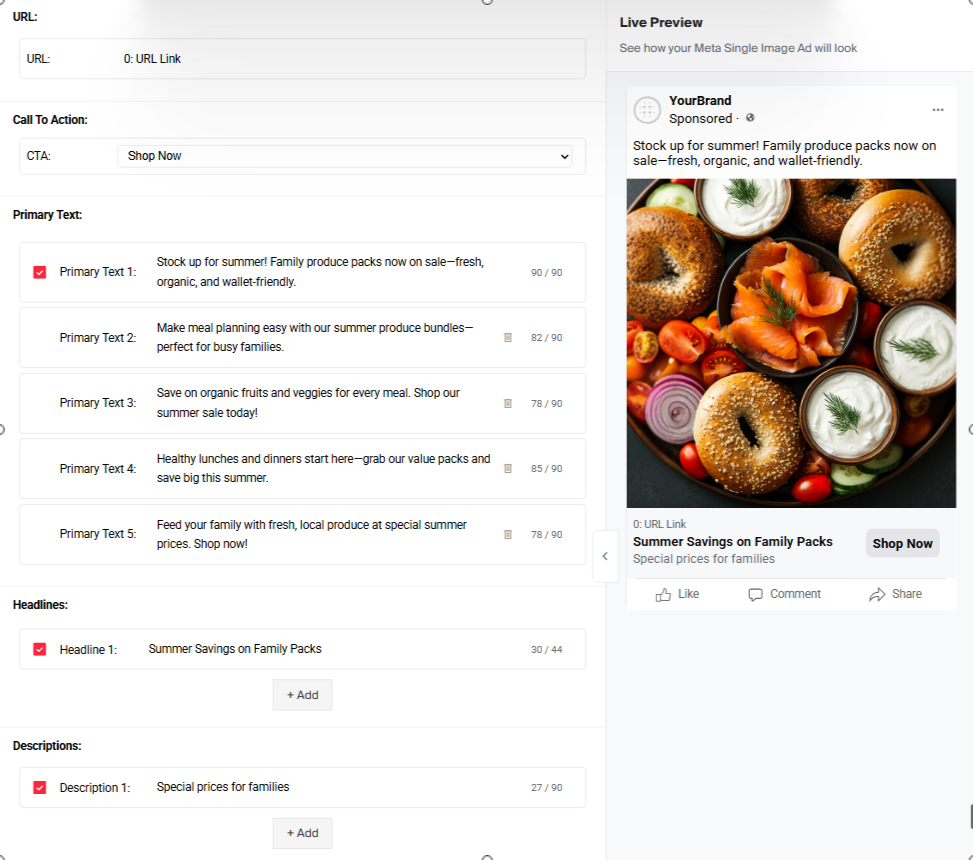
Test out different Meta ad formats with AI advertising tools
Ad formats not only vary from one social media platform to another, but also within the same platform. Depending on where you want your ad placed, the ad format can change. For instance, a Facebook Feed ad would have a different format from a Right Column ad. Manually resizing every ad for different formats and platforms can seem like added work for an already busy marketing team.
AI advertising tools can automate this process, giving you ads tailored to each platform and format without any manual effort needed. On Typeface, Ad Agent adapts a single ad creative into different aspect ratios to meet channel-specific requirements, without affecting the integrity of the design. From image cropping to outpainting, it cleanly resizes ads for different platforms.
Choose ad placements carefully
Where your ads appear can make a big difference. Ad placements can vary depending on the goal of your ad campaign or your budget. Meta Ads lets you choose the placement or use their Advantage+ Placements, which automatically picks the best placements and optimizes the creatives to fit the specific placements.
When choosing placements manually, you can decide if you want the ads to appear in Facebook feed, right column, Instagram feed, Instagram stories, and so on.
There are pros and cons of choosing different placements. For instance, feeds can give you more visibility, but you will also face higher competition here. The cost-per-click (CPC) can also vary depending on the ad format and placement.
You can use an AI ad generator to create multiple variations of your ads to test which ad placements work best for you, bringing in high-quality leads. By quickly learning from your campaign performance, you can modify your placements to get the most from your ad spend.
Repurpose ads
Turn ads into posts across social media channels. Typeface reformats the asset and applies the channel-specific tone you've set.
Create Meta ads with motion
Select static ads you want to animate and tell Ad Agent what elements to add motion to. It applies realistic physics to the specified elements without distorting your product or original design.
Improve ads with every campaign
AI can learn from your best-performing ads. Feeding performance data into how AI creates ads can measurably improve performance over time. At Typeface, we're building toward closed-loop optimization with Arc Loop — a content flywheel that turns performance data into action, creating a system that adjusts itself.
Get the most out of your Meta ads
Rapid ad testing. Personalized variants in minutes. Localized scenes and translated copy without the complexity. Auto-resizing for different placements. Typeface makes your Meta ads workflows more efficient while supporting ad performance.
Get a demo or discuss ad use cases with our team.
FAQs
1. Do I need a big content library or historical campaign data before AI can generate effective Meta ads?
Typeface starts from your brand guidelines. Arc Graph centralizes your brand voice, visual rules, and terminology, so AI generations are on-brand from the first prompt.
2. How much creative control does my team keep versus the AI?
You steer the output, collaborating with Ad Agent and reviewing outputs at every step. AI takes care of the copy, creative, and resizing, but nothing ships without your team's review.
3. Does Typeface work for platforms beyond Meta, or is it Meta-specific?
Typeface is multimodal and not built around a single channel. The same brand-governed generation and testing approach used for Meta Ads extends to other paid and organic channels.
4. What happens if an AI-generated ad doesn't match your brand voice?
As generations are grounded in Arc Graph, most outputs already reflect your brand rules. If something's off, your team can adjust the prompt, add more specific brand guidance, or edit the output directly. Nothing publishes without review, so brand misses get caught before they go live.
Related articles

March 31, 2025
While new social platforms come and go, Facebook remains the top choice for marketing and advertising, with over 80% of marketers preferring it. Recent Pew Research data shows that Facebook is where m

January 16, 2025
Enterprise marketers are facing a paradox, while social media and ad spending globally races toward $345 billion by 2029, the efficiency of that spend is declining or unclear. The days of reliable CP

March 18, 2026
With 11.4 million searches happening every minute across Google Search and Display Network, the opportunity to reach customers is massive, but so is the work required to do it well. Creating a single