April 29, 2026
Arc Fabric: Turning Marketing into a Repeatable, Scalable System

Dhruv Sood
Product Manager
AI summary
Many teams are able to achieve individual AI wins, but they struggle to turn these wins into repeatable, scalable results. Arc Fabric is Typeface's infrastructure layer that helps IT and marketers do exactly that: codify what works, govern it, and scale it across the organization.
You likely already have AI pilots running in pockets of the business, teams experimenting with prompts, and a small group of power users getting impressive results. Yet those wins rarely become reliable systems. They sit in Slack threads and one-off documents.
Arc Fabric helps in turning those AI wins into governed workflows your whole team can run at scale. It gives IT the infrastructure to codify what works, connect it to existing systems, and make it reusable across teams.
Why marketing AI adoption depends on IT
As AI becomes part of everyday marketing work, cross-functional collaboration is taking center stage more than ever. The teams getting the most out of AI are the ones where marketing and IT are working together from the start, deciding how AI fits into existing systems, how it supports real workflows, and how teams can actually use it day to day.
Gartner found that 3 in 5 organizations exceeding their AI goals run an integrated, enterprise-wide strategy, not isolated pilots. And half of those high-performing organizations have IT and business units working together.
But in many organizations, alignment between the two happens too late. IT gets pulled in after workflows are already designed, or marketing moves ahead without the governance layer in place. The result is duplicated effort, manual fixes, and workflows that are hard to standardize across teams.
Closing that gap requires each team to play to its strengths: marketing defining the use cases and content needs, while IT brings the infrastructure, data, and governance to make those workflows reliable and secure.
Here’s a playbook that works:
Build: IT captures what's already working and turns it into agents with the right logic, data, and constraints baked in
Govern: compliance rules, brand guardrails, and approval workflows are embedded at the system level
Scale: any team can run a validated workflow without starting from scratch or depending on a power user to show them how
This is where Marketing Engineers and Content Engineers come in. These are people who can build AI agents tailored to specific marketing workflows and keep them running reliably at scale, with the right controls. Arc Fabric is built specifically for these teams, giving them the infrastructure to build, govern, and scale AI workflows.
What is Arc Fabric?
Arc Fabric gives IT teams everything needed to turn repeatable marketing workflows into custom agents that run with the right logic, data, and control. It reduces manual setup, one-off fixes, and the friction that usually slows AI adoption down the moment you try to scale it across teams.
Arc Fabric is built on three core components:
1. Build governed, scalable marketing agents with Agent Studio
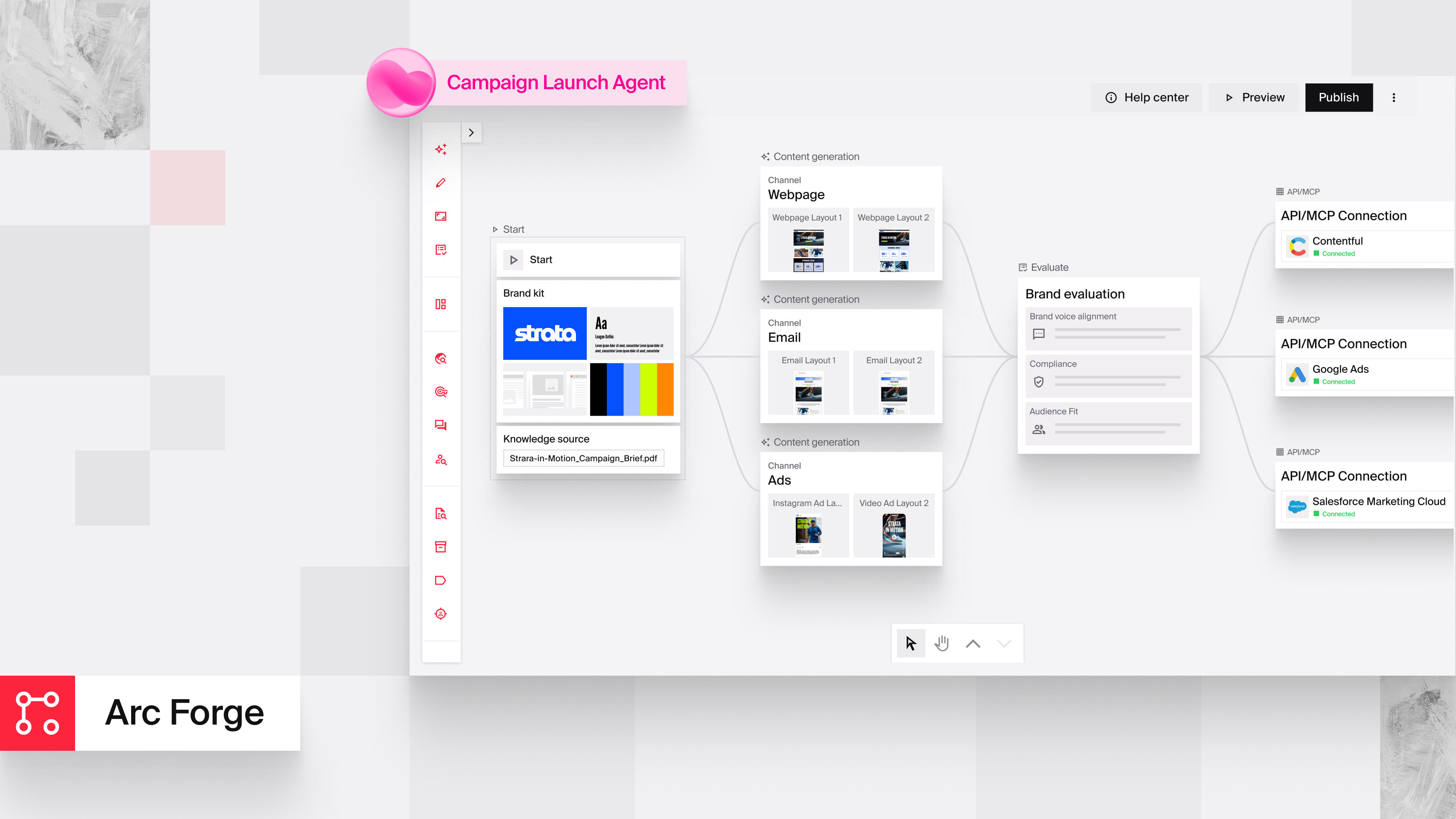
Every workflow your marketing team relies on can be codified and turned into custom agents the entire organization can use, across campaigns, markets, and channels. IT sets the rules once, including inputs and constraints, then your teams run faster with fewer errors and less rework. Agent Studio gives you this control in a no-code environment that’s easy to manage.
Specifically, it allows you to:
Scale proven marketing workflows across channels, products, and audiences by capturing them in custom agents, all without writing a line of code.
Run high-volume campaigns with custom agents that can process structured inputs like CSVs, collections, and bulk records.
Create outputs that reflect your brand, audience, and campaign context
by giving every agent access to the right data.Automate even your most complex or proprietary workflows by extending agents with APIs, webhooks, or custom code.
Governance is embedded at every step. IT teams can set permission tiers, enforce approval workflows, and encode brand and compliance rules directly into agents, ensuring every execution meets enterprise standards.
2. Run agents with full context inside existing tools with MCP
Your teams can also use agents directly in the tools they already work in, so adoption doesn't depend on getting everyone into a new platform. Typeface MCP brings your brand context, assets, and approved workflows directly inside any MCP-compatible environment, whether that is Claude, ChatGPT, or VS Code.
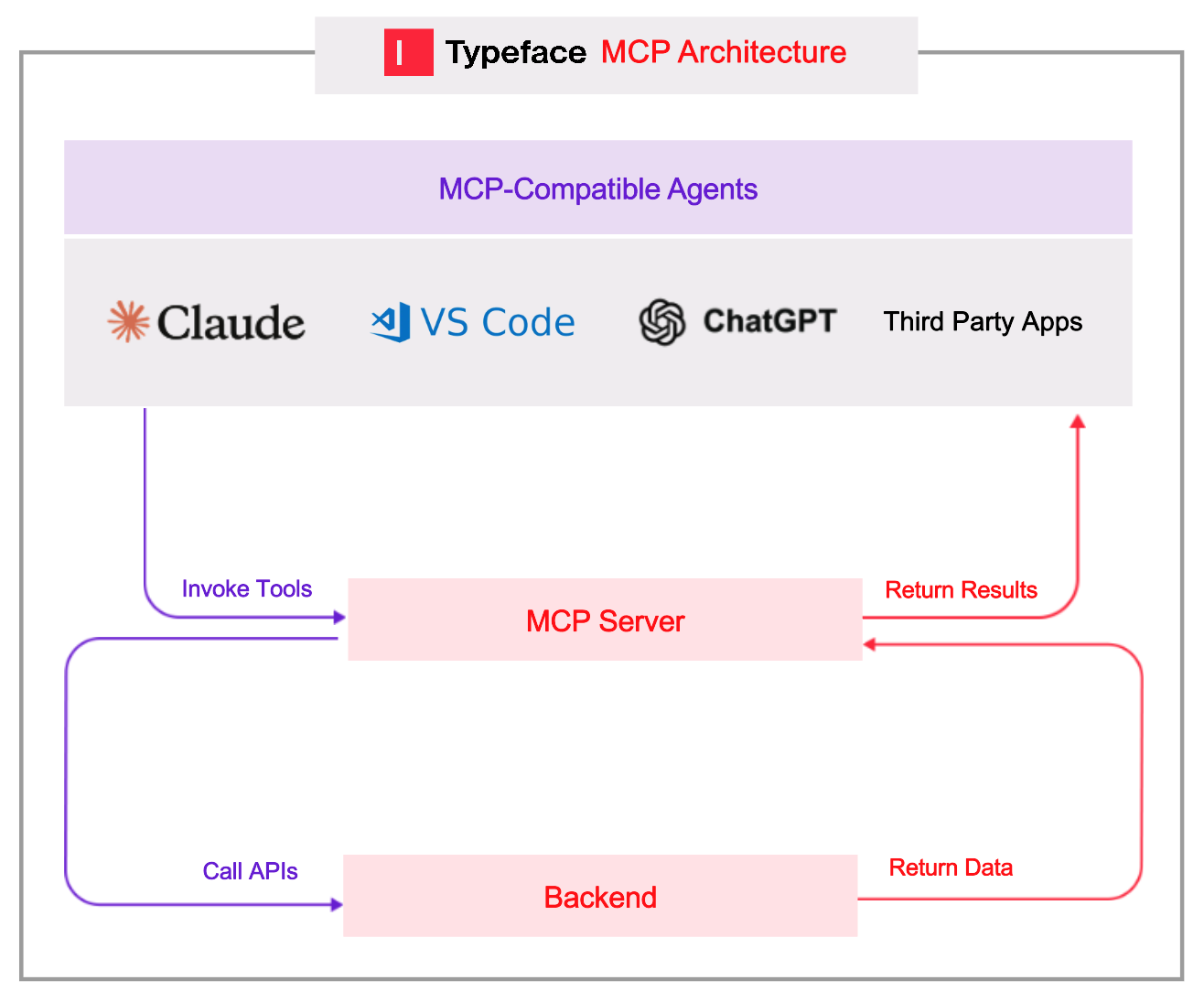
Because MCP uses secure, permission-based access with audit trails, IT keeps full visibility into what’s being generated and where, without restricting how teams work.
Learn more: Introducing Typeface MCP: Context-Aware Content, Right Where You Work
3. Connect, automate, and publish across your stack with APIs and integrations
Your AI workflows are more useful when they plug into the rest of your stack. Arc Fabric lets agents connect with your existing systems, pull from the right systems and data sources at every step, and trigger actions across them.
Pre-built connectors let workflows run end to end across Adobe Experience Manager, Salesforce, HubSpot, Braze, Google, and other commonly used tools, without workarounds or manual handoffs.
You can also extend workflows to fit your environment. Import any REST API to bring external systems into your workflows or embed Typeface into internal tools.
That means your teams can streamline workflows and publish directly into the platforms they already use, without switching systems or stitching tools together.
How Arc Fabric drives ROI for enterprise teams
The case for Arc Fabric is built on the compounding effect of making every successful marketing workflow reusable. As more workflows run through governed agents, your organization gets faster, more consistent, and more confident with AI.
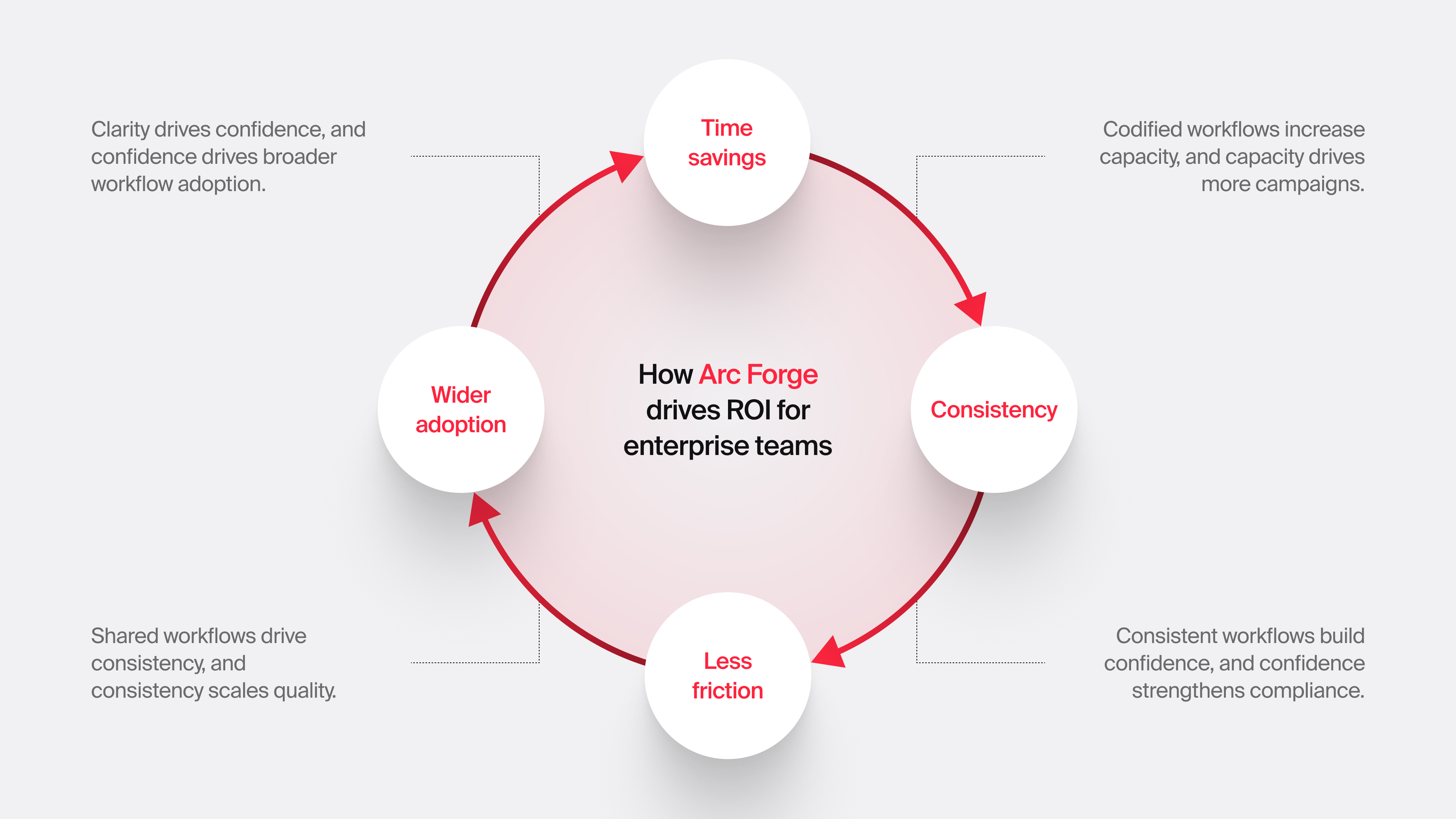
The outcomes show up in multiple ways:
Time savings become apparent quickly. When workflow logic is codified into custom agents, every subsequent run removes the manual setup and repetitive effort behind it. Workflows are built, tested, and ready to run. Teams spend less time setting things up, repeating the same steps, or figuring out how to get started, so the time savings stack up across the full campaign lifecycle.
Real-world impact
Real-world impact
A Fortune 100 financial services company was running campaigns across paid social, web, and email with no centralized system to coordinate messaging. Building audience variants meant manual work for every segment and lifecycle stage. Campaign launches averaged six weeks from brief to live.
With Arc Fabric: They built a custom campaign agent that standardized personalization into a single, centralized workflow. That same workflow now runs in 7.5 hours. That’s a 99% reduction in campaign production time.
You also see it in consistency. When workflows are standardized, quality doesn’t depend on individual execution. Teams produce more consistent content because they’re running the same governed workflows. Arc Graph (our brand intelligence layer) ensures brand rules, tone, and compliance requirements are built into every agent run and applied automatically.
Real-world impact
Real-world impact
A Fortune 500 CPG brand was rewriting Product Detail Page (PDP) copy from scratch for every new product launch and retailer expansion, adjusting character limits, keyword rules, and feature bullets manually, for every SKU. The result was a Performance Marketing team buried in adaptation work instead of strategy.
With Arc Fabric: They built a custom agent trained on their product catalog and retailer specifications. The agent now automatically transforms master PDP copy into compliant, correctly formatted copy for every retailer. Approved keyword guidance and brand rules are applied automatically across every SKU.
When you’re working with AI across multiple tools, every context switch introduces risk and delay. Teams often spend hours just reorienting, time that adds up across every campaign your team runs. Arc Fabric ensures there’s less friction across the entire workflow. With MCP and pre-built connectors, data flows in from the right systems, outputs go directly to where they need to be, and context doesn’t get lost between steps.
Organization-wide adoption of AI also improves when teams feel set up to succeed. Arc Fabric turns complex workflows into clearly defined agents with brand context, compliance rules, and guardrails already built in. Instead of figuring out how to use AI, teams run a process that IT has already built and validated for them. That clarity is what drives consistent, confident usage across the organization.
From one-off wins to workflows that scale
You have AI wins. What you need now is a way to make them repeatable. Arc Fabric gives you the infrastructure to turn what's working into something the whole organization can run at scale.
Custom agents encode the logic. Connectivity puts the right data within reach. Governance keeps IT in control. Over time, this builds a library of workflows your teams can rely on. Each workflow adds to how your teams work, and each run makes it more useful.
If you're ready to scale what's working, see Arc Fabric in action.