October 29, 2026
AI Transformation in Enterprises: What It Actually Looks Like for Marketing Organizations

Akshita Sharma
Senior Content Marketing Associate

AI summary
AI transformation in enterprises goes beyond adopting AI tools. This blog explains the four stages of AI transformation for enterprise marketing teams, and how organizations can connect workflows, systems, and governance to scale AI across the campaign lifecycle.
AI transformation in enterprises is about more than adopting new AI tools. It means changing how work gets done by embedding AI into existing workflows and measuring its impact against results that matter to your business.
For enterprise marketing teams, this means rethinking how campaigns move from strategy to execution, connecting the people, systems, and processes involved at every stage.
Yet many organizations have adopted AI without fundamentally changing how their teams work. According to the 1st edition of the Typeface Signal Report, 82% of marketers already use AI, yet most remain stuck in experimentation.
This is the gap between AI adoption and AI transformation. Adoption brings AI into existing processes. Transformation redesigns those processes so AI can support work across the organization.
Learn what that shift looks like for enterprise marketing teams and the capabilities they need to scale AI effectively.
TL;DR
Enterprise AI transformation is an operating model change, not a technology rollout. The challenge is coordinating people, processes, governance, and systems.
Most enterprise marketing organizations move through four stages of AI transformation: Tool Sprawl, Workflow Integration, Platform Consolidation, and Orchestrated Execution.
Moving from one stage to the next requires different capabilities. Organizations need to standardize workflows first, then connect systems and governance, before orchestrating marketing operations end to end.
AI delivers the most value when it's embedded across the entire campaign lifecycle, from planning, content creation, approvals and publishing to performance measurement.
The organizations that scale AI successfully treat transformation as a long-term operational shift, replacing disconnected tools and manual handoffs with governed, AI-enabled workflows.
What is AI transformation in enterprises?
For enterprise marketing organizations, AI transformation extends beyond individual workflows. It connects people, processes, governance, and technology so planning, creation, collaboration, governance, and measurement happen within a unified operating model instead of across disconnected applications.
As organizations scale, the challenge shifts from using AI to coordinating how it's used. Enterprise marketing teams operate across functions with different budgets and risk tolerances, making AI adoption as much an organizational challenge as a technical one.
This explains why AI hasn't delivered the speed many enterprises expected. AI made content production faster, but it did not solve the coordination problems.
In 2025, 85% of marketing leaders said they could ship a campaign in one to two weeks. By 2026, that number had fallen to 50%. (4th edition of the Typeface Signal Report)
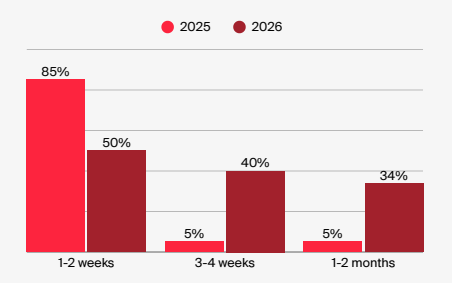
These are the problems that AI transformation is meant to solve. Our platform, for instance, can help coordinate multi-channel campaigns against your audience data and brand style, then improves as campaign performance feeds back into it.
Benefits of AI transformation in enterprises
When AI is integrated into marketing workflows rather than used in isolation, it can help organizations:
Reduce delays between campaign stages: Connect content creation, reviews, approvals, and publishing, so teams spend less time coordinating work across disconnected tools.
Apply brand and compliance rules during production: Bring brand guidelines, approved messaging, and review requirements into content workflows, reducing the need to catch inconsistencies late in the process.
Use campaign results to guide what happens next: Feed performance data back into planning and content creation so teams can refine messaging, prioritize effective assets, and make better-informed decisions about future campaigns.
Plan more strategic marketing campaigns: Teams spend less time on repetitive production work and more on planning and optimization.
What are the four stages of AI transformation in enterprise marketing?
Enterprise marketing organizations usually sit at one of four stages of AI transformation. We call this the Marketing AI Transformation Curve.
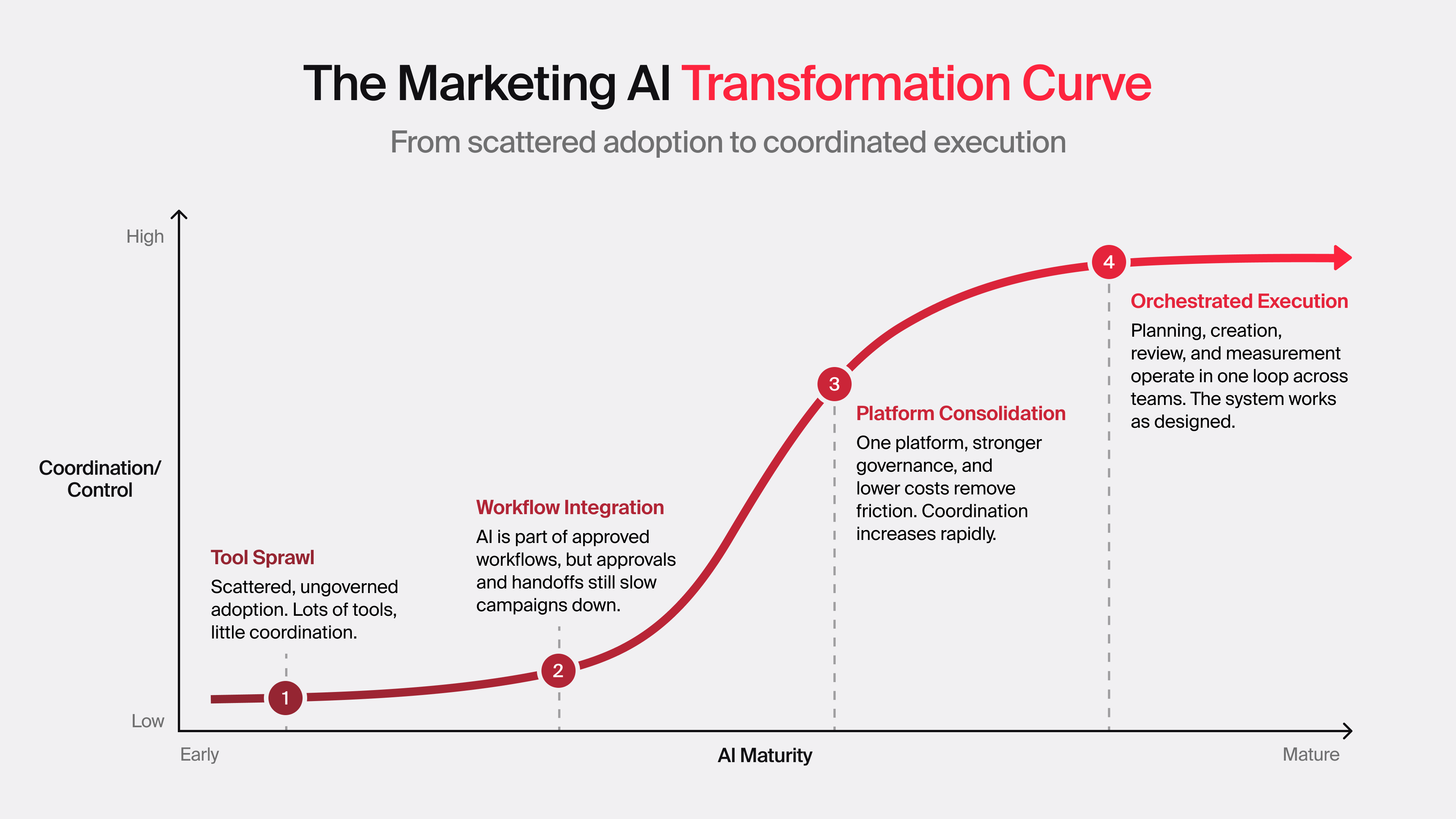
Stage 1: Tool Sprawl. Teams adopt AI tools on their own to move faster, creating a growing mix of disconnected tools with little governance or oversight.
Stage 2: Workflow Integration. AI becomes part of approved marketing workflows, helping teams create content faster. But reviews, approvals, and handoffs still slow campaigns down.
Stage 3: Platform Consolidation. The organization replaces scattered AI tools with a single platform. Costs become easier to manage, governance improves, and teams start working from the same system.
Stage 4: Orchestrated Execution. AI connects planning, creation, review, and measurement across teams, enabling campaigns to move from strategy to execution through one coordinated workflow.
This is a position check rather than a plan, so you can identify your stage here, then use the roadmap to sequence what comes next.
How do you tell which stage your marketing organization is in?
You don't need a formal assessment to understand where your organization stands. A few indicators can tell you a lot:
Stage | What it looks like | What breaks |
1. Tool Sprawl | Marketers adopt AI tools individually, ahead of procurement | Brand inconsistency, no audit trail, cost creep |
2. Workflow Integration | AI sanctioned inside one or two workflows, usually content generation | Approval replaces creation as the constraint |
3. Platform Consolidation | Brand intelligence, customer data, and enterprise systems connect to one platform | Undocumented workflows surface; compliance and legal join the program |
4. Orchestrated Execution | Campaigns run end to end with AI executing and people directing, against tracked targets | Approval authority and role definitions need rewriting |
What does an AI transformation framework for enterprises look like?
The Marketing AI Transformation Curve helps enterprise marketing organizations identify where they are today. The next question is how to progress from one stage to the next.
At each stage, the challenge changes. Early on, the priority is reducing tool sprawl. Later, it becomes building governance, connecting systems, and ultimately redesigning how marketing work happens.
This enterprise AI transformation framework outlines the capability each organization needs to develop before moving to the next stage.
Stage 1 to Stage 2: Integrate AI into workflows
The first step is to create a common way of working. When individual marketers choose their own AI tools, productivity may improve temporarily, but every team develops different workflows, prompting habits, and review processes. That makes it almost impossible to scale AI across the organization.
To move into stage 2, enterprise marketing teams should:
Standardize campaign workflows before introducing more AI tools.
Identify repetitive, high-volume use cases such as campaign briefs, email creation, or content localization
Establish shared prompts, templates, and brand guidelines that every team can use
Define success metrics such as campaign turnaround time or production capacity
This creates a repeatable workflow that AI can support consistently instead of accelerating fragmented processes.
Stage 2 to Stage 3: Connect systems and embed governance
Once AI is embedded into one or two workflows, the next bottleneck usually becomes governance and disconnected technology.
Enterprise marketing organizations often find themselves creating content faster than they can review, approve, or distribute it.
To progress to stage 3 of AI transformation, organizations should:
Consolidate disconnected AI tools onto a shared enterprise platform
Connect AI to existing systems such as DAMs, CMSs, customer data platforms, and analytics tools
Embed brand rules, legal approvals, and security controls directly into content workflows
Replace manual reviews with governed, repeatable approval processes wherever possible
Stage 3 to Stage 4: Optimize and orchestrate
By this point, technology is rarely a limiting factor. The challenge shifts to organizational alignment.
Enterprise marketing teams need AI to coordinate work across planning, creation, approvals, localization, publishing, and optimization rather than supporting each function independently.
To reach stage 4 of AI transformation, organizations should:
Connect planning, content creation, governance, and measurement into one continuous workflow
Measure operational outcomes such as campaign cycle time, marketing throughput, and content reuse instead of AI adoption alone
Continuously refine workflows based on campaign performance and operational data
Shift marketers' time from repetitive production work toward strategy and experimentation
At this stage, AI becomes part of the marketing operating model instead of another productivity tool. The result is a system where campaigns move from brief to launch with fewer manual handoffs, built-in governance, and continuous optimization.
The future of AI transformation is orchestration
AI has moved beyond the experimentation phase and so has the conversation around AI adoption.
As Abhay Parasnis, Founder and CEO of Typeface, puts it:
"A few months ago, the imperative was to start using AI and use it as much as you can. Today, organizations are realizing they weren't built to operate at AI speed. The next phase of transformation is about orchestration, redesigning how workflows, systems, governance, and human judgment work together to deliver trusted customer experiences at scale."
That's the shift enterprise marketing leaders need to make. A successful pilot doesn't guarantee success at enterprise scale, especially if teams adopt AI in silos or governance is treated as an afterthought. Lasting transformation comes from connecting AI to the way marketing actually operates, with shared workflows, integrated systems, and built-in governance that scales with the business.
Typeface helps enterprise marketing teams make that shift. By orchestrating AI across the entire marketing workflow, it enables organizations to move faster without sacrificing brand consistency and governance.
Book a demo to see how Typeface can help you build the next stage of AI transformation.
FAQs
Q. What is AI transformation in enterprises?
AI transformation in enterprises means embedding AI into the workflows the organization already runs on and measuring it against real operational and financial targets. For marketing, that's the shift from manual creation and point tools to an AI marketing platform where AI executes and people direct.
Q. How is AI transformation different from AI adoption?
AI adoption introduces AI tools into existing ways of working. AI transformation redesigns those ways of working, integrating AI into enterprise workflows and business processes to improve how the organization operates.
Q. What does an AI transformation framework for enterprises include?
A usable framework names the stages, gives an observable marker for each, states the failure mode specific to it, and identifies the prerequisite for advancing. Our Marketing AI Transformation Curve uses four: Tool Sprawl, Workflow Integration, Platform Consolidation, and Orchestrated Execution.
Q. Which enterprise AI transformation strategies work best for marketing organizations?
Standardize workflows before scaling AI, invest in workflow design over tool selection, embed governance inside production, and consolidate onto a connected platform.
Q. What does AI transformation for marketing departments look like day to day?
Campaigns move from asset-by-asset production to AI-generated variants across channels and segments, with brand standards applied at creation and people directing rather than assembling. Fewer stakeholders sit in the approval chain and fewer tools sit between brief and launch.
Related articles
May 7, 2026
AI can transform how you do marketing, but the move from manual creation to AI-powered campaigns is rarely linear. Governance must be in place and early wins need to be visible before AI becomes part

July 30, 2026
AI is changing marketing economics, and the numbers back it up. The 4th edition of the Typeface Signal Report, surveying 200+ marketing leaders at VP level and above, found that 61% had captured ROI f

July 30, 2026
Marketing teams have adopted AI almost everywhere, but the metrics to measure success haven’t caught up yet. In the 4th edition of the Typeface Signal Report, 86% of senior marketing leaders said they