October 5, 2026
Scaling Enterprise Video Production with AI: A Strategic Guide

Ashwini Pai
Senior Copywriter

AI summary
From sizzle reels to viral clips, AI makes video generation fast and easy. See how to scale video with AI and save time for projects requiring human expertise.
To scale video using AI, identify where AI fits your video strategy. Pilot it on low-risk use cases, build repeatable workflows with quality guardrails, and use AI to repurpose every finished video into sizzle reels, social clips, blogs, and emails, so a single asset can feed a full week of content.
When you use AI for video production, you're fundamentally changing how you create. Success depends on careful planning to streamline workflows, maintain quality, and help your team get the most out of AI. Below, we'll walk through how to build that kind of scalable, AI-powered production system, from planning your strategy to turning finished videos into blogs, emails, and social content that extend the life of every asset you create.
Why use AI for scaling video?
Every stage of the video production process is crucial to the success of video marketing. Significant time, effort, and talent go into creating a professional video. But this comprehensive process comes at a cost.
Scripting, filming, and editing are lengthy processes, and workflow bottlenecks are all too common. Staying on schedule is a challenge, with production running into weeks and often missing deadlines.
This creates a fundamental scaling problem.
You can't scale video without committing hundreds of hours or thousands of dollars to each project. You can't capitalize on emerging trends instantly. You end up with teams working around the clock to deliver videos for last-minute campaigns or urgent communications.
Demand keeps climbing, too: nearly 90% of consumers say they expect to see more video from the brands they follow, according to HubSpot, which puts more pressure on teams already stretched thin.
The reality is clear: traditional video production comes up short in today's competitive marketing world. Agentic marketing platforms are here to fill the gap, helping scale video content efficiently and cost-effectively, without sacrificing quality.
How to scale video production with AI
1. Identify where AI fits in your video strategy
AI video generators can create short- and long-form videos, generate multiple variations of a video, animate still images, and automate editing tasks, among other capabilities. You can leverage AI to meet different video needs across your marketing funnel.
Defining those use cases upfront is a key first step in choosing the right tool and setting clear expectations for how AI will support your video marketing.
Example use cases:
Videos tailored to different audiences and cultural contexts
Personalized retargeting videos
Internal communication videos
Campaign mood boards
Video resizing across social media platforms
A/B testing
2. Start with low-risk use cases
As AI transforms video workflows, it's best to scale in phases. Launch a pilot project that focuses on 2–3 simple use cases, like localizing videos, creating video snippets, or automating video resizing for different platforms. A pilot gives your team time to get comfortable with the tool and build confidence before moving on to full-scale campaigns.
If it doesn't work out, you can adjust and try again without disrupting ongoing work. If it succeeds, you can scale workflows and extend AI use to global teams and agency partners.
Begin with a small group of AI champions who test the tool, provide feedback, fine-tune workflows, and share best practices. Support them with training and workshops to create a strong learning foundation as AI adoption expands across your business.
3. Establish scalable workflows
A scalable workflow establishes clear, repeatable steps for video creation that anyone on the team can follow. Whether you're creating five or 50 video assets, you use the same process, which remains efficient even as volume increases.
To build this kind of scalability, the AI video generator you choose must support a process that is both intuitive and consistent from creation to approval. This requires three key components: structured creation processes, centralized asset management, and systematic approval workflows.
Structured creation process: AI video generators guide users through defined steps that make video creation simple and efficient. This structured approach ensures consistency and reduces the learning curve for team members.
Asset management: AI can animate and remix existing brand assets to scale video across channels, but those assets must be easy for your team to access. With Typeface working alongside your digital asset management (DAM) system, you maintain a centralized Arc Graph library of approved assets, while Video Agent uses visual search to surface relevant clips for storyboards.
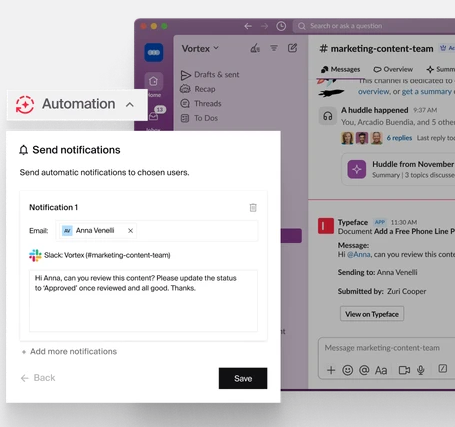
Content approvals: Compliance review takes time, but streamlined processes help teams check AI videos efficiently while maintaining oversight. In Typeface, build approval workflows that mirror your existing review process, assign tasks to the right reviewers, and let legal add comments or suggested edits directly in the workspace, with a complete edit history for accountability.
4. Add quality and safety guardrails
AI excels at generating options quickly, but your team's judgment remains essential for making deliberate decisions about what works best for your brand and audience. Typeface streamlines this by building compliance and brand consistency directly into video creation, with Brand Graph checking outputs against your brand standards before they ship.
Asset-level compliance: Your team uses pre-approved images, videos, layouts, audio, and brand elements to generate videos, ensuring standards are met.
Voice consistency: Train Video Agent in your brand voice, or adapt tone for a specific platform.
Pro tip: Conduct regular audits to ensure only current, approved materials are available to generate video ads, social clips, sizzle reels, and more.
Responsible AI built into workflows: Careless descriptions of scenes can slip through and lead to harmful outputs. Typeface has integrated responsible AI (RAI) into content creation workflows. Prompts describing inappropriate or harmful scenes are automatically blocked, and AI-generated outputs are reviewed for compliance before display.
5. Build AI-ready teams
AI creates new skills and collaborative workflows. You need a strategic AI adoption plan that unites people around your transformation vision and secures their buy-in.
Assemble a cross-functional team: Include leaders from marketing, legal, operations, and key creative and copywriting members.
Be clear about changing roles: Explain that AI supports video creation while teams provide creative input to maintain quality and engagement.
Support AI learning: Offer workshops and training while encouraging teams to share insights and showcase successful examples.
6. Measure and optimize
A hybrid strategy where AI handles heavy lifting while your team focuses on creative concepts delivers speed, scalability, and cost-efficiency. It's crucial to understand whether AI-generated videos are hitting production targets or actually influencing audience behavior.
Compare your video performance before and after using AI, and monitor how audiences respond to your AI-generated content. Watch how competitors use AI and apply those insights to improve your results.
Try Typeface’s Video Agent
Escape production challenges with Video Agent. Create realistic scenes from simple descriptions and use built-in editing options to stylize, caption, and trim videos.
Get more out of your best content. Video Agent transforms video and image assets into short-form video and sizzle reels for social media virality and dynamic business presentations.
Text-to-video use cases:
Video ads
Campaign teasers
Seasonal promos
Lifestyle scenes
Product mood boards
Animated product showcases
Brand storytelling clips
Videos to sizzle reels
Videos to sizzle reels
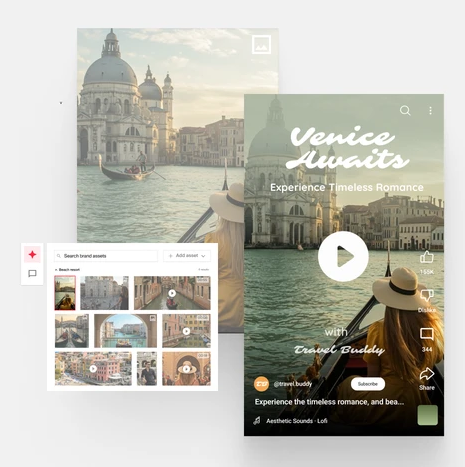
Sizzle reels work well as attention-grabbers at product launches and investor presentations, and bring a buzzy vibe to social feeds. They're easy to create with AI and your existing videos in Video Agent, from scene-by-scene storyboards to precise edits.
Here's how it works:
Start with a brief. State the goal of your video (e.g., increase brand awareness for a product launch) and the themes or key messages you want featured. Optionally, upload a campaign brief or other reference file for added context.
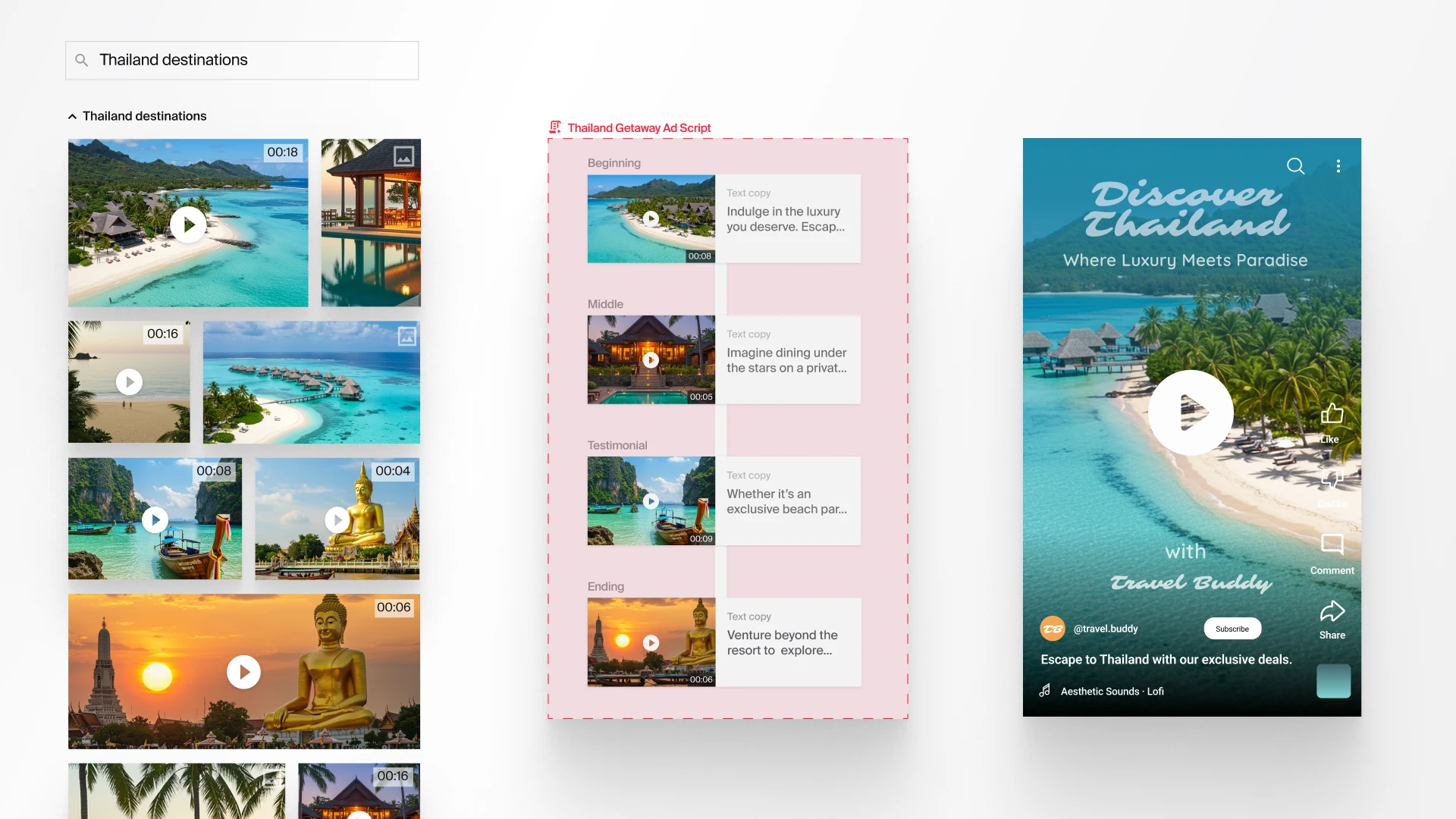
Review the AI-generated outline. Video Agent extracts relevant themes from your brief and generates an editable script outline with a beginning, middle, and end. Add, remove, or reorder sections as needed, then pick your sizzle length, upload music if needed, choose a video format (e.g., vertical for TikTok), and set language, Brand Kit, and target audience.
Generate and refine the scene-by-scene script. Video Agent scans your imported or asset-library videos and matches clips to each scene, suggesting copy along the way. Every scene and line of copy is editable. Use visual search to find and swap clips by describing what you want.
Create and download. Click "Create video" and Video Agent combines scenes with transitions and animations. Download the finished video, or download the script to share with stakeholders. From there, you can still adjust text overlays, effects, and transitions.
Social media snippets from long videos
Even a seemingly simple task like extracting impactful quotes or moments from a video can take hours when done manually, since finding highlights, trimming, styling, and captioning clips all add up. Video Agent turns a 60-minute webinar into 3–5 viral LinkedIn clips, or a batch of customer testimonials for Facebook, in one workflow.
Here's how it works:
Choose the original video. Upload a video file or select one from your Assets library. Videos need clear English voice audio, minimal background noise, and a duration between 30 seconds and 2 hours. This won't work on silent or music-only videos. Supported formats: MP4, M4V, WMV, AVI.
Generate video clips. From the homepage or document copilot, select "Generate video clips."
Search for a moment. Add a video block to a document in the same project, then search a phrase related to the moment you want (e.g., "AI impact on education"). Typeface surfaces matching clips using natural-language search. Click "Create clip" on the one you want.
Edit the clip length. Trim by adding or removing sections directly in the transcript, and the underlying video updates as you edit.
Add captions. Turn on captions and choose a style, such as a word-by-word "Karaoke" highlight effect.
Optimize for platform. Typeface automatically adjusts the aspect ratio for the platform you choose. Save the clip to your document or download it as an MP4.
Repurpose video into blogs, emails, and social posts
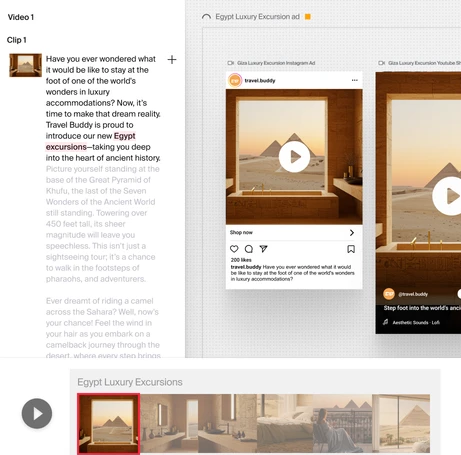
Video still makes up the majority of internet traffic, but written content remains essential for discoverability. Once a video is live, the fastest way to get more mileage from it, and from the production budget behind it, is repurposing it into the formats your audience searches for and scrolls past every day.
Why it's worth the extra step
Treat video as the source material for your content ecosystem. Planning upstream (thinking about which segments of a video can feed a blog post, an email, or a social clip) means one shoot can power a full week of content.
Turn videos into social posts
Repurposing preserves the core message of a video while adapting it to each platform's audience and format. Adapt each clip to its channel. For example, turn a product-update video into a LinkedIn carousel covering each new feature, and isolate a single high-impact moment as a 14-second clip with tightly focused copy for X.
In Typeface, select "Rewrite into a social post" (or enter a custom instruction) from the YouTube or Vimeo Blend template, then paste the video URL. You'll get on-brand, platform-ready copy you can edit, or use AI to adjust tone before publishing.
Turn videos into blog posts
There are two ways to repurpose a video into a blog post, depending on the source material:
Full repurposing: The AI builds a structured article around the video's key insights and quotes, adding context and research to deepen the content beyond what's said on camera.
Verbatim transcript: The video's dialogue is transcribed word-for-word and lightly edited for clarity, with a short summary up top previewing the key topics. This works best for podcasts and interviews, where preserving the speaker's voice matters.
Choose "Rewrite into a blog post" (or request a verbatim transcription) from the YouTube/Vimeo Blend template, add the video URL, and specify a target audience for a more personalized draft. Treat the output as a starting point: add your own insights, then run it through AEO Analyzer to check the draft against current search and AI-search signals.
Pro tip: Embed the original video at the top of the post, with the transcript below. It creates multiple SEO entry points and improves dwell time, and both signal quality to search algorithms.
Turn videos into email content
Videos can also make emails more persuasive, in one of two ways: a concise summary of the video's core message for busy scanners, or the video embedded directly with complementary content such as timestamps of key moments, a step list from a how-to video, or a short blurb on why it's worth watching.
Open the content blend tool and choose "Rewrite into a sales email" or "Rewrite into a newsletter email" (or specify your own goal), add the video link, and generate. The repurposed email copy is ready in seconds.
Maximize your video potential
Boost scale, speed, and customer experience with Video Agent. Take the next step with a demo or talk to sales.
FAQs
1. What training do employees need to use AI for video?
Most agentic marketing platforms offer intuitive interfaces that let users create videos through simple text prompts. However, employees still need some foundational training. For technical skills, they need platform-specific tutorials, prompt engineering guidance, and basic video editing capabilities to refine AI outputs. Beyond technical training, workshops should train employees to assess AI video quality, provide creative direction, and follow best practices for human-AI collaboration.
2. Can AI-generated videos match the quality of human-created ones?
It depends on the project. For scaled production needs like marketing content, product videos, or multi-market campaigns, AI combined with human review delivers quality that meets brand standards. For highly creative or cinematic work, human production is preferable.
3. What if my AI-generated videos are falling short of expectations?
AI does best when given clear direction. Revisit your prompts: can you add more detail, break complex requests into smaller steps, or adjust your wording? Typeface's Prompt enhances simple prompts into detailed descriptions that capture the full vision, and Video Agent generates variations to help you explore different creative directions.
Beyond prompting, consider your workflow: are you making full use of the built-in editing tools, or integrating your AI platform with video software for advanced fixes? Finally, assess whether the project aligns with AI's strengths: repetitive, high-volume tasks are a great fit, while projects requiring meticulous creative control should stay with your creative team.
Related articles

June 17, 2025
Creating video content (whether it’s a customer interview, a product demo, a webinar, or a training session) takes a lot of time, energy, and budget. But once the video is live, turning it into writte

September 3, 2026
To summarize videos and podcasts using an AI summarizer, drop in a video or podcast URL, choose what you need — a bullet-point summary, a social post, a full blog draft — and the AI extracts the key m
November 14, 2025
Short-form videos are everywhere right now—scroll through any feed and you’ll see them pull in your attention. The problem? Making them is a pain. One retail marketing team told us they have years of