August 4, 2026
How to Choose Secure AI Tools for Enterprise Marketing — What to Evaluate Before You Buy

Akshita Sharma
Senior Content Marketing Associate

AI summary
Many AI tools promise enterprise-grade security, but security means more than encryption and compliance badges. Learn how to evaluate AI platforms for data protection, responsible AI, governance, and brand safety using a practical framework designed for enterprise marketing teams.
What is a secure AI tool for enterprise marketing?
Many vendors answer that question by pointing to SOC 2 compliance for marketing teams.
While SOC 2 is an important baseline, it only tells part of the story. It verifies core security controls like encryption, access management, monitoring, and incident response, but doesn't assess the AI-specific risks that matter to enterprise marketing teams.
That's why evaluating an enterprise AI platform requires asking a few important questions before you buy.
TL;DR
AI tools with enterprise-grade security need to be safe (your data stays isolated and owned by you), responsible (outputs are filtered and bias-checked), and trusted (governance is enforced and provable).
SOC 2 doesn't cover AI-specific risks like whether your data trains the model, how outputs are reviewed for bias, or who owns what the AI generates.
ISO 42001, the first international standard built specifically for AI governance, is the certification that closes the gaps SOC 2 leaves open.
The five things to check before you finalize any AI tool is this: data ownership and handling, access controls, content safety, brand governance, and certifications.
Never skip the pilot. Test the tool on a real workflow with your actual brand rules for 30 to 60 days. A demo tells you what the tool can do. A pilot tells you whether it works for you.
What are secure AI tools for enterprise marketing?
Security here means a set of guarantees: where your data goes, what the AI does with it, and whether you can provide evidence that those safeguards are in place when required. Secure AI tools let marketing teams move fast on content and campaigns without putting brand or customer data at risk.
The problem is that most vendors collapse all of it into one word, which makes it hard to know what you're getting. When a vendor says their AI tool is secure, it's fair to ask: secure in what way?
Break it down, and "secure" is really three separate questions, the three layers of the Safe, Responsible, Trusted (SRT) framework.
Is the AI tool safe?
Safe AI means your data stays yours, is stored where you expect, and is used only how you allow. It’s all about control over your information. The strongest tools keep your work isolated, with your custom models and data sitting in a dedicated, private environment.
Ownership should be just as clear. Your inputs and outputs stay private, with no sharing to third parties or outside models. It helps when the tool is built on established enterprise models that already carry strong guardrails, so safety starts at the foundation.
Is the AI tool responsible?
Responsible AI means the output is filtered, checked for bias, traceable to its source, and governed by real rules.
Look for controls on both ends of generation. Good tools filter risky prompts before they run, blocking anything that breaks content guidelines. They also review output afterward and hold back anything that fails a safety standard.
Transparency matters, too. Tools that follow the C2PA standard embed credentials in AI-made content, so people can tell what was created by AI. That helps you stand behind what you publish. Behind all of this, you want a clear acceptable-use policy.
The ISO 42001 certification is a useful signal for this layer. It's an AI management system standard and passing it means a vendor had to prove real practices, like tracking where training data comes from.
Is the AI tool trustworthy?
Trusted AI means you can enforce your rules and keep your brand consistent at scale.
Trusted AI tools with enterprise-grade security standards can back up those claims with certifications and audits. On top of that sits human oversight. Feedback tools and approval steps that follow a simple rule: AI suggests and a human approves before anything goes live.
For marketing, trust means one more control over your brand. A trusted tool is grounded in your own data and audiences, so it produces content that sounds like you.
How do you evaluate whether an AI tool is secure?
Evaluating a tool has three parts. First, define the criteria the platform must meet. Next, evaluate how well it satisfies those requirements. Finally, pressure-test the tool in real-world scenarios before making a decision about whether to move forward.
Here’s a look at what each step involves:
1. Set your criteria
Before you compare vendors, get clear on what makes an AI tool secure for enterprise marketing. The five checks below highlight the capabilities that matter most, mapped to the three SRT layers.
Data ownership and handling (Safe): Your product information and campaign plans are among your most sensitive assets. A secure tool keeps them in a dedicated, private environment, never trains shared models on them, and leaves ownership of your inputs and outputs with you.
Access and control (Safe): Look for permissions that map to your team structure, so people only reach the content their role allows. Plus, a full audit trail you can hand to compliance. The strongest tools also keep a human in the approval loop, so nothing publishes on the AI's say-so alone.
Content safety (Responsible): A safe tool guards both ends of generation. It filters prompts on the way in, blocking anything that breaks your guidelines, and reviews output on the way out, holding back anything unsafe. It should also mark AI-made content through a standard like C2PA, so you can identify it later and stand behind what you publish.
Brand governance (Responsible): At enterprise volume, off-brand content becomes a reputational risk. That's why brand governance belongs to this list as a security control, not a creative nice-to-have. A secure tool holds your brand rules and assets centrally, applies them automatically across brands and regions, and flags drift before content goes live.
Certifications (Trusted): Look for SOC 2 Type II. Type I checks whether the right controls exist as of today, a single snapshot. Type II checks whether those controls held up over a period of time. Besides that, look for ISO 27001 and ISO 42001. ISO 42001 is the one worth pushing on, since it covers the AI-specific risks SOC 2 was never built to catch, like data provenance and bias assessment.
2. Run the evaluation
Your criteria are only useful if you know how to validate them. During demos and evaluations, focus on gathering evidence, comparing vendors consistently, and involving the right stakeholders before you make a decision.
Score vendors on a shared rubric: Build a simple scorecard with your criteria before the first demo and score the vendors as you go. Without it, the tool with the best demo wins, rather than the one that fits your work. A rubric also gives procurement and security a shared record instead of competing opinions.
Ask questions that have a verifiable answer: Every question worth asking has a strong answer and a weak one, and the weak ones show up later as security-review blockers. So, demand proof you can check. Get the data-training and content-ownership answers in writing, and route anything vague to legal before you sign.
Start with the problem and pick one with clear value and low risk: Name the specific job that your team is ready to run. The best starting point is a use case that delivers measurable value quickly, not the most ambitious idea on the roadmap.
Buy outcomes, not hype: Ignore the "cutting-edge" language and ask what measurable result the tool delivers, and how you'll know it worked. (A reference call with a company in your industry, at your scale, could be useful.)
Involve the people who'll use the tool: Involve your marketing team in the evaluation. The people doing the daily work judge it on friction, how many steps to get from prompt to on-brand asset, whether the interface fights them or gets out of the way, and whether outputs need heavy rework before they're usable. That gap is exactly what a demo won't show you.
Check that it fits your stack: List your must-have integrations before the demo, like your DAM, CMS, and approval tools. Ask to see a working connection. A tool that won't connect to your systems creates new work.
3. Pressure-test with a short pilot
Demos run on clean examples and ideal prompts. Your real content is messier, and that gap is where most AI purchases disappoint. That tracks with what we see across the market: 82% of AI initiatives remain stuck in the pilot phase, per our 1st edition of the Signal Report, and the cause is often a weak pilot design. So, before you sign, test the tool on real campaigns.
Pick a workflow: Choose a weekly, high-volume job that can be automated. Write down what you're testing and what you're not. A tight scope gives you a clean answer instead of a vague impression.
Feed it your data and brand rules: Load your real guidelines and past content. You're testing whether the tool can hold your voice.
Test the failure path: Demos prove the tool works when everything is perfect. Push it where things break, like a vague prompt or an off-brand request. How it handles the bad cases is the real signal.
Measure against your threshold, and count it: AI is probabilistic, so the same prompt can give different output on different days. Track how often output goes off brand, makes a claim you can't back, or needs rework, then compare that rate to the pass bar you set in step one.
Test the controls: Try the approval steps. Pull the audit trail. Check that roles limit who can generate what.
Give this process 30 to 60 days, long enough to see the tool handle a full campaign cycle. A real pilot tells you more than any feature grid, and it answers the one question that matters: does this work for you, with your data, under your rules?
Why this evaluation is worth the time
A hard question during the buying process costs you one more vendor call. The same question after deployment costs you a rip-and-replace that has not been budgeted for.
But evaluating a secure AI platform is about protecting both data as well as your brand. One tool, used across many campaigns and regions, can spread voice drift and off-message claims faster than any human can catch them.
That's why brand governance belongs in the security conversation.
A platform that enforces your brand rules automatically, the way Typeface’s Arc Graph does makes compliance easier.
Our 4th edition of the Signal Report found that compliance, legal, and brand governance are now their top worry with AI, ahead of budget or technology.
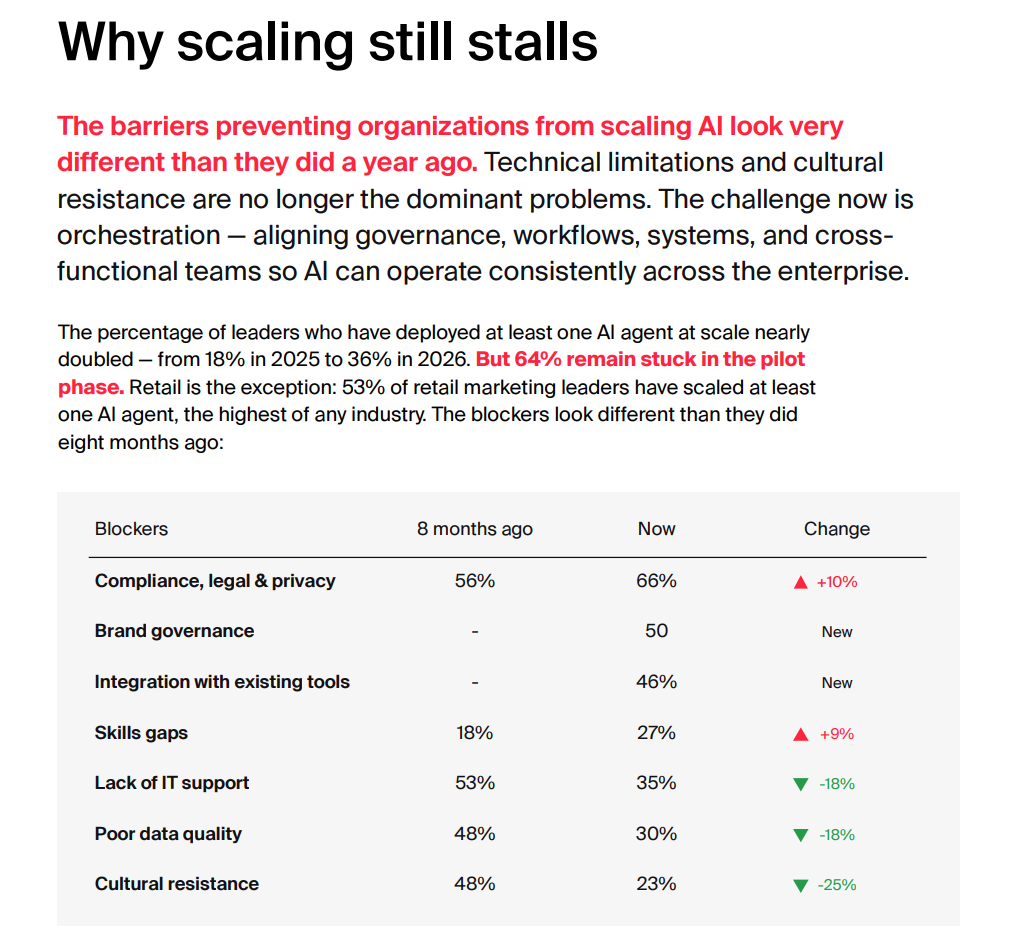
The need for strong AI governance will only grow. Gartner expects spending on AI governance tools to more than double, from $492 million in 2026 to over $1 billion by 2030, as regulations spread.
That's why investing time in a thorough evaluation upfront is worth it. The right platform will protect your data, safeguard your brand, and give your team a secure foundation they can scale with confidence.
The bottom line
Choosing a secure AI tool for enterprise marketing comes down to a clear path:
Judge each tool on all three layers
Take the checklist into your next three vendor calls and compare the answers side by side
Pick your top one or two workflows, then run a 30-day pilot with your own brand rules
That's one month of focused evaluation. It'll tell you more than any feature comparison, and it'll show you the thing that matters most: whether the tool protects your brand when no one's watching. Here's how Typeface measures up against the same evaluation framework:
Your data stays in an isolated tenant, encrypted end to end. You keep full ownership of every input and output.
Your brand rules live in one place and apply automatically as you scale, so your voice holds instead of drifting campaign by campaign. That's what Arc Graph does, checking every piece of content against those rules before it goes out.
Typeface is certified to ISO 42001, with release gates that block a system from shipping if it fails bias testing.
Every certification and audit report is yours to download in the Trust Portal, no chase required.
See what enterprise-grade security looks like in a platform built for it. Contact our sales team or book a demo to learn more.
FAQs
Q. What are secure AI tools for enterprise marketing?
Secure AI tools follow three guarantees: your data stays yours and isolated, outputs are filtered and checked for bias, and governance is enforced and provable. That's the Safe, Responsible, Trusted framework. A tool only counts as secure if it can show evidence for all three, not just one.
Q. What is SOC 2 compliance, and why does it matter for a secure AI tool for enterprise marketing?
SOC 2 is an independent audit of how a vendor handles your data: access controls, encryption, monitoring, and incident response. Type I checks that the right controls existed on a single day. Type II checks that they hold up over an extended period.
For any tool that processes your content day after day, Type II is the version that counts. A Type I report or a “report in progress” is a sign the vendor is early in its security journey.
Q. Does SOC 2 cover AI-specific risks, or do you need more?
Buyers often assume AI tools for marketing with SOC 2 compliance are fully covered, but SOC 2 was built for software in general. So, it’s important to ask about the AI-specific risks, whether your data is used to train the model, how the model behaves as it changes, or whether outputs are checked for bias and brand safety.
The right AI platform layers an AI-specific standard on top. ISO/IEC 42001, the first management standard built for AI, audits governance policies, data practices, and safeguards that SOC 2 leaves untouched.
The table below shows where each one helps.
What you're checking | Covered by SOC 2 Type II | Needs AI-specific governance |
|---|---|---|
Access controls and encryption | Yes | Already covered |
Incident response and monitoring | Yes | Already covered |
Whether your data trains the model | No | Check the vendor's data and training policy |
How the model behaves over time | No | Look for ISO 42001 or NIST AI RMF practices |
Bias and unsafe output checks | No | Ask about pre and post-generation review |
Who owns generated content | No | Confirm in the contract |
Q. What are some red flags to watch for during vendor evaluation A few answers should make you slow down, no matter how good the demo looked:
Vague answers about training data. “It depends” usually means yes.
No SOC Type II report. A Type I report or one “in progress” means the controls aren't proven over time yet.
No named security contact. If a generic inbox owns security questions, expect slow answers during review.
A trust center with no downloads. Marketing copy about security is not the same as evidence.
No AI-specific governance. If the only answer is SOC 2, the AI risks are still unaddressed.
Brand and legal guardrails left to you. At enterprise volume, that's a liability.
Q. What security certifications should enterprise marketing teams look for beyond SOC 2?
ISO 27001 for broader information security and ISO 42001 for responsible AI management. The strongest SOC 2 compliant AI marketing tools carry all three, because ISO 42001 covers the AI-specific risks SOC 2 skips, like data provenance and bias assessment.
Q. How do I evaluate an AI marketing tool's data privacy practices?
Check the trust center for downloadable reports and a sub-processor list, confirm data residency and access controls, and get data-training and content-ownership terms in writing before procurement.
Q: What are the best AI marketing tools with SOC 2 certification?
There's no single "best" list here, since SOC 2 status changes as vendors complete audits and the right tool depends on your specific compliance and workflow needs. Instead of chasing a ranking, evaluate any AI marketing platform against the criteria that matter for enterprise security:
SOC 2 Type II status
Data residency and retention controls
Role-based access and permissions
Model training opt-outs
Audit logging
Vendor transparency around sub-processors
Related articles

July 22, 2026
Your team is excited to use AI. Leadership has approved a budget. And in a vendor demo, everything looked seamless. But once you are in your actual environment, the real question arises: How do we ge

July 17, 2026
It's a well-known trope for marketing teams to say that AI content “doesn’t sound like us,” or “isn’t insightful enough,” or “could get us into trouble.” That lack of confidence, in most cases, comes

June 17, 2026
From our conversations with clients exploring AI for marketing, two requirements consistently emerge. First, brand assets are non-negotiable — product imagery, company logos, and color palettes must