

AI summary
Email marketing in 2026 is shaped by six shifts: privacy-first personalization, smarter segmentation, AI-mediated inboxes, agentic workflows, closed-loop optimization, and mobile-first design. This guide explains what each trend means for your strategy, from writing emails that hold up in AI inbox summaries to turning campaign performance into learnings that improve every send.
It's 2026, and email marketing still delivers strong returns. A recent study by Litmus puts the average at $36 for every $1 invested.
Yet brands face familiar obstacles, and new ones keep showing up alongside them. Maintaining engagement, conversions, and customer loyalty takes more effort than it used to.
That's why more brands are turning to generative AI and new strategies to keep up, because the ones that don't evolve leave room for faster-moving competitors to take their place. These trends mark the strategic shifts brands are making to stay ahead. Here's what they are.
TL;DR
Balancing personalization with privacy: As data privacy and transparency rules evolve, brands need smarter, compliant ways to personalize customer data.
Data-driven segmentation is the secret to relevance at scale: Combining data insights with AI-powered workflows delivers personalized email experiences to every segment at scale.
Your emails now have two readers: Your subscriber, and the AI that summarizes your email before your subscriber sees it.
Agentic AI set to transform email marketing: Agentic workflows automate email marketing steps and optimize campaigns in real-time without constant manual input, increasing both efficiency and impact.
Closed-loop optimization is the next frontier: Performance data can feed directly back into content creation, turning campaign results into structured learnings that improve the next round of content.
Mobile is the default inbox: Emails need to be designed for mobile from the start, with content, layouts, and CTAs that remain clear and usable across screen sizes.
Privacy-first email marketing
User privacy and consent requirements have grown more stringent, requiring marketers to take a measured approach to their email strategies.
While technical privacy policies like Apple's Mail Privacy Protection have obscured actual email open rates and fundamentally changed how marketers measure campaign success and engage with customers, privacy regulations like the GDPR and CCPA emphasize user consent and data minimization, making over-personalization risky.
Navigating these restrictions while ensuring high email engagement and efficient campaign execution can be challenging for enterprises that send vast volumes of email daily.
What this means for you:
Amid rising privacy regulations and Google’s ongoing changes to third-party cookies, first-party and zero-party data has become increasingly valuable. You can unlock its potential, often stored across disparate systems, to personalize marketing, stay compliant, build trust, and drive stronger campaign results.
1. Improve data integration and content consistency
Connect your Arc Graph to your customer and brand data from existing knowledge libraries or your CDPs, DAMs, and PIMs. Drive more personalized, on-brand emails that boost engagement and reveal deeper customer insights, even as open rates shift.
2. Implement journey automation and preference-based targeting
Use Email Agent to craft personalized, stage-based email journeys driven by customer preferences or behaviors using your owned data while focusing on relevant insights tied to the customer lifecycle.
3. Keep campaigns effective and compliant over time
Email Agent will utilize analytics and feedback to suggest content optimization. With content insights and user feedback, you can adapt content without relying on invasive tracking.
Enhanced segmentation
Segmentation continues to be one of the most powerful drivers of email marketing performance, generating 30% higher open rates and 50% more click-throughs compared to unsegmented campaigns. Efforts to create highly specific groups and gain deeper insights into them have implications for marketing as a whole. They drive the fine-tuning of messaging to the unique attributes and needs of each audience segment, increasing the chances that they’ll convert.
Today’s top-performing marketers are going far beyond basic list slicing. They’re using advanced segmentation strategies that involve layering demographic, behavioral, and contextual data to build sophisticated audience profiles and deliver highly personalized content across the customer journey. These include:
Multidimensional audience targeting: Combining demographics, purchase behavior, and engagement history to create segments that reflect each audience's unique needs.
Behavioral segmentation in real time: Using live signals like browsing behavior or preferred reading times to serve relevant messages at the right moment.
AI-powered insight generation: Leveraging machine learning to uncover hidden behavioral patterns, anticipating customer needs and automating personalized campaigns.
As privacy laws and attention spans evolve, segmentation ensures marketers stay relevant without becoming intrusive. The more intentional your segmentation, the more your content resonates and converts.
What this means for you:
By combining data insights, you can send batches of emails that resonate with each segment, boosting conversion rates.
1. Engage all segments with AI-powered personalization
Personalize emails to audience segments from your CDP. Spare no time in tailoring messages to evolving audiences or reaching out to the most receptive audience—at scale.
2. Rapidly test and optimize for each segment
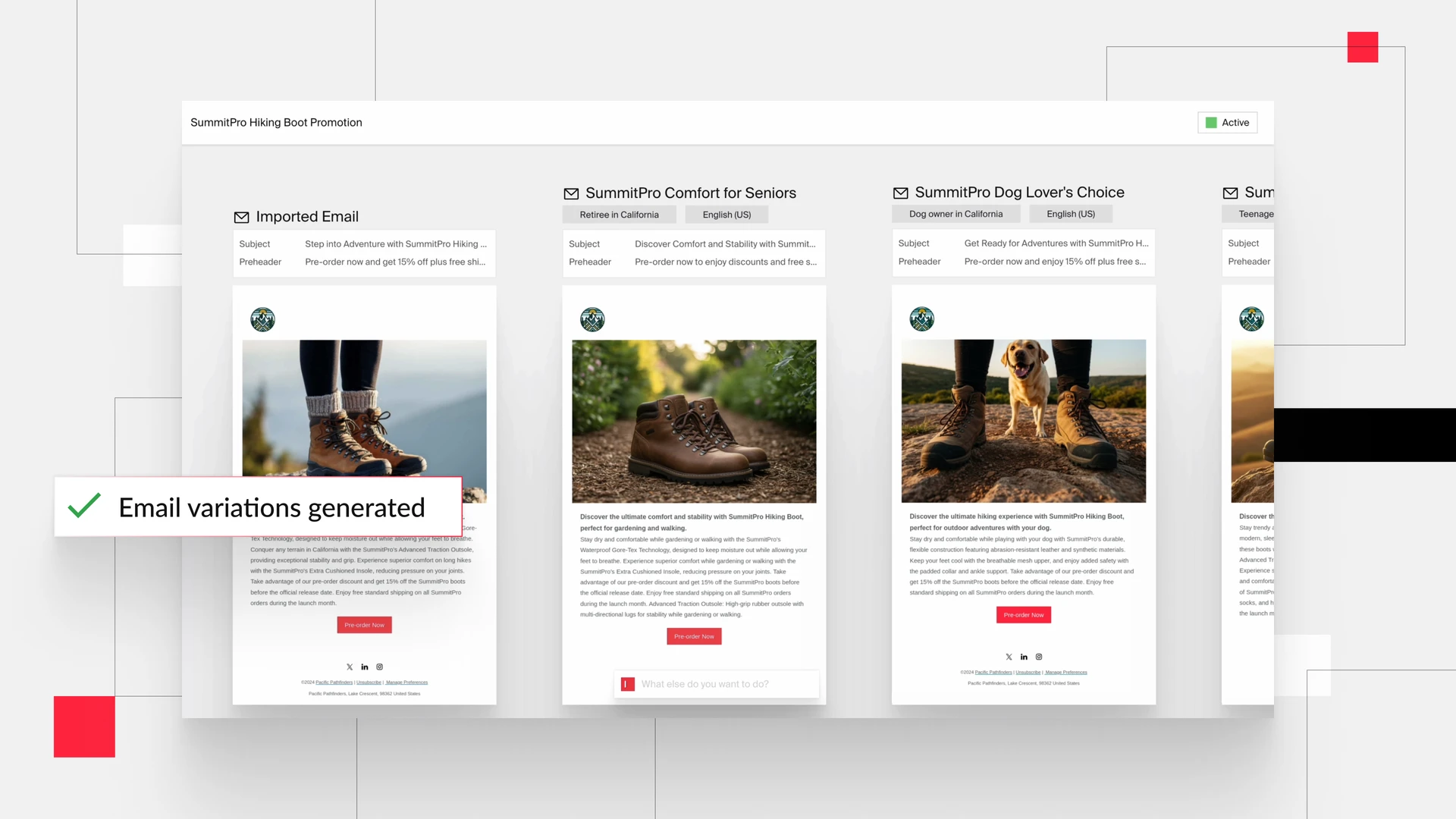
Run content experiments at scale with AI-generated variations of your email creative. Our platform simplifies and speeds up headlines, layouts, CTAs, and more—without draining resources—so you can quickly identify what resonates with each segment and refine your messaging strategy.
3. Align teams around shared segmentation strategies
Our platform supports cross-functional collaboration by helping teams create consistent, segment-specific messaging across marketing, sales, and support. Shared templates, asset libraries, and performance dashboards make it easy to build customer-centric journeys that reflect a unified brand experience.

AI-mediated inboxes
In early 2026, Google rolled Gemini into Gmail, giving it the ability to summarize email threads, prioritize messages, and answer questions about what's in your inbox. Yahoo and Microsoft have reportedly built similar summarization and relevance-based sorting into their own inboxes. This means that for a meaningful share of your list, an AI system now reads your email and decides what to surface before a human ever sees it.
The early effect on performance is already showing up. After Gmail's AI summaries launched, open rates rose to 45.6% but click-through rates fell from 4.35% to 3.93%, according to a study. This means people are reading the AI-generated summary instead of clicking through to the full email.
So, what is the practical implication of this email marketing trend? If AI is now deciding what a recipient sees first, email copy needs to work at two levels: for the AI summarizing it and for the person deciding whether to act on it.
What this means for you:
1. Write subject lines and preview text as summaries, not teasers
State the specific offer, product, or details up front in your subject lines. An AI summary preserves concrete facts and drops vague enthusiasm, so specificity is what makes it into the version your subscriber actually reads.
Email Agent can help you put this into practice by generating strong, segment-specific subject lines that surface the most relevant details upfront, without requiring multiple rounds of prompting.
2. Make the key message easy for AI to extract
Don’t make readers work to understand what your email is about. Put the core value proposition, offer, or action near the top of the body, and keep supporting details clear and self-contained.
3. Optimize for engagement beyond the open
An open no longer necessarily means a recipient read your message or saw your full content. Watch for changes in click-through and conversion rates alongside opens to understand whether your message is still driving action after AI has summarized it.
And make sure you use those performance signals to inform what you create next. Arc Loop, for instance, closes the feedback loop by bringing performance data from your marketing channels back into Typeface, analyzing what worked, and turning those findings into structured learnings that agents can use to create and optimize your next round of content.
AI agents for email marketing
AI’s potential for email marketing is vast, with exciting advancements steadily unlocking new opportunities. Among them, agentic AI is emerging as a powerful force, driving smarter automation and personalization at scale.
Email marketing AI agents dive into customer data to generate hyper-targeted messages that speak to audience’s needs and interests, leading to higher engagement and conversion rates. They analyze performance data to optimize various campaign elements and enhance their effectiveness.
Agentic workflows reduce human error by having AI agents follow precise logic, cutting down on mistakes, overlooked details, and inconsistencies in repetitive tasks. This also saves time by eliminating manual approval steps, with AI ensuring consistent and accurate task execution. Marketers are increasingly leveraging agentic workflows to execute campaigns that are more efficient and produce a better ROI.
What this means for you:
There’s no better time to harness the potential of agentic AI to elevate your email marketing, enabling smarter automation and personalized campaigns that drive better results, increased efficiency, and reduced costs.
1. Achieve personalized email content at scale
Use Email Agent to create hyper-targeted messages tailored to your audience’s preferences, boosting engagement and conversions.
2. Optimize campaigns in real-time
Get proactive content optimizations to continuously refine your campaigns, enhancing effectiveness and maximizing ROI.
3. Streamline your email workflows
Automate key processes for more efficient campaign execution, reducing manual effort and improving scalability.
4. Enhance cost-efficiency
Maximize your marketing budget by leveraging our agentic assistant to optimize resources and improve the impact of your email campaigns.
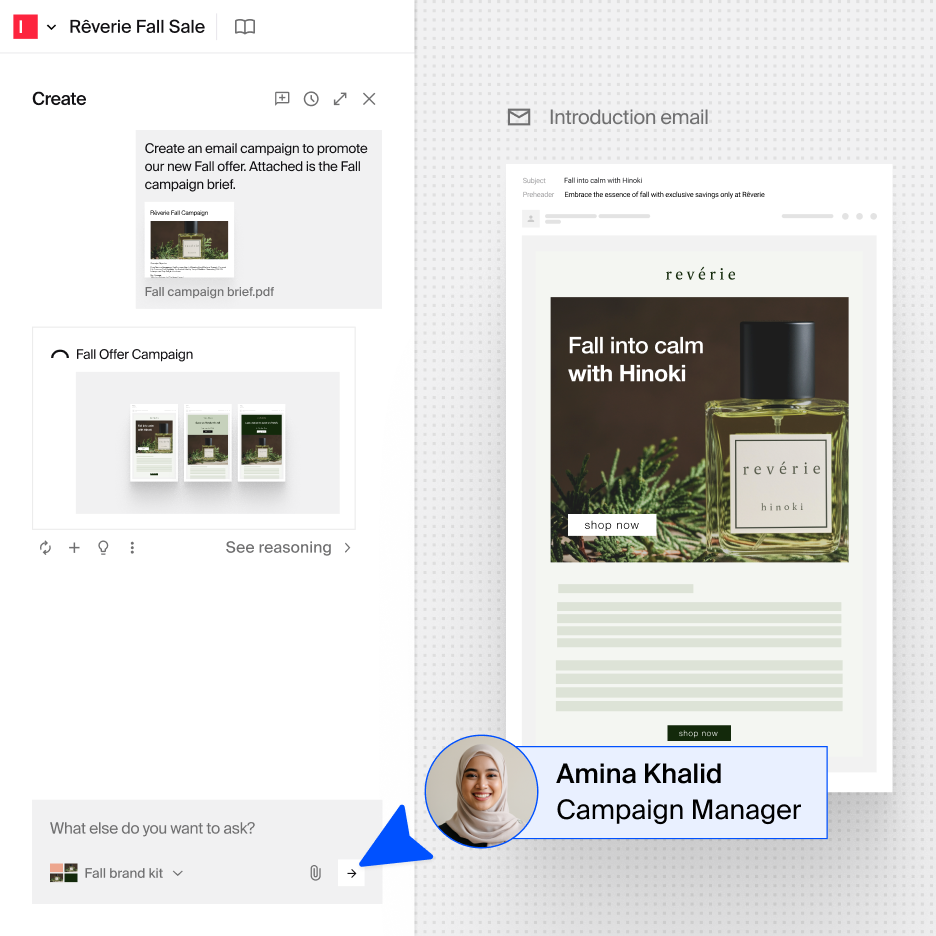
Closed-loop optimization is becoming the next frontier of AI email marketing
AI has made it dramatically easier to create more email content, but the next step is making sure every campaign makes the next one better. In a closed-loop model, performance data flows back into the content creation process, allowing AI to identify what worked, turn those insights into structured learnings, and apply them to future campaigns.
This shifts email marketing from a linear process of create → send → measure to a continuous cycle of create → activate → learn → optimize. Instead of starting each campaign from scratch, marketers can build on what they've already learned about their audiences, messaging, and creative.
What this means for you:
Turn campaign performance into reusable learnings
Don't let performance data end up in a dashboard that only gets reviewed after the campaign is over. Identify which messages, offers, creative approaches, and audience variations drove results, and turn those findings into inputs for your next campaign.
Arc Loop automates this, by bringing your performance data from your marketing channels back into Typeface. It analyzes what worked and turns those findings into structured learnings that agents can use to create and optimize the next round of content. That means your email campaigns generate knowledge that makes future campaigns better.
Mobile is the default inbox and design hasn't caught up
Mobile-first design is no longer an optimization you make after creating the desktop version of an email. With subscribers increasingly reading and acting on emails from their phones, marketers need to design for smaller screens from the start. That means concise copy, clear visual hierarchy, prominent CTAs, responsive layouts, and imagery that works across screen sizes.
As AI makes it easier to generate more personalized email variations, mobile-first design also becomes a scalability challenge: every version needs to remain readable, usable, and on-brand regardless of the audience or content being generated.
What this means for you:
1. Design for the smallest screen first
Keep the most important message and CTA easy to find without excessive scrolling or zooming. Use short sections, clear hierarchy, and responsive layouts that adapt naturally to different screen sizes.
2. Keep personalization from compromising usability
More personalized content can mean longer copy, more products, or additional content blocks. Make sure personalization improves relevance without making the email harder to scan or interact with on mobile.
3. Scale mobile-ready emails with Typeface
Email Agent automatically optimizes your email content for both mobile and desktop, so you don't have to create or manually adjust separate versions. You can preview how your email will look across screen sizes as you generate it, making it easier to refine the content and layout before you send.
The future of email marketing is more adaptive
Email remains one of the most effective channels for driving revenue, but if you want to get the most from it in 2026, you need to account for privacy, increasingly sophisticated segmentation, AI-mediated inboxes, mobile experiences, and the growing need to continuously learn from campaign performance.
Typeface brings these capabilities together in one platform. From creating personalized emails with Email Agent to optimizing content across mobile and desktop, and using Arc Loop to turn campaign performance into structured learnings for future content, Typeface helps marketing teams move from one-off email creation to a continuous cycle of creation, activation, learning, and optimization.
To learn more about our enterprise marketing platform, contact sales.
FAQs
Q. How is AI changing email marketing in 2026?
AI is moving beyond content generation to support more of the email marketing workflow. Marketers can use AI to personalize content, segment audiences, optimize campaigns, automate workflows, and analyze performance. AI is also becoming part of the inbox itself, with tools such as Gemini in Gmail summarizing and prioritizing emails before recipients read them.
Q. What is closed-loop optimization in email marketing?
Closed-loop optimization connects campaign performance data back to the content creation process. Instead of treating analytics as the final step after a campaign, marketers use performance insights to identify what worked and apply those learnings to future campaigns. This creates a continuous cycle of creating, activating, learning, and optimizing email content.
Q. How can marketers optimize emails for AI-generated inbox summaries?
Write email content that is clear, specific, and easy to understand without requiring additional context. Put the key offer, value proposition, or action near the beginning of the email and avoid relying entirely on vague, curiosity-driven messaging. Subject lines and preview text should also communicate concrete information that can survive AI summarization.
Q. How important is personalization in email marketing?
Personalization remains a major driver of email performance, but it is becoming more sophisticated. Instead of relying only on names or basic demographic information, marketers are combining behavioral, contextual, and customer data to create more relevant messages for specific audiences and stages of the customer journey.
Q. How can marketers personalize email while protecting customer privacy?
Use consented first-party and zero-party data to understand customer preferences and behavior, and avoid collecting or using more information than necessary. Connecting customer data with content and marketing systems can help marketers deliver relevant experiences while maintaining transparency and respecting privacy requirements.
Q. Why is mobile-first design important for email marketing?
Mobile-first design ensures that emails are easy to read and interact with on smaller screens. Marketers should use concise copy, clear visual hierarchy, prominent CTAs, responsive layouts, and appropriately sized imagery. As AI makes it easier to create personalized email variations, maintaining a consistent mobile experience across those variations becomes increasingly important.
Q. How can AI agents improve email marketing workflows?
AI agents can help automate repetitive parts of the email workflow, from creating personalized content and generating variations to optimizing campaigns and analyzing performance. This allows marketers to scale campaign production while spending more time on strategy, creative direction, and decision-making.
Q. How can marketers measure email performance when open rates are less reliable?
Open rates should be considered alongside downstream metrics such as click-through rates, conversions, and revenue. Privacy features such as Apple's Mail Privacy Protection can make open data less representative of actual engagement, so marketers should focus increasingly on metrics that show whether email content drives meaningful action.
Related articles

October 10, 2026
When sales cycles span months or even years, email marketing can help keep the relationship going between major touchpoints. It gives you a way to stay connected with prospects throughout their journe
April 30, 2025
Marketers have never known more about their customers, yet putting that insight into action remains frustratingly complex. We recently sat down with the marketing director of a major grocery retailer
October 7, 2026
Email marketing continues to be one of the most effective channels in a marketer’s stack, delivering an impressive 36:1 return on investment. That’s 3,600% ROI. Getting those returns, however, requi