October 1, 2026
What Are the Best AI Email Prompts for Promotional Campaigns?

Akshita Sharma
Senior Content Marketing Associate

AI summary
Promotional emails compete with inbox fatigue, so an AI prompt has to do more than describe an offer. It needs to explain why the offer matters to a specific reader. That starts with giving AI the full brief: what the promotion should achieve, what's on offer, who's receiving it, the one action you want them to take, and the tone to strike. Once a strong foundation exists, prompts can adapt it for new segments and markets while keeping the offer and CTA intact.
Promotional emails have a difficult job: besides communicating an offering, they need to capture attention, communicate value, create the right sense of urgency, and ultimately guide readers toward an action. That becomes harder when you need to create variations for multiple markets and audiences.
AI makes this process much more efficient. However, the quality of the output still depends on the quality of the brief you provide it. That’s why a strong AI prompt is so important: it gives AI the context and direction it needs to make decisions about the message, audience, offer, and desired outcome.
In this guide, we'll look at what makes an effective AI email prompt for promotional campaigns and share examples you can adapt for different audiences and campaign goals.
These prompts are part of the broader framework we cover in our guide on how to use AI email generators for marketing and sales. To learn more about using AI for email, make sure to check out this guide.
What should you include in an AI email prompt for a promotional email?
An effective AI email prompt for promotional emails should have enough information to turn an offer into a relevant reason to act.
It should give the AI five things to work with:
Purpose: State what the promotion needs to achieve, whether that’s driving purchases, announcing a sale, launching a product, clear inventory, or increasing adoption of a specific product or service.
Context: Explain the offer in enough detail for AI to build the message around it. Include the product or service, discount or incentive, key benefits, promotional period, eligibility requirements, and any important limitations. If urgency is part of the strategy, explain the real reason for it rather than simply asking AI to "create urgency."
Target audience: Describe who is receiving the promotion and, where relevant, their relationship with the product or brand. For example, are they existing customers, repeat purchasers, first-time buyers, or people who have browsed but haven't purchased.
CTA: Tell AI what action the recipient should take, such as shop now, claim an offer, explore a new product, or book a consultation. Promotional emails generally benefit from one clear primary action.
Tone: Define how persuasive the email should feel. For example, energetic and timely for a flash sale, premium and understated for a luxury launch, or helpful and product-led for an existing customer.
Prompt template:
Write a promotional email for [product/service/offer] to [target audience and their relationship to the brand]. The goal is to [purpose]. Highlight [key product benefits/offer details] and explain why the offer is relevant to this audience. [Include legitimate urgency or promotional timing if relevant]. Use a [tone] tone and end with a CTA to [desired action]. Here is additional context: [campaign, product, audience, offer, or brand details].
How to use AI email prompts to create audience-specific promotional emails?
Audience context is important for promotions because the same offer can have different relevance depending on what someone has previously bought or shown interest in.
That relevance matters because generic promotional emails can quickly feel like spam. A recent market report found that nearly 55% of consumers consider promotional emails spam, while 45% say they unsubscribe because brands email too often.
By including audience context in a prompt, marketers can help AI move beyond one-size-fits-all messaging and create promotions that feel more timely and personally relevant.
For example, imagine you're promoting a new running shoe.
A generic prompt might ask AI to:
"Write an email promoting our new running shoe."
A segment-specific prompt could say:
"Write a promotional email for customers who purchased running shoes more than 12 months ago but have not purchased in the past six months. Position the new shoe as an opportunity to replace well-used gear. Highlight cushioning and durability, and avoid assuming they are training for a specific race."
For a different audience:
"Write a promotional email for customers who frequently browse trail-running products but have never purchased from the category. Position the new shoe around exploring different terrain. Keep the copy educational rather than discount-led."
What should an AI email prompt say about urgency?
Urgency is useful in promotional campaigns, but simply telling AI to "create urgency" can result in repetitive or exaggerated language.
Instead, give the model a legitimate reason for the deadline.
For example:
"The promotion ends Sunday at midnight. Communicate the deadline, but do not use phrases such as 'last chance ever,' 'act immediately,' or 'don't miss out'."
You can also specify the type of urgency:
Time-based: The offer ends on a specific date.
Event-based: The promotion is tied to a holiday or seasonal moment.
Inventory-based: A product has limited availability.
Benefit-based: Acting now allows the customer to receive a particular benefit.
This gives the AI constraints that help it create urgency without manufacturing it.
How can AI help create promotional email variations?
Once you have a strong promotional email, you can use AI to adapt the campaign for different markets or audiences rather than rewriting every version manually. Use prompts to specify what should change, such as the messaging angle for different audience segments or the language and phrasing for different markets, while keeping core campaign elements consistent.
For example: "Create three versions of this promotional email for:
repeat customers
customers who have browsed but not purchased
customers who purchased from this category more than a year ago
Then create a French version for the French market. Preserve the offer, CTA, key product information, and brand voice across all versions. For the French version, adapt the language and phrasing naturally for the market. If you’re using Typeface, this becomes a lot easier. You can create email variations localized for different audiences and languages, or both.
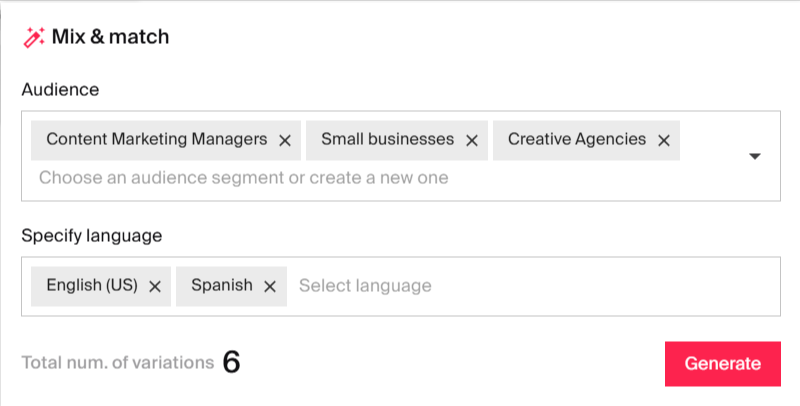
Using your brand guidelines, customer data, product information, and campaign goals, AI then generates distinct email versions for each segment, adapting the messaging, offers, and visuals to reflect the preferences and characteristics of that audience.
The goal isn't to make every email completely different, but to adjust the message so each audience sees why the promotion is relevant to them.
What are some AI email prompts for promotional campaigns?
Here are some examples of AI email prompts for a few different promotional scenarios:
For a product launch:
"Write a promotional email introducing [product] to [audience]. Lead with [primary benefit], explain what makes the product different from [existing alternative], and use [CTA] as the only call to action. Keep the tone [tone]."
For a limited-time offer:
"Write a promotional email for [offer] ending [date]. Target [audience]. Explain why the offer is relevant to them, communicate the deadline clearly, and create urgency without exaggerated scarcity. Use this CTA: [CTA]."
For a personalized promotion:
"Create three versions of this promotional email for [segments]. Keep the offer and CTA consistent, but adapt the opening, product benefits, and supporting proof points to each audience's interests and purchase behavior."
For promotional experimentation:
"Create three distinct messaging approaches for this promotion: value-led, benefit-led, and urgency-led. For each, provide a subject line, preheader direction, core message, and CTA. Avoid repeating the same language across approaches."
Flash sale:
"Write a promotional email for a [duration]-hour flash sale offering [discount/offer] on [products/category], targeted at [audience]. Lead with [discount/offer] and create urgency around the limited timeframe without using exaggerated scarcity. Use [CTA] as the only call to action."
Tiered loyalty offer:
"Write a promotional email offering [discount/offer] to [loyalty tier/audience]. Frame the promotion as an exclusive reward for their loyalty, highlight [key benefit or reason for the offer], and create urgency around [expiration date/timeframe]. Use [CTA] as the only call to action."
Seasonal bundle:
"Write a promotional email for a [seasonal/holiday] bundle featuring [products]. Target [audience] and highlight [key bundle benefit or value]. Create urgency around [shipping cutoff/date/event] and use [CTA] as the only call to action."
Make your promotional email prompts more strategic
AI can make it much faster to create promotional emails, but getting from a generic offer to a message that feels relevant still requires the right campaign context.
With Typeface Email Agent, you don't have to work through a long series of prompts to turn that context into an email. Give the agent a campaign brief and it can move from idea to email in minutes, building the message iteratively from subject lines and preheaders to body copy and imagery. The thread retains what has already been established, while audience and brand context carry through each step so the finished email stays aligned with the campaign and the people you're trying to reach.
Book a demo today to learn how Typeface can help you with your promotional emails.
FAQs
Q. How specific should an AI email prompt for a promotional campaign be?
As specific as the offer itself. Include the exact discount or deal, the segment it's for, and a concrete reason to act now, rather than describing the campaign in general terms.
Q. Can AI write urgency into a promotional email without sounding pushy?
Yes, if you specify the type of urgency in your prompt. Naming a real deadline, limited stock, or an exclusive window reads as informative rather than pushy. A vague "act now" without a stated reason is what tends to feel forced.
Q. Why do promotional emails perform worse than other email types?
Promotional emails face more subscriber fatigue than other categories, since a majority of consumers say they consider frequent promotional email spam. Specific, well-segmented prompts help counter that by making each email feel relevant instead of routine.
Related articles

July 23, 2025
Email remains the cornerstone of B2B communication with 60% of customers preferring it as their primary channel for communicating with businesses. Most marketing teams maintain a cadence of 2-3 emails
December 5, 2024
Despite the constant evolution of digital marketing channels, email marketing continues to be one of the most effective channels for engagement, delivering an impressive 36:1 return on investment. Tha

July 23, 2025
When promotional offers flood your subscribers' inboxes daily, they naturally become selective about what deserves their attention. With average retail email open rates hovering between 35-40%, email