October 14, 2026
The Typeface Signal Report: The AI Visibility Gap
Why the race to be found in AI is costing brands the quality that set them apart. Report based on research findings with 500+ marketing leaders at large enterprises across the US & UK.
Executive summary
The audience doubled. The playbook didn't.
For years, brands optimized to be found by people. Now there's a second audience:
AI agents that increasingly discover, evaluate and act on a person's behalf. As personal agents become a new gateway between people and brands, the question isn't only whether AI can find you — it's what it will understand, trust and represent about you.
Marketers know it's coming. In a new Typeface survey, 9 in 10 say they're ready to shape how AI describes their brand, and 97% expect AI to be a top-three way people find them by 2030. Behind the bravado, a bigger risk is forming: in the rush to be picked up by AI, brands are trading away the quality and originality that made them worth mentioning in the first place.
This Signal Report explores that gap — between how ready marketing leaders feel and how ready their operations actually are — and what it will take to win the next era of discovery: visible to AI, yet unmistakably themselves. This research is part of The Typeface Signal Report, an insights series spotlighting the signals redefining marketing in the age of AI.
What we found
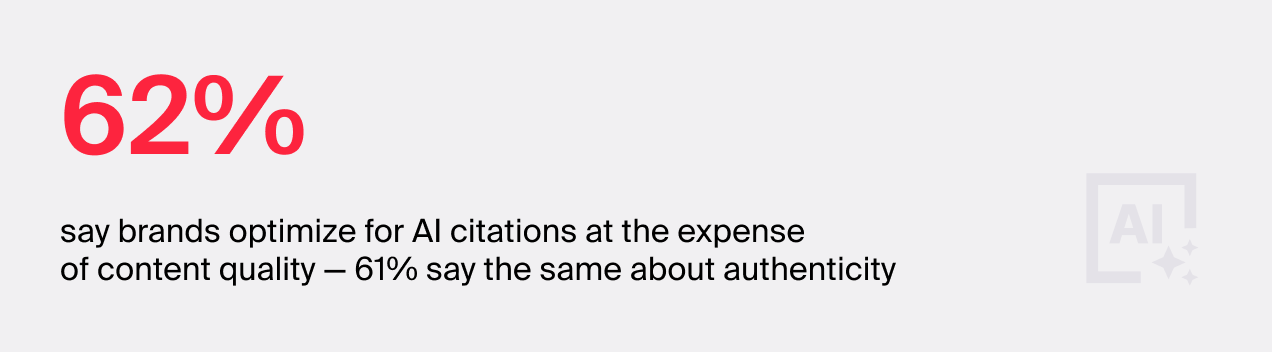
The authenticity risk: 62% say brands are optimizing for AI citations at the expense of content quality. A nearly identical share (61%) says the same about brand authenticity.
The confidence trap: 90% marketing leaders say their teams are prepared to shape how AI describes their brand — but their strategies are all over the map.
Discovery is shifting: 64% say AI chatbots will drive more brand discovery than traditional search within three years. Nearly half (49%) plan to deprioritize or stop investing in SEO.
No clear owner: 30% only three in 10 say their teams collaborate closely on answer engine optimization with shared tools and shared metrics.
The lifecycle gap: 39% while 93% say a connected content lifecycle matters as AI adoption grows, only 39% actually have one.
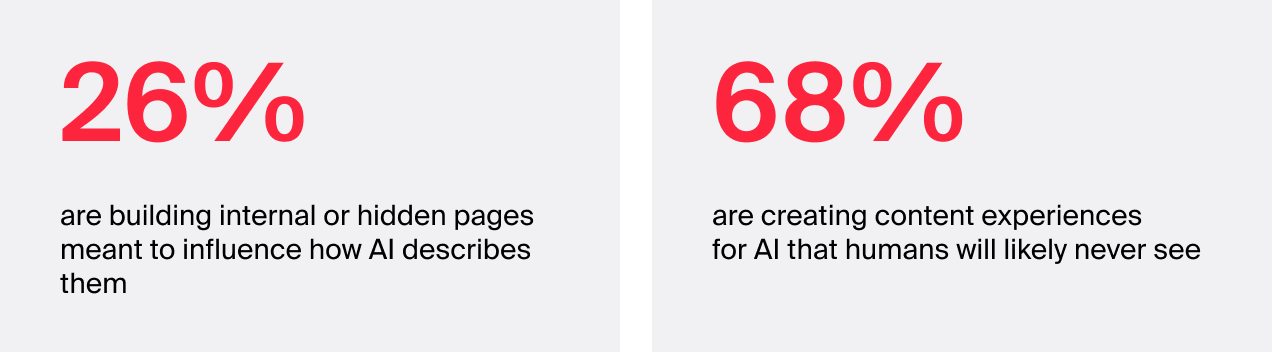
Building for machines: 68% are creating content experiences designed for AI that humans will likely never see — often using tactics they themselves call overhyped.
The confidence trap
Marketers feel ready. Their operations tell a different story.
The belief is nearly unanimous. 90% of marketing leaders say their teams are prepared
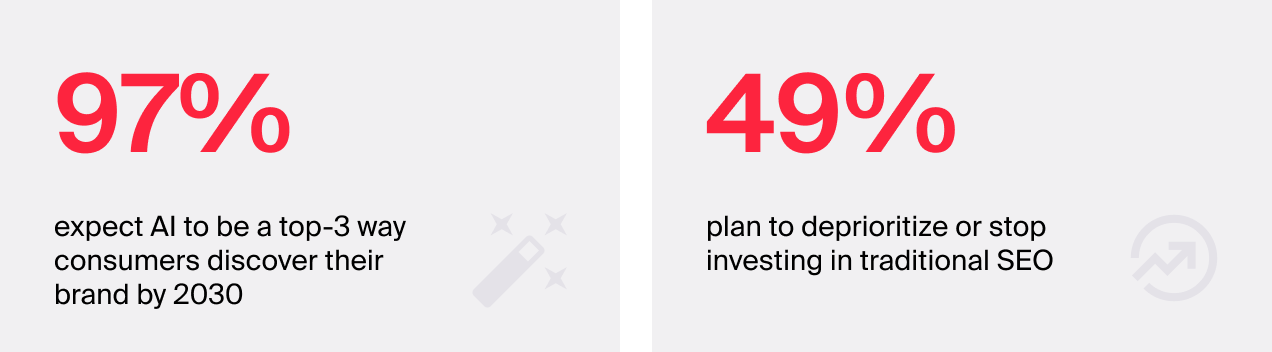
to influence how AI describes their brand, and 97% expect AI to become one of the top three ways consumers find them by 2030. This is not a fringe bet on a distant future.
64% say AI chatbots will drive more brand discovery than traditional search within three years.
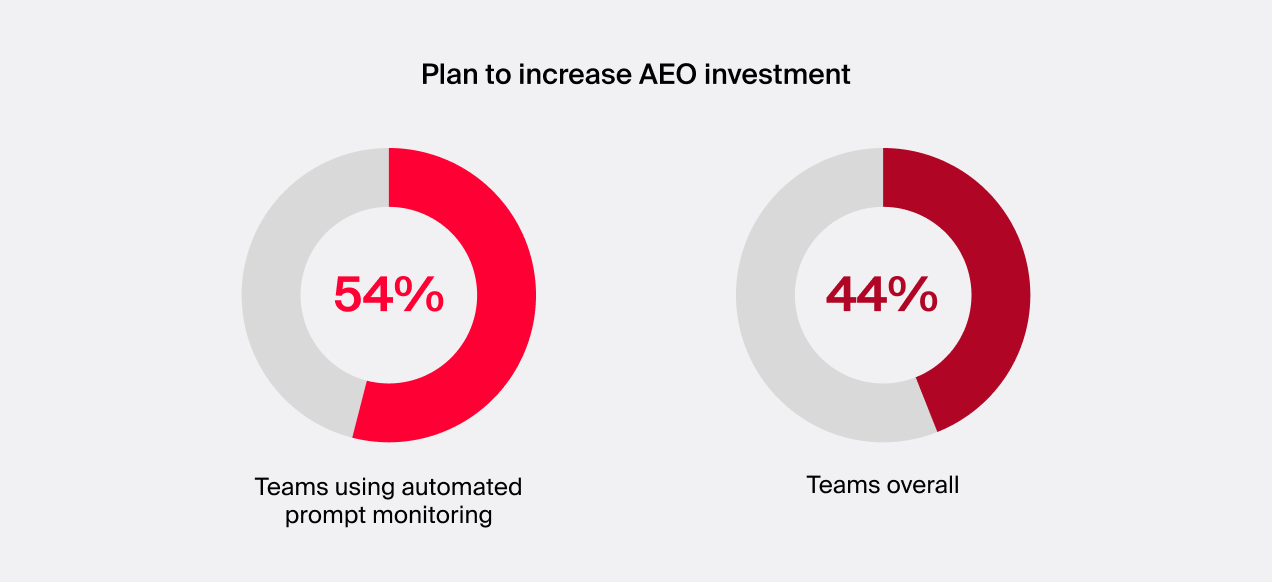
44% plan to increase their investment in AEO over the next 12 to 24 months.
That conviction is already reshaping budgets. Nearly half of leaders (49%) plan to deprioritize or stop investing in traditional SEO as AI discovery rises. Marketers are not waiting for proof. They are moving money toward a channel they believe will define the next decade of brand discovery.
But confidence and readiness are not the same thing. The same leaders who feel prepared describe strategies with no clear owner, toolsets that do not connect, and measurement they cannot trust. The gap between belief and operational reality is the through-line of this report — and every chapter that follows is a symptom of it.
The signal is clear: The industry has decided AI visibility matters. What it has not decided is how to actually run it.
Nobody owns the answer
Everyone is responsible for AI visibility. No one is accountable for it.
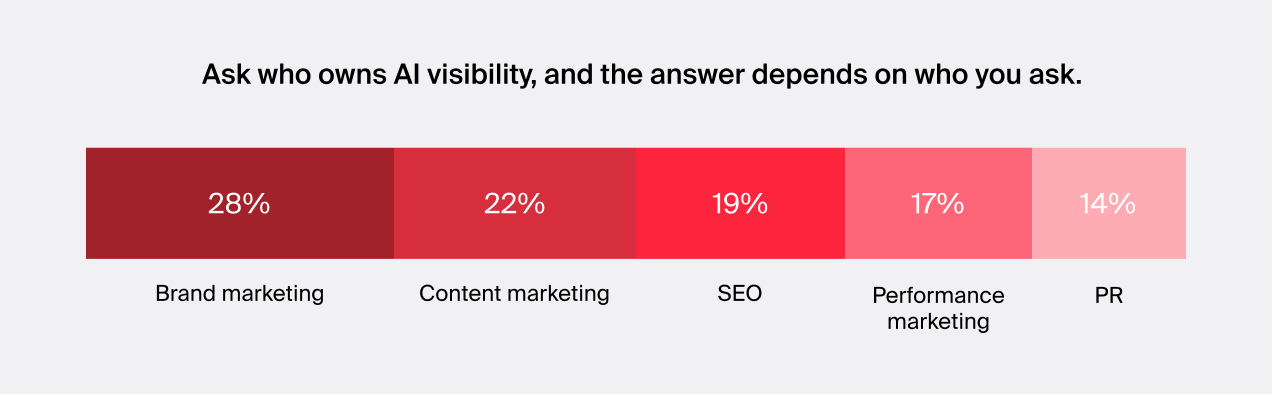
Where brand marketing leads, teams are more likely to collaborate closely toward shared goals (38% versus 30% overall) and least likely to work in silos. Where SEO leads, teams lean on point solutions and automated prompt monitoring. Where communications and PR leads, one person or group tends to own the strategy and hand insights to everyone else. The leader does not just execute the strategy — the leader defines what the strategy even is.
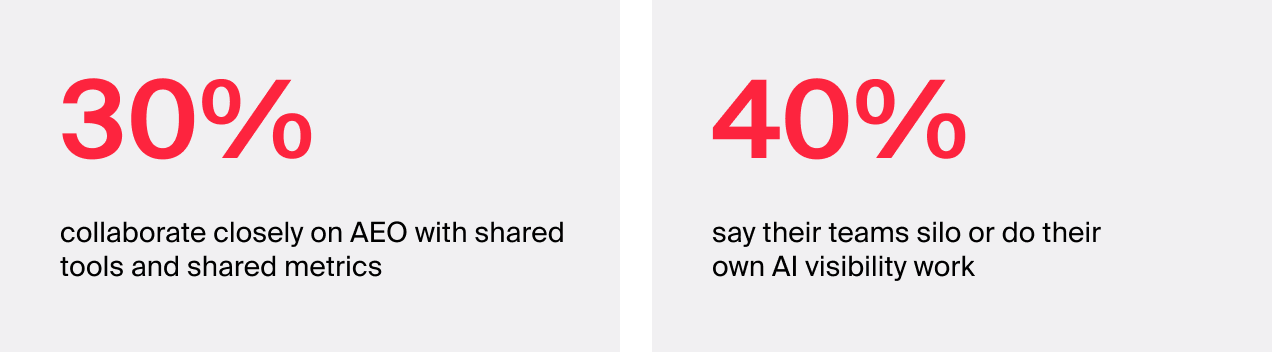
The bigger problem is that these functions rarely work together. Only 30% of leaders say their teams collaborate closely with shared tools and shared metrics.
The rest are fragmented:
21% keep each other informed but mostly do their own thing
19% operate in silos and rarely share what they learn
30% rely on a single person or team to dole out insights to everyone else.
AI visibility touches every part of marketing, yet most organizations run it as a collection of disconnected efforts.
The signal is clear: The fix isn't handing AI visibility to one team — that just relocates the silo. Bolt AI onto disconnected functions and you scale the silos faster. What's missing is a shared foundation: the values, approved messages, and source of truth every team works from.
The disconnected lifecycle
The tactics are not the problem. The disconnection between them is.
Marketing leaders know what good looks like. 93% say it is important that content creation, governance, activation, and measurement stay connected as AI adoption grows.
Far fewer live it: only 39% say their content lifecycle is connected from creation through measurement in a shared workspace. For about half, the lifecycle still runs on manual coordination and handoffs. For nearly one in 10, it is completely disconnected.
That disconnection is expensive. When leaders name their biggest barrier to scaling AI-powered content, measurement and optimization top the list (27%), followed by brand governance (19%) and integration across platforms (18%). These are not creative problems. They are orchestration problems — the work of connecting people, content, and data so a brand can move as one system instead of a set of parts.
Fully connect lifecycle | Disconnected lifecycle | |
|---|---|---|
AI as a major Discovery channel | 86% expect AI to be a top 3 channel by 2030 | 48% believe AI chatbots will out search for their brand |
AEO investment | 53% plan to increase investment | 16% plan to cut investment |
Brand readiness | 49% feel extremely prepared to shape AI brand perception |
This is where orchestration enters the picture: not as a feature, but as the operating model that turns scattered AI visibility tactics into a coordinated system. When creation, governance, activation, and measurement share one workflow, brand control and measurement stop being afterthoughts and start being built in.

The signal is clear: The winners will not be the teams with the most AEO tactics.
They will be the teams whose tactics are connected, and whose brand still sounds like itself at the end of the pipeline.
Gaming the machine
Marketers are optimizing for AI they cannot see, measure, or fully trust.
AEO is early, and it shows. Just as they once chased search hacks, marketers are now throwing tactics at AI to see what earns a mention.
45% make AEO-specific site changes
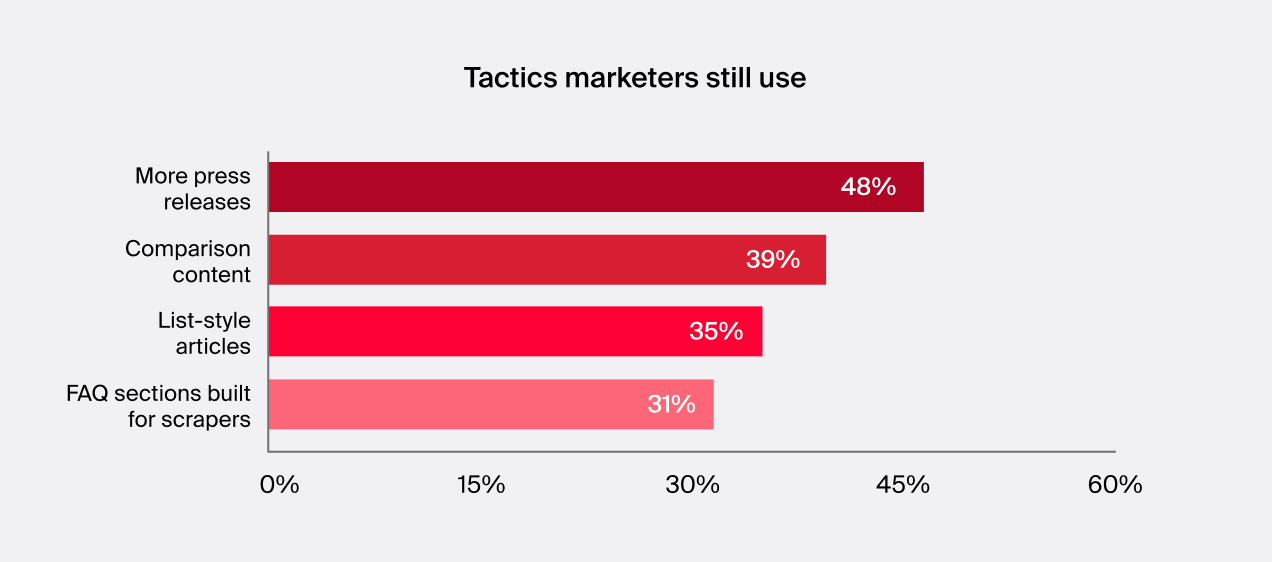
39% publish more press releases to be referenced in AI answers
36% publish competitor comparison content
34% publish list-style articles that slot their product into the recommended set
The strangest part is that marketers often distrust the very tactics they use. Among leaders who call publishing more press releases overhyped, 48% say their organization does it anyway. The same contradiction shows up across the board: comparison content (39%), list-style articles (35%), FAQ sections built for scrapers (31%). When no one knows what works, everyone hedges by trying everything.
Measurement is where the uncertainty becomes acute.
27% name it their single biggest barrier to scaling AI content — and the fundamentals are shaky. AI platforms do not tell brands which prompts customers use, so marketers guess: 52% turn their top search terms into prompts, 50% simply make their best guess, and 48% ask sales what customers ask. Approaches to measurement itself are just as split, from automated prompt monitoring at scale (39%) to web traffic from AI engines (33%) to manual checks (25%). Notably, the teams using automated prompt monitoring are the most likely to increase AEO investment (54%-> 44% overall) — a sign that better measurement builds real conviction.
How teams choose prompts | How teams measure |
|---|---|
Turn top search terms into prompts | Automated prompt monitoring |
Make their best guess | Web traffic from AI engines |
Ask sales what customers ask | Manual checks |
The signal is clear: You cannot optimize what you cannot measure — and in optimizing anyway, brands are about to pay for it in the one currency that matters: their own quality and distinctiveness.
The authenticity reckoning
The AEO playbook is becoming universal. That is exactly why it will stop working.
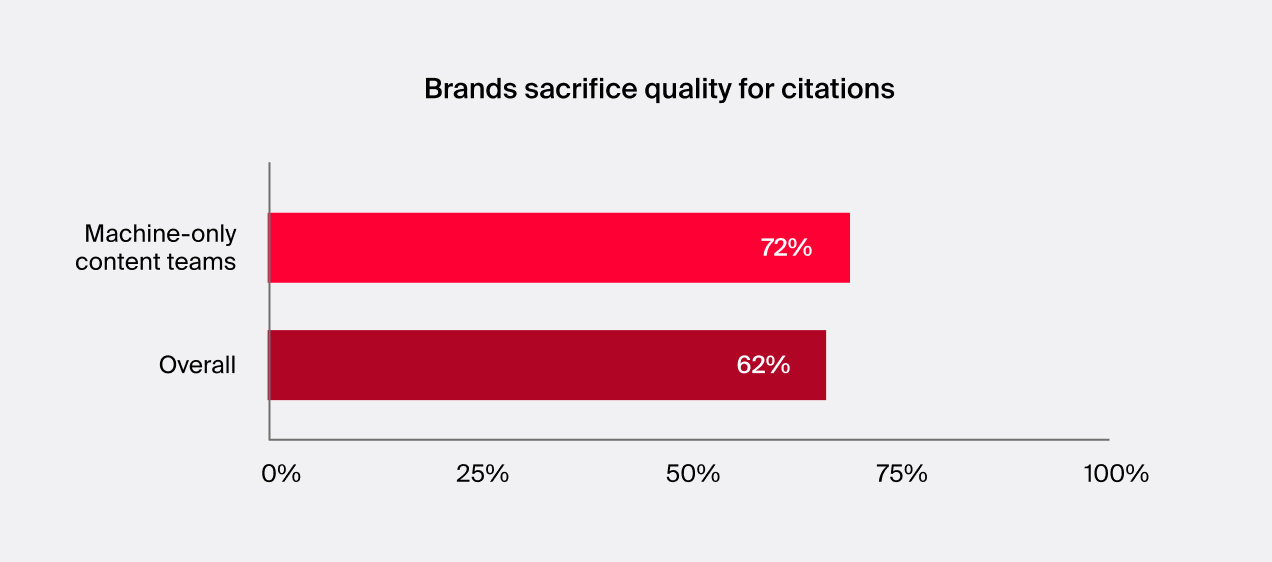
Here is the uncomfortable math of AEO. 62% of marketing leaders say brands are already optimizing for AI citations at the expense of content quality, and 61% say the same about brand authenticity. As the tactics in the last chapter spread, they commoditize. When every brand runs the same AEO plays with the same tools, those plays stop being an edge and become table stakes. The output converges. The web fills with content written for machines — the 68% of experiences built for AI that humans will never see — and it all starts to sound the same.
This points to where brand experience is heading: adaptable experiences. The web was built for a world where brands published fixed pages and people navigated them. That era is ending. That shift is accelerating as personal agents begin to sit between people and the enterprises they interact with — discovering information, evaluating options and increasingly taking action on their behalf. Increasingly, every brand surface will adapt to whoever is on the other side — a person who expects a responsive, conversational experience, or an AI agent seeking structured, authorized answers — always grounded in brand-approved, human-reviewed content. In that world, visibility is table stakes. The advantage goes to brands whose experiences stay distinctly, recognizably human while speaking fluently to machines.
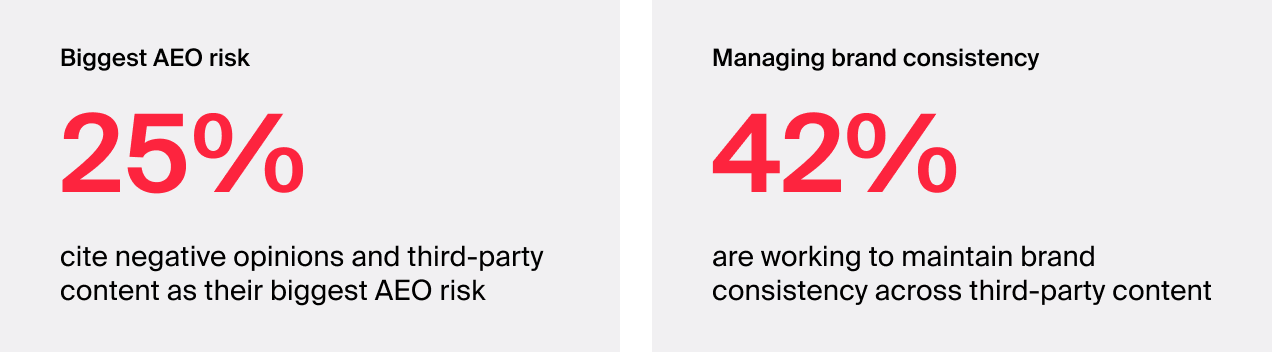
The risk is that brands optimize their way into sameness right when differentiation matters most. 25% already cite improved visibility for negative opinions and third-party content as their biggest AEO risk, yet only 42% are actively working to keep their brand presence consistent across the third-party content AI draws from. And the teams building the most machine-only content are the most likely to admit the trade-off: 72% of them say brands sacrifice quality for citations, versus 62% overall. They can see the cost of the path they are on.
The signal is clear: As experiences adapt to people and agents alike, AI is the supporting player and human creativity is the differentiator. It is the one advantage that cannot be copied.
“As personal agents begin discovering, evaluating and acting on people's behalf, every enterprise has to ask what those agents will understand about its brand, and whether that experience is grounded in the same context, standards and values it gives its people. The answer isn't to optimize harder for machines. It's to give every person and agent a shared brand foundation, so greater AI visibility doesn't come at the cost of what makes the brand distinctive.”
- Abhay Parasnis, Founder and CEO Typeface
The path forward
The gaps in this report are real, but every one of them is fixable. Here is where to start.
Set the shared foundation first.
Align leadership on the brand's values, approved messages, source of truth: the trusted system and context every team and AI agent builds from. Ownership without a shared foundation just relocates the silo.Connect the whole lifecycle, not just the tactics.
Bring creation, governance, activation, and measurement into one orchestrated workflow, so brand control and measurement are built in rather than bolted on.Measure what matters — reach, pull-through, and share of voice.
Move beyond web traffic to track how many prospects you reach through AI discovery, how well your message carries in AI mentions, and how your share of voice compares to competitors.Protect the quality that makes you worth citing.
Guard against optimizing your brand into sameness. Audit the third-party content AI draws from, and set governance so accuracy, consistency, and your distinct voice scale alongside your visibility efforts.Build for people and agents — without losing your voice.
Every brand surface increasingly serves two audiences: people who expect responsive, conversational experiences, and personal agents discovering, evaluating and acting on their behalf. Enterprises need to be ready for both — giving agents trusted, authorized access to the right brand context while keeping governance and human judgment intact. Ground every experience in brand-approved, human-reviewed content, so adaptability never comes at the cost of control — or of the voice that makes the brand its own.
What comes next & methodology
The shift is already underway. As discovery moves from search bars to AI answers —
and increasingly to agents acting on people's behalf — the brands that treat visibility
as a system, not a scramble, will set the standard everyone else is measured against. Typeface will keep tracking the signals that separate them, from orchestration and measurement to the rise of adaptable experiences built for people and agents alike.
This edition is part of the ongoing Typeface Signal Report series, spotlighting the signals redefining marketing in the age of AI.
Methodology
Typeface surveyed 500+ U.S. and U.K. marketing leaders, with titles ranging from director to vice president. Respondents represented organizations, including large enterprises, across industries spanning construction, education, finance, insurance and real estate, healthcare, hospitality, manufacturing, professional services, retail, and software and technology. Results are reported in aggregate.
About Typeface
Typeface is the Orchestration Engine for the world's leading enterprises, coordinating brand intelligence, AI agents, and enterprise systems across cross-channel marketing operations. Built for large organizations, Typeface combines shared brand intelligence, governed agent workflows, and deep enterprise integration at scale — connecting seamlessly with platforms like Salesforce, Microsoft, and Google — to help teams scale what works without sacrificing quality or control. Trusted by Fortune 500 companies, Typeface enables organizations to operationalize AI inside real marketing workflows, turning brand standards, approvals, and performance signals into coordinated systems that improve over time. Typeface is backed by Lightspeed, GV, Salesforce Ventures, Madrona, Menlo, and M12, and has been recognized by Fast Company, Gartner, TIME, LinkedIn, and Adweek as a leader in AI for marketing.
AI visibility is one of the shifts reshaping enterprise marketing. Explore the Typeface Signal Reports for more research on how marketing teams are navigating AI adoption, brand discovery, and the challenges of turning investment into impact.