April 2, 2026
How Are Enterprise Marketing Teams Using Generative AI Right Now?

Neelam Goswami
Senior Content Marketing Associate

AI summary
Generative AI is providing marketers with the scale to personalize and localize content across channels, helping drive better campaign performance. AI agents can orchestrate workflows across text and image generation, saving teams time for strategy and creativity while enabling brands to consistently enforce their visual identity and tone of voice.
Most enterprise marketing teams are already using some form of generative AI. The real question isn't whether to use it — it's which workflows are actually worth your attention, and which ones will create more process overhead than they save.
The use cases below aren't aspirational. They're what marketing teams at large companies are running in production today, with clear business outcomes. Each one maps to a real workflow challenge, and each one is different enough from what general-purpose AI tools offer that it's worth understanding the distinction.
Key Takeaways:
Generative AI is most valuable in enterprise marketing for high-volume, repeatable content tasks — not one-off creative work.
Brand governance is the make-or-break factor: AI without guardrails creates editing debt, not efficiency.
AI agents run multi-step workflows autonomously; copilots just respond to prompts. Enterprise scale needs agents.
The highest-ROI starting point for most teams: content repurposing across channels.
Regulated industries (finance, healthcare) can use AI — but need platforms built for compliance workflows, not adapted from them.
1. AI for SEO blogs and copy
It’s challenging to maintain a consistent cadence for blog posts when you’re managing multiple website assets. This was especially true before AI, when building a blog draft was a purely manual process.
Need expert input? You’d wait on subject matter expert (SME) availability.
And once the blog was ready, more waiting through lengthy review cycles.
It all added up to a slow, often frustrating process.
Using AI in blog and copy creation workflows removes these familiar bottlenecks by supporting your writers at every stage, from initial outlining to final publishing.
Streamlined workflows: By consolidating content creation, review, and publishing in one place, you provide unified visibility into where each piece stands in the workflows. This helps keep teams aligned and projects moving.
Unified knowledge base: When you centralize resource documents, expert insights, research, images, videos, and audio assets, you make it easy for writers to access brand-approved materials and reduce demands on SME time.
AI-powered generation: Generate blog outlines, drafts, keywords, images, and video. Make the most of in-line editing support. Whether you need a quick outline, a full draft, or wants to transform a recent report into a blog post, AI steps in on demand.
How can you use AI to create SEO blog posts and web pages?
An AI blog agent like Typeface’s Web Agent creates detailed first drafts of blog posts or copy within minutes. Give it context: topic, word count, SEO keywords, target audience, and reference documents. Establish your brand voice, tone, and messaging rules in a Brand Kit, and you’re set to create at scale.
For web pages, AI agents autonomously execute multi-step workflows by generating content within your brand templates. Upload your web page templates and the agent will create contextually relevant, on-brand copy for each zone within the template.
You can also use Web Agent to create:
Case studies
Product or feature release posts
Thought-leadership articles for media sites (with deep editorial review)
How-to articles
Resource pages
Location pages
Industry pages
Solutions pages
2. AI for social media posts
Regular posting to social networks can drive 5x more engagement. That means 1-2 posts/day on Facebook, 3-5 posts/week on Instagram, 3-4 posts/day on X, and 2-5 posts/week each on TikTok and LinkedIn. (Whew.)
These numbers take on a different scale for enterprise brands, which maintain separate brand, regional, product, or customer service accounts across multiple platforms.
All of the above is why one of the best use cases of generative AI in marketing is creating social media content. With the right AI marketing platform, you can maintain active feeds across all your social channels and meet campaign asset demands while preserving your visual and brand identity.
How can you use AI for social media content?
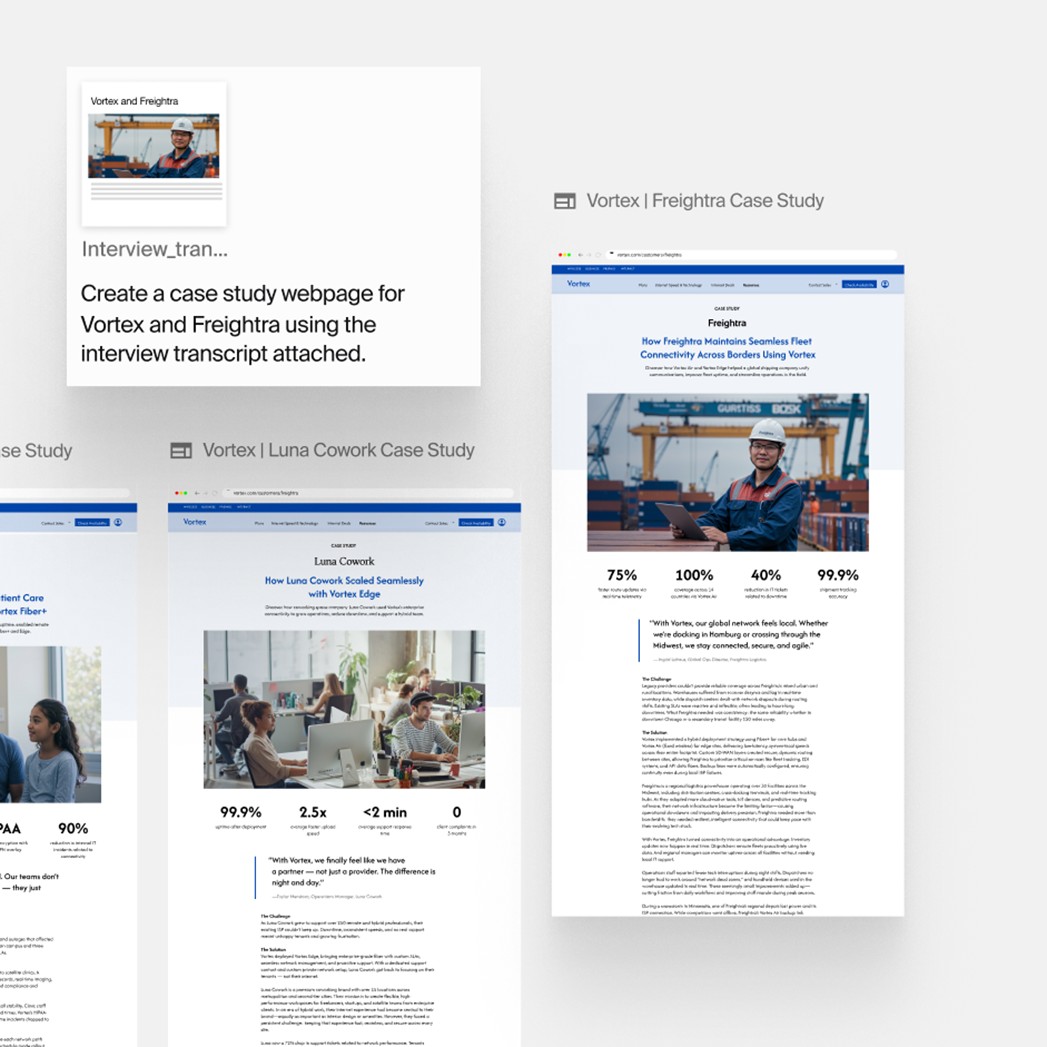
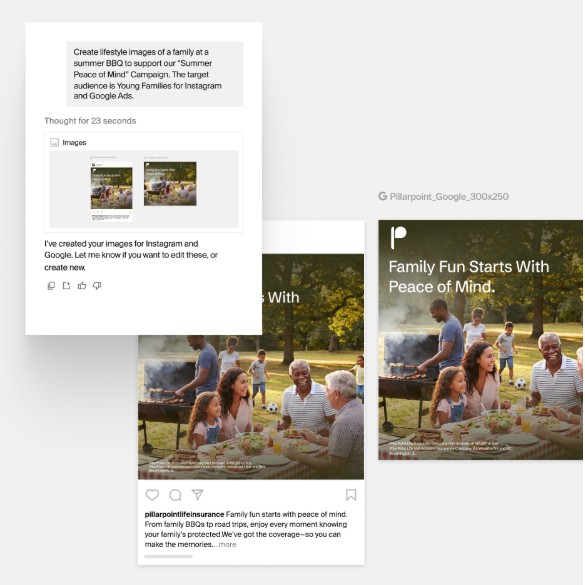
Typeface’s AI can create social posts, ads, reels, and carousels from text prompts or your existing visuals and video assets.
To create an Instagram post for your summer sale, give the relevant prompt (“Create an Instagram post for our summer sale”), attach campaign brief, image or video, and select your Brand Kit to apply your Instagram tone and style rules.
Repurpose static images into animated ads, convert long video into social snippets, and pull the best moments from your videos and stitch them into a shareable reel.
Create studio-quality product shots, lifestyle imagery, and location-based visuals at a fraction of the cost and effort (more on this below).
3. AI for image generation
Visuals drive impact, and ideally every graphic or photograph you create would resonate perfectly with your audience.
Of course, the problem is that the volume and variety of visual content enterprises need demands serious capacity, budget, and time.
The good news is, AI optimizes all three while maintaining your brand's visual identity.
How can you use AI for image creation?
AI can create marketing, advertising, and social media visuals using the typography, layout, color, and imagery you’ve defined for your brand. All it needs are your product photos and a clear creative direction via AI image prompts.
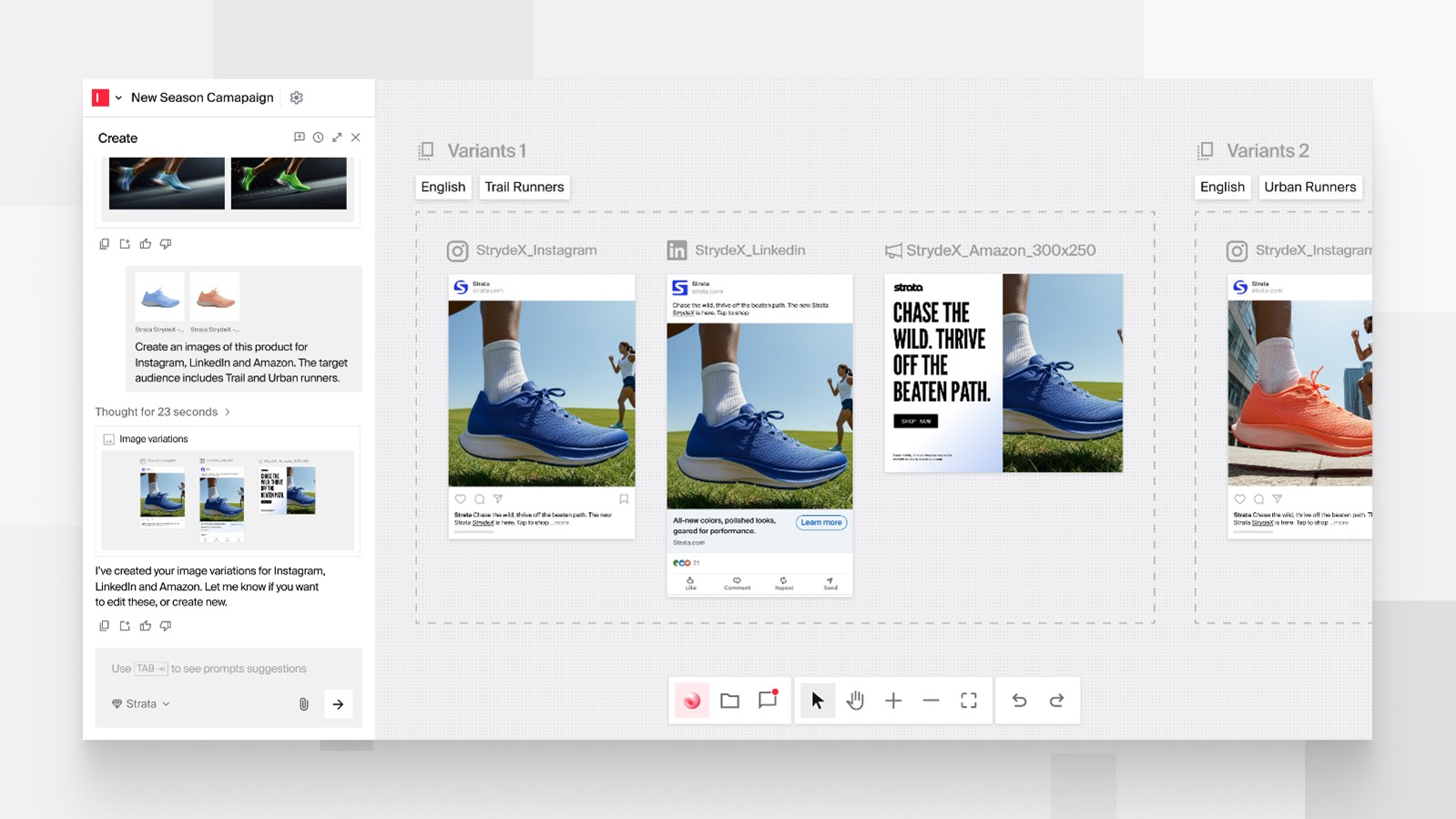
With Typeface’s Image Agent, you can iterate on images by specifying changes in the chat (e.g., say “Make the background a wilderness resort) or directly manipulate the images (e.g., use color buttons to switch colors). You can also crop, resize, and add logos or product overlays.
Use cases:
Lifestyle images for social and digital ads
Reformat visuals for different platforms, markets, and audiences
Create mood boards
Example
A shoe brand uploads product shots and asks Image Agent to place them in an urban setting. It uploads reference images to create the desired look and feel.
4. AI for micro-targeted ad campaigns
Creating personalized ads at scale has remained a persistent challenge for enterprises — but AI is changing that. AI can analyze audience data to produce hundreds of ad variations. By adapting copy, visuals, and tone to different demographics and interests, AI compresses what once took weeks or months of manual work into a matter of days (or even hours).
CMOs are becoming increasingly familiar with this capability and, according to the Dentsu Creative 2025 CMO Report, are looking beyond efficiency gains toward greater effectiveness and deeper AI ad personalization.
How does AI work for micro-targeted ad campaigns?
AI can take targeted advertising to the next level by creating ads that are specifically designed for micro-segments of your audience. These campaigns leverage AI to generate multiple ad variants, each tailored to different audience segments, maximizing their effectiveness and ROI.
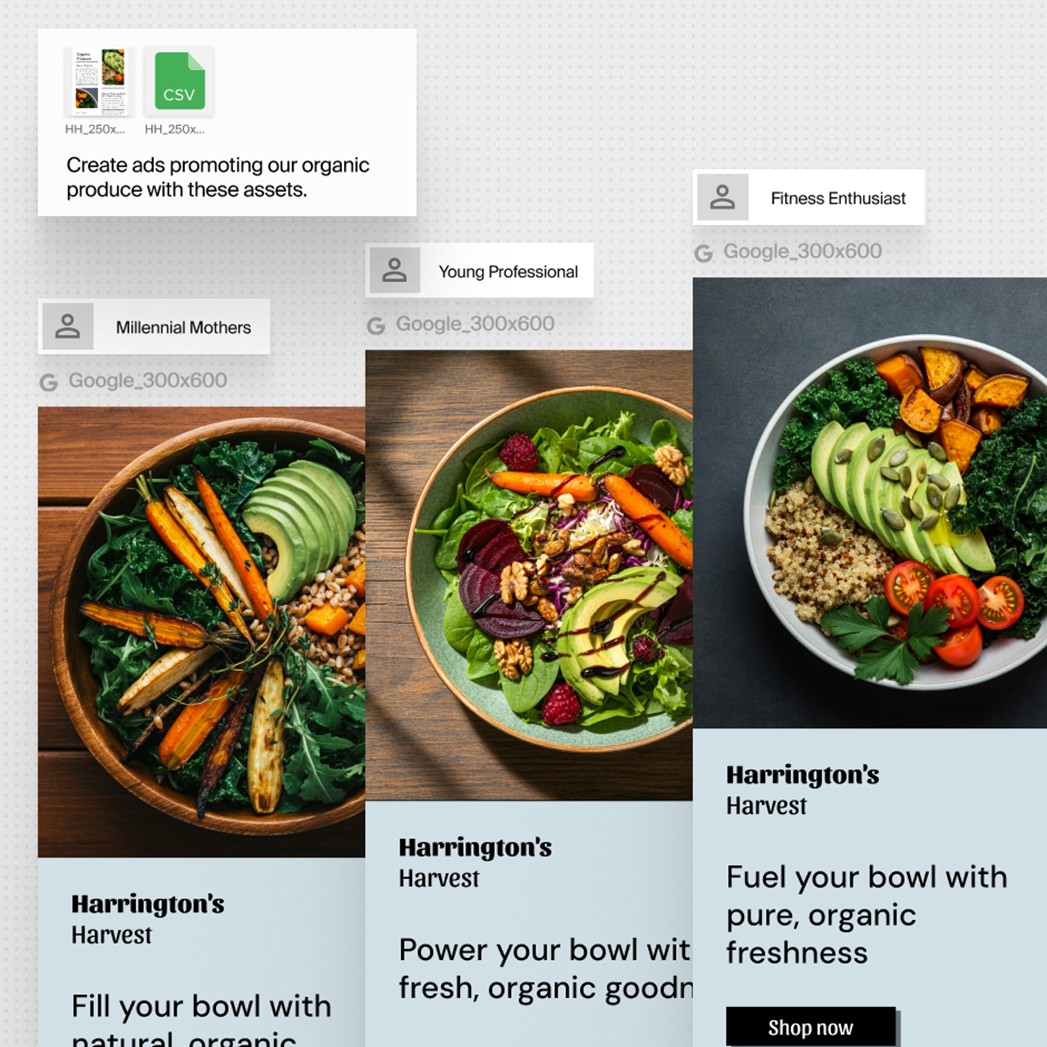
With Ad Agent, you can generate personalized ad campaigns at scale. Import pre-approved images, copy, and brand assets to produce on-brand ad variants across audiences and languages. Iterate quickly by generating alternative headlines and visuals, adjusting CTAs, and testing formats.
Create Google responsive display ads, Google search ads, social media ads, and more, without compromising brand standards.
Example:
A natural foods brand uses Ad Agent to generate Google Ads variants tailored to millennial mothers, young professionals, and fitness enthusiasts. It creates these in half the time required for manual production, while generating 3x more creatives for testing, improving campaign effectiveness.
5. AI for creative adaptation
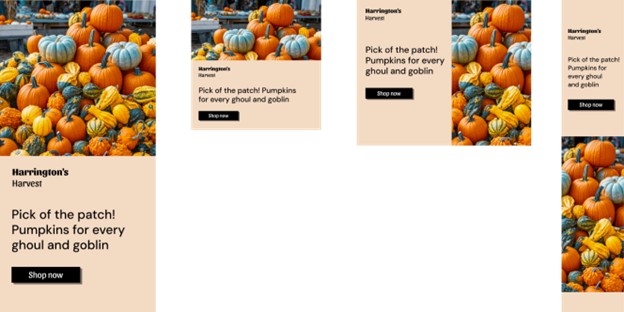
AI reformats your ads for different social media placements. It automatically crops and expands your images and videos to fit different aspect ratios. Besides saving hours of tiresome work, you can see how your ads will look before they go live.
In Typeface, ad resizing happens automatically. It crops your images perfectly and ensures your logo stays in a safe zone, while maintaining your specific fonts and colors across every adaptation.
6. AI for content repurposing
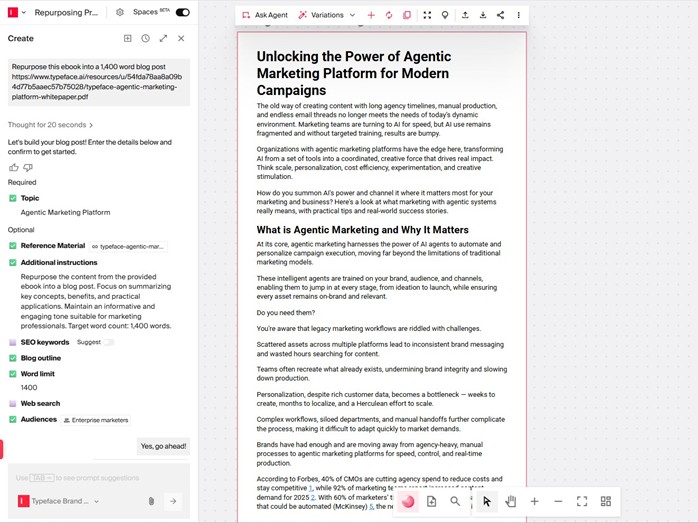
Repurposing is a common marketing tactic. Generative AI makes it faster, allowing you to move at the speed of relevance. It’s one of best uses cases to start AI on because you’re repurposing material that’s already been approved and adapting existing ideas into new formats to suit different audience needs.
Typeface can help you repurpose:
Blog content into social media posts
E-books or whitepapers into blog posts
YouTube videos into social media content and blog posts
Podcasts into newsletters and social media posts
Long form content for different use cases
7. AI for personalized email marketing
75% of marketers plan on maintaining or increasing their email marketing investment in 2026. As always, marketers across the board will aim for conversions over just open or click-through rates. Targeted messaging and meaningful dialogue will take precedence to build persuasion and drive conversion.
The only major shift is that AI will make email personalization (and, equally importantly, relevance) easy for everyone and those who don’t adopt AI strategically will fall behind.
How does AI work for personalized email campaigns?
AI-driven email personalization can be valuable across the funnel, but particularly impactful in the messy middle funnel where personalized content keeps you top-of-the-mind while prospects compare options. AI can boost email split testing by quickly generating personalized variations across roles to identify the best performer before scaling outreach.
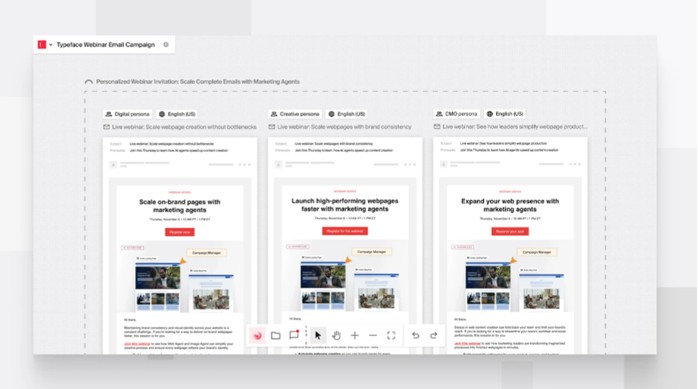
Typeface’s Email Agent drives email personalization and testing with a critical difference: It connects your brand knowledge, email templates, and messaging styles to create emails that are relevant to each audience and on-brand in look, language, and feel. That way, you can collaborate with teammates, build, review, and publish entire campaigns through seamless workflows, all within a single platform.
Another advantage is faster A/B testing to identify, for example, an audience segment that may be highly interested in your offer. We tried such an experiment for one of our webinars, where we generated five versions of the same webinar registration email, each written for a different persona (CMOs, brand teams, marketing ops, etc.), sent out each variant to small test segments, identified the segment with the highest engagement, and scaled the winning variant to a larger pool matching that profile. The result? A 4x higher email-to-registration conversion.
Frequently Asked Questions
1. What is generative AI in marketing, and how is it different from earlier marketing AI?
Generative AI produces original text, images, and other content — not just predictions or classifications. Earlier marketing AI helped you decide when to send an email or which segment to target. Generative AI helps you create the actual content, adapt it for different audiences, and do both at a speed and volume that wasn't possible before.
2. How do I start using generative AI in my marketing team without disrupting existing workflows?
Start with a single high-volume, low-risk use case — like repurposing existing long-form content into social or email variants. This lets your team learn how to prompt, review, and approve AI output without touching brand-critical campaigns. Once you've built confidence and internal processes, expand to higher-stakes use cases like campaign content or multi-market adaptation.
3. What types of marketing content can generative AI produce reliably at scale?
Generative AI is most reliable for structured, repeatable content: product descriptions, email subject lines, ad copy variants, landing page headlines, social captions, and content repurposing across formats. It works best when you give it clear brand guidelines, a defined audience, and a specific goal.
4. Will generative AI replace my content team?
No — but it will change what your team spends time on. The research from enterprise AI deployments consistently shows that AI handles volume and variation, while humans focus on strategy, quality review, creative direction, and stakeholder relationships. Teams that adopt AI well typically don't shrink; they take on more complex work and broader scope with the same headcount.
5. How does AI keep content on-brand when you're producing at scale?
Enterprise-grade AI platforms let you encode your brand voice, tone guidelines, approved messaging, and visual style directly into the system — so the AI generates within those boundaries from the start rather than requiring heavy editing after. In Typeface, the Brand Kit stores your brand rules and makes them active constraints for every content generation, not a style guide someone has to manually apply. This is a key difference between general AI tools and platforms built for enterprise marketing.
6. How do enterprise marketing teams handle AI content in regulated industries?
Regulated industries — financial services, healthcare, pharma — need AI that works within defined compliance guardrails and integrates with existing approval workflows. That means the AI shouldn't just generate content; it should flag potential compliance issues, support human review checkpoints, and maintain an audit trail. General-purpose AI tools don't do this. Purpose-built enterprise platforms can be configured with industry-specific rules and integrated with legal and compliance review steps.
7. How do you measure the ROI of generative AI in enterprise marketing?
The most common metrics are: content production speed (time from brief to publish), content volume per FTE, number of variants tested per campaign, and cost per content asset. Beyond efficiency, teams track downstream performance — do AI-assisted campaigns convert as well or better than fully manual ones? Early enterprise adopters report 40–60% reductions in content production time, though this varies significantly by use case and how well the AI platform is configured for your brand.
Why Typeface?
Marketing is one of the top three enterprise investments in generative AI. With a host of AI marketing use cases to take advantage of, the key is identifying those that solve real challenges for your teams, and drive measurable impact for your business.
Success also depends on choosing a generative AI marketing platform built for complex workflows, enterprise scale, and rigorous brand consistency.
Typeface delivers on all three. Request a demo or talk to sales.
Related articles
May 10, 2024
Made with Typeface This blog was generated using Typeface’s blog post template based on an outline, resulting in: • Total time savings of 5 hours for this blog • 63% decrease in composition time Pict

September 16, 2024
New intelligent agent technology, strategic acquisitions, and product advancements automate complex multimodal workflows to deliver unparalleled personalization in the flow of work. Enterprises have l
October 16, 2024
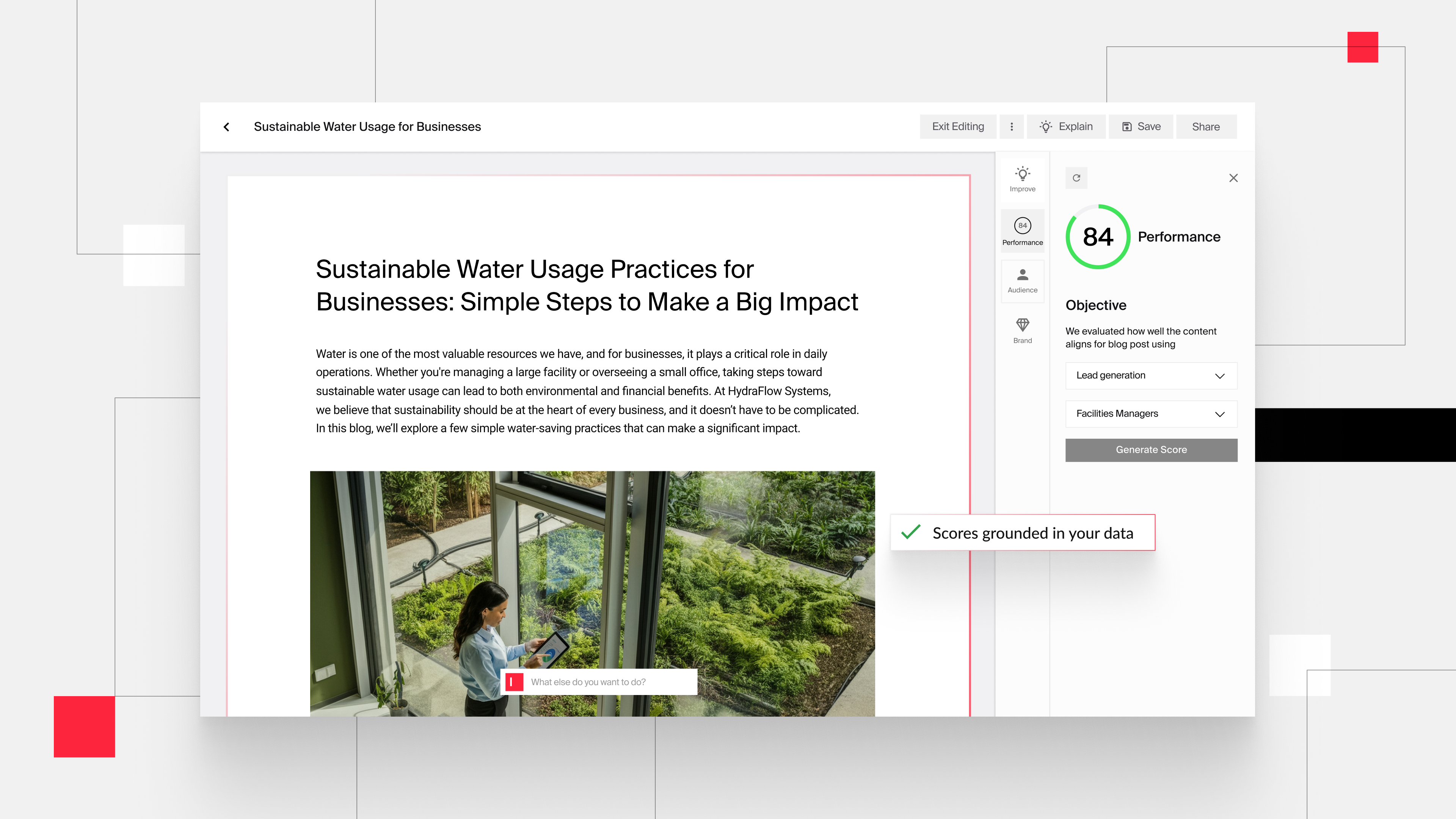
As AI becomes a crucial part of content creation, the need for AI trust and transparency has never been greater. Marketers want to know how AI evaluates content in consideration of their brand, conten