

AI summary
How do you increase your blog's visibility in search? Can AI tools help save time on blog SEO — even boost results? Here's a better way to create and optimize content.
Blog SEO means optimizing posts to rank higher in search results and, increasingly, to get cited by AI answer engines like ChatGPT, Perplexity, and Google's AI Mode. It still pays off, because the same best practices that win in search also power AEO and GEO. This guide covers what blog SEO is today, simplified keyword research, applying E-E-A-T, and how AI tools can shoulder the work.
Part of our AI SEO series. this is a focused how-to guide on blog SEO fundamentals like keyword research, E-E-A-T, and on-page optimization. For the bigger picture on using AI across your entire SEO workflow, start with the pillar guide: How to Use AI for SEO Content: The Complete Guide.
What is blog SEO?
Blog SEO is a set of tactics for reaching top search positions, built on three pillars: keyword research, creating helpful content, and optimizing on-page elements (title tags, meta descriptions, images, links, URLs, schema, page speed).
How do you find the right keywords for a blog post?
rimary keywords: Chosen by search volume, keyword difficulty, and search intent. Use one primary keyword per post; optimizing for newer search trends like AEO requires targeting long-tail terms and queries.
Secondary keywords: Support the primary keyword and capture related searches (variations, long-tail, related questions).
Competitor analysis: Reveals traffic-driving terms, content gaps, and overly competitive keywords, informing a sharper strategy.
What does "quality content" actually mean for SEO?
E-E-A-T (experience, expertise, authoritativeness, trustworthiness) is Google's quality benchmark. Though not a direct ranking factor, it is influential through algorithmic signals, especially in healthcare and finance. A good AI tool should weave keywords naturally, draw on your proprietary knowledge, and match your brand voice.
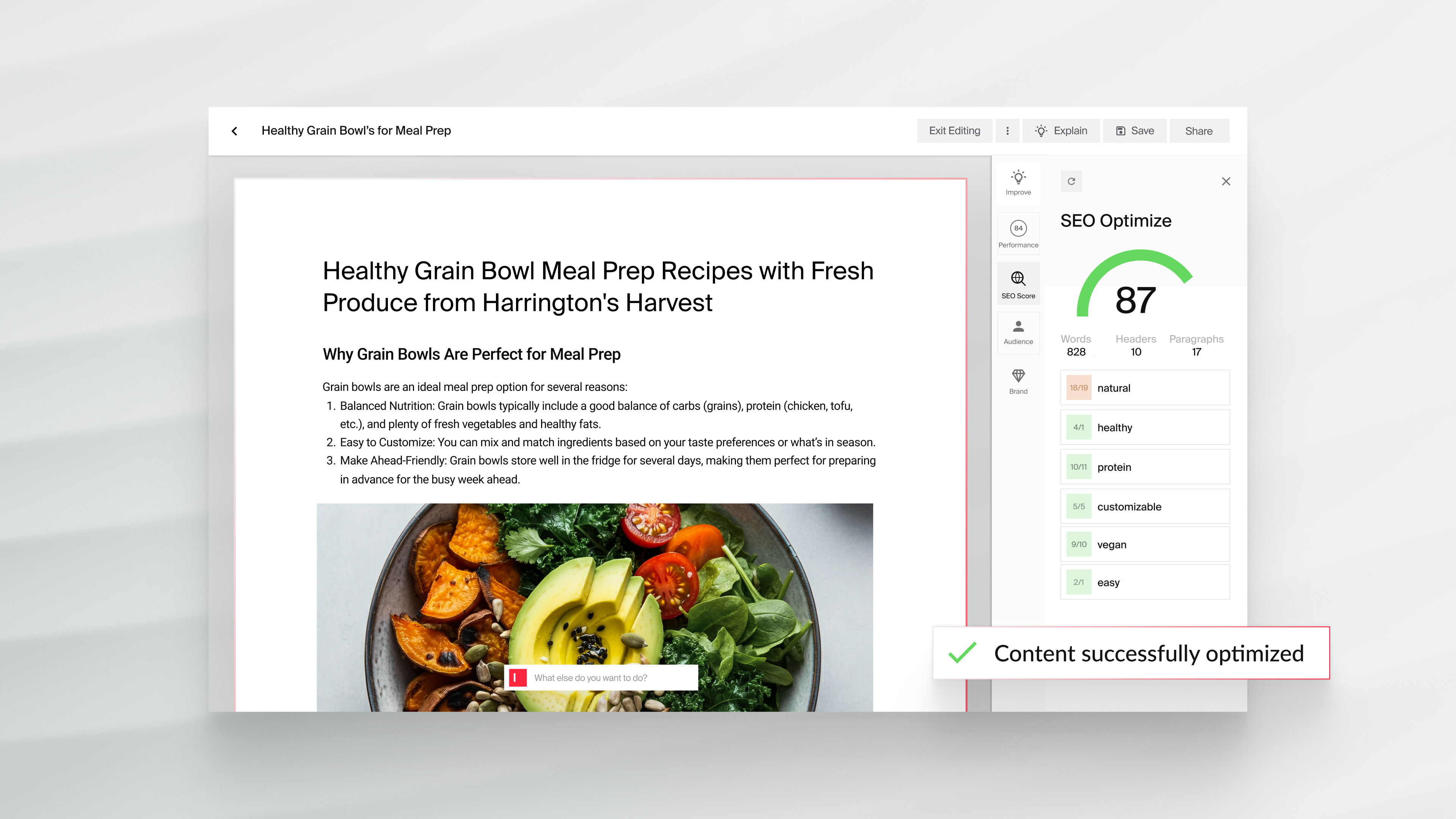
Typeface's Web Agent uses your keywords, word count, and audience; draws on your knowledge documents; matches brand voice; uses approved images; and generates editable outlines. You can even build custom no-code agents (e.g., an FAQ agent) to keep blogs current.
What on-page SEO changes make the biggest difference?
On-page SEO is the optimization work that happens alongside or after the writing process. While marketers may not directly manage technical aspects like page speed or mobile responsiveness, they apply on-page tactics to make content easier for search engines to understand and for users to read and grasp. These on-page optimizations have become increasingly important as AI-powered search continues to influence how content is discovered.
Essential on-page optimization tasks:
Scannable formatting (headers, bullets, short paragraphs)
Primary keywords in titles, H1, and H2–H3
Optimized images (alt text, descriptive file names, compression)
Clean, keyword-rich URLs
Schema markup
Internal links
1-minute blog SEO checklist
Keyword research:
Find what your audience is searching for and prioritize high-demand topics.
Target one main keyword per post, supported by related terms.
Analyze competitors to identify content gaps and refine your blog strategy for better performance.
Quality content (E-E-A-T): Ensure experience, expertise, authority, and trustworthiness to satisfy readers and search engines.
On-page SEO: Use clear headings, scannable formatting, keyword-rich URLs, alt-texted images, schema markup, and internal links.
Boost with AI: Web Agent creates SEO-compliant blogs in your brand voice. A great way to use the AI Agent is to generate blog posts based on your knowledge documents. It can give you the edge over blogs that repeat common ideas and lack unique insights.
FAQs
How often should I update my blog?
Blog updates should happen when you need to add, remove, or replace information to reflect new insights, product features, or changing circumstances. Prioritize refreshing top-performing blogs that have declined in rankings by adding current, useful information, such as FAQs addressing questions people are asking now. Update fast-moving topics frequently and evergreen content periodically.
What are the most important blog ranking factors?
The fundamental factors for search visibility are:
Content quality (E-E-A-T, content freshness, search intent, and keyword optimization are important)
Page experience (page speed, mobile friendliness, Core Web Vitals)
Internal links — for example, connecting pillar and cluster content to show semantic relationships — and inbound links — earned through channels like social media sharing or digital PR.
Is keyword density still important?
Keyword density is not a search ranking factor. Keywords are important because they tell search engines what your page is about. Using them naturally enhances your content’s relevance and focus, but there’s no need to hit a specific count. In fact, trying to force a certain number of keywords can come across as keyword stuffing and may hurt your SEO.
What are the current trends in blog SEO?
While the basics of SEO still matter, a few trends are shaping how content gets created and discovered:
AI is everywhere: More marketers are using AI to create, improve, and scale content faster.
SEO fundamentals still count: With Google SGE, getting the basics right is more important than ever to avoid dips in traffic.
Search isn’t just Google: People are discovering content on YouTube, Instagram, TikTok, and other platforms for products, local events, trends, and recommendations.
Visual search is growing: Users are searching with images for things like shopping, landmarks, and even checking food or skincare ingredients.
AI chat and LLMs are on the rise: While Google is still the go-to for detailed information, LLMs are increasingly shaping how users discover content. Consider this: a recent Ahrefs study found that AI currently accounts for 0.1% of clicks, but another analysis revealed that 63% of 3,000 websites studied now receive traffic from AI chat — highlighting the growing influence of LLMs in driving web traffic and engagement.
How many marketers use AI for blog SEO?
Studies show that marketers are increasingly using AI for content creation and optimization.
As a popular form of ungated content, blogs are ideal for AI to scale, enhance, and optimize for SEO. Brands that are just starting to explore AI for marketing can try AI’s potential for blog creation to satisfy readers and search engines alike.
Does blog SEO still matter now that AI is changing search?
Yes — and the argument for it is actually getting stronger. The same signals that help Google rank a blog post (original insight, clear structure, authoritative sources, relevant keywords) are exactly what AI engines look for when deciding what to cite. Rather than competing for blue-link rankings, a well-optimized blog is competing to be the source that ChatGPT, Perplexity, or Google’s AI Mode quotes when someone asks your exact question.
How do I optimize a blog post for AI search (AEO)?
Glad you asked! We actually have a whole blog about how to structure content AEO here.
TL;DR: The key is to write in a way that makes your content easy to extract and cite. That means using clear, direct headings (ideally phrased as questions), giving short self-contained answers near the top of each section, adding a robust FAQ section, and using structured data markup so AI engines understand your page’s context. It also helps to lead with a direct definition of your topic — AI systems reward content that answers the question fast, before adding nuance.
How long should a blog post be for SEO?
There’s no magic number. Length should match the complexity of the topic. A post answering a simple question can do its job in 600 words. A comprehensive guide covering multiple subtopics might need 2,000+. What matters more than word count is whether you’ve actually answered the reader’s question completely — without padding. Google (and AI engines) have gotten good at telling the difference between posts that are long because they’re thorough and posts that are long because someone chased a word count.
Can AI write SEO-optimized blog posts?
AI can handle the structural and technical side of SEO well — keyword integration, heading structure, meta descriptions, and content formatting. Where it falls short on its own is originality: generic AI outputs tend to repeat what’s already out there, which won’t help you stand out. The best results come from AI tools that can draw on your proprietary knowledge — your research, customer data, case studies, and brand voice — to create something genuinely useful and distinctive. That’s exactly what Typeface’s Web Agent is built to do.
If this is you, don’t wait to harness the power of AI for your SEO content strategy. See how blog SEO with Typeface's Web Agent can work for your team — get a demo today, or check out a quick product tour.
Related articles

September 16, 2025
While marketers initially approached AI SEO content generators with skepticism, the technology has rapidly matured beyond basic keyword optimization. IDC predicts that by 2026, generative AI will take
January 29, 2025
When a leading healthcare insurer's content team came to us, their SEO writers were spending six weeks on each piece of content. Their days were consumed by manual research: analyzing Semrush data, st

August 12, 2026
AI has quietly powered search for years, but the launch of numerous AI answer engines and Google's AI Overviews changed how people find answers for good. Search has expanded into "AI SEO," where brand